Agreement on Three Principles
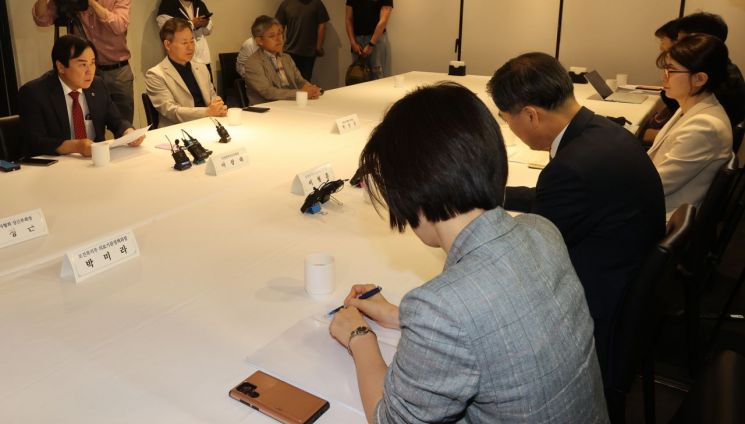
It was confirmed on the 8th that the government and the Korea Medical Association (KMA) have agreed on the position that the number of medical school admissions should be increased. This was the result of the 10th Medical Issues Consultative Body (Consultative Body) meeting held between the Ministry of Health and Welfare and the KMA at 3 p.m. that day. Regarding the causes of the shortage in essential and regional medical care, the government believed there was a shortage of medical personnel, while the KMA argued that the phenomenon of essential medical staff leaving had a greater impact, resulting in a stalemate.
The Ministry of Health and Welfare and the KMA agreed on three principles. ▲ Expanding the number of doctors based on scientific evidence, ▲ devising measures to ensure that the increased number of doctors flows into essential and regional medical care, and ▲ preparing plans to improve resident training and working conditions.
First, a detailed analysis of future medical demand will be conducted to estimate the necessary workforce supply and demand, and an objective post-evaluation through monitoring of doctor workforce supply and demand will be used to prepare plans for adjusting quotas. To this end, a forum of experts on doctor workforce supply and demand estimation will also be held.
They also agreed to prepare and thoroughly implement specific and comprehensive action plans to ensure that the increased number of doctors flows into essential and regional medical care. Measures to reduce legal burdens, such as legislation on medical accidents, will also be prepared, as criminal charges related to medical accidents are cited as a cause of essential medical staff leaving.
Improvement plans including reducing resident working hours and limiting continuous shifts will also be implemented. The appropriate number of patients per resident will be estimated and gradually reduced. Institutional support plans to enhance the quality of resident training education and improvement plans for doctor workforce management centered on specialists will also be prepared.
The issue of expanding medical school admissions was raised as a major agenda item in medical issues for the first time since the consultative body was formed in January. Although about ten meetings between the Ministry of Health and Welfare and the KMA were held through the consultative body, discussions were postponed due to medical issues such as the COVID-19 pandemic, the Nursing Act, and telemedicine.
Government officials attending the meeting included Lee Hyung-hoon, Director of Health and Medical Policy, Cha Jeon-gyeong, Director of Health and Medical Policy Division, Song Yang-su, Director of Medical Workforce Policy Division, and Lim Kang-seop, Head of External Cooperation Team, while KMA officials included Lee Kwang-rae, President of Incheon Medical Association, Park Jin-gyu, Vice President of KMA, Lee Jeong-geun, Full-time Vice President of KMA, Seo Jeong-seong, General Director of KMA, and Kang Min-gu, President of the Korean Intern Resident Association.
A KMA official participating in the consultative body on that day evaluated, “The issue of expanding medical school admissions has been a long-standing stalemate between the government and the KMA for decades, but we succeeded in narrowing the gap to some extent this time.” Meanwhile, the 11th consultative body meeting is scheduled to be held at 2 p.m. on the 15th.
© The Asia Business Daily(www.asiae.co.kr). All rights reserved.

















