'World's Tallest' 238-Layer NAND Mass Production Begins
Expansion to PC and Server Applications Following Mobile
NAND Industry Stacking Competition Ongoing
SK Hynix has raised its cost and quality competitiveness to a new level by mass-producing the world's tallest and smallest 238-layer 4-dimensional (4D) NAND flash. Attention is focused on whether this will serve as an opportunity to diversify its DRAM-centered business structure and increase its NAND market share.
SK Hynix announced on the 8th that it has been mass-producing consumer solid-state drive (SSD) products used in smartphones and PCs based on the 238-layer 4D NAND since last month. Currently, it is conducting product certification with overseas customers that manufacture smartphones. Once certification is complete, it plans to equip the 238-layer NAND in mobile products first, followed by PC and data center SSDs in the future.
The 238-layer 4D NAND is the industry's highest layer. Previously, SK Hynix succeeded in developing the world's first 238-layer NAND in August last year. When the U.S. company Micron announced mass production of 232-layer NAND in July last year and took the 'world's first' title, SK Hynix immediately introduced a higher-layer product. NAND forms layers by stacking cells that store data, increasing capacity, so the stacking level is considered a key technological competitiveness. This is why the stacking competition among NAND manufacturers is fierce.
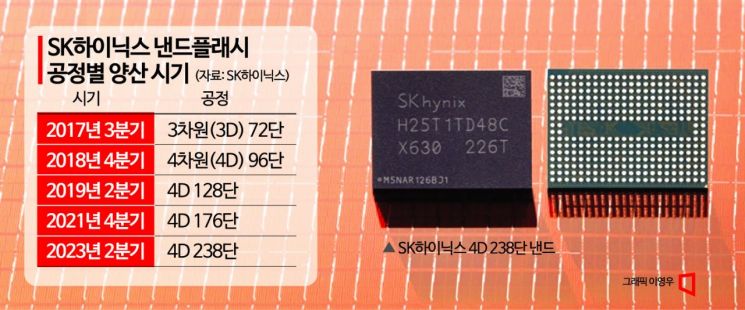
SK Hynix explained that mass production of the 238-layer NAND is an example of raising cost and quality competitiveness to a new level. As a result of releasing the chip with the smallest size in the world, production efficiency increased by 34% compared to the previous generation product (176-layer 4D NAND). Data transfer speed also became 50% faster at 2.4 gigabits (Gb) per second. Read/write performance improved by 20%. Kim Jeom-su, Vice President of SK Hynix (in charge of 238-layer NAND), said, “We will continue to break through NAND technology limits and strengthen competitiveness.”
The semiconductor industry is paying attention to whether SK Hynix will diversify its DRAM-centered business and increase NAND revenue through the highest-layer NAND. The proportion of DRAM in SK Hynix's total sales was 58% as of the first quarter, higher than NAND's 33%. Since the NAND market size in the memory sector is expected to grow to the level of DRAM, expanding related businesses is an inevitable task. According to market research firm TrendForce, SK Hynix ranked third in the NAND market in the first quarter with a 15.3% share, following Samsung Electronics (34.0%) and Japan's Kioxia (21.5%).
Securing NAND technology and expanding market share for SSD business expansion are also essential. SSD is a device that stores information using NAND. It is a replacement for hard disk drives (HDDs), which store information using mechanical parts (rotating disks). Recently, it has been replacing HDDs in the server market following PCs and laptops, expanding the market size. In SK Hynix's case, the proportion of SSD in total NAND sales is the second highest after mobile. Expanding synergy with Solidigm, an SSD subsidiary acquired from Intel in 2021, is also an important task this year.
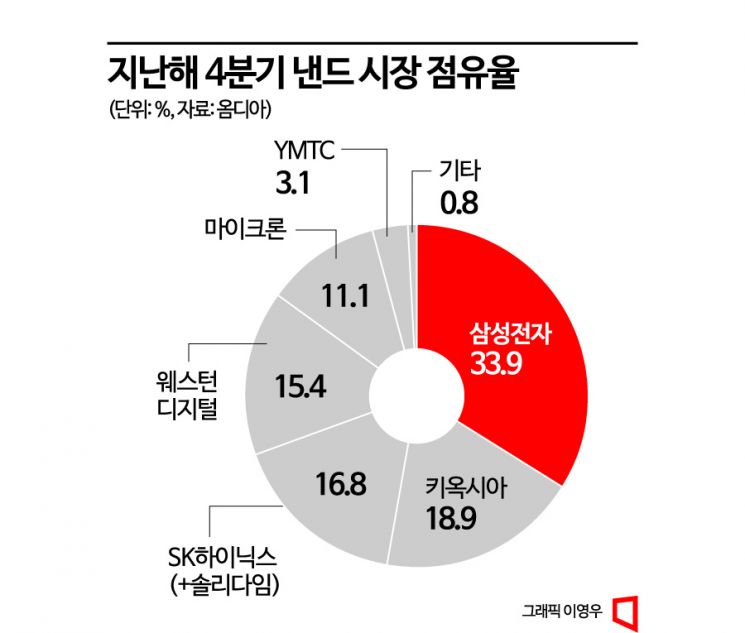
The market expects the stacking competition in the NAND industry to continue. Unlike the DRAM market, which is dominated by three major players, the NAND market has 5 to 6 competitors and relatively small differences in market share, leading to active competition. NAND manufacturers have been rushing to introduce 200-layer NAND products since last year. Samsung Electronics began mass production of 236-layer 1-terabit (Tb) 8th generation V-NAND in November last year. Kioxia plans to mass-produce 218-layer 3-dimensional (3D) NAND this year in collaboration with U.S. company Western Digital.
© The Asia Business Daily(www.asiae.co.kr). All rights reserved.
![Clutching a Stolen Dior Bag, Saying "I Hate Being Poor but Real"... The Grotesque Con of a "Human Knockoff" [Slate]](https://cwcontent.asiae.co.kr/asiaresize/183/2026021902243444107_1771435474.jpg)












