Folk Paintings and Old Textbooks from the Joseon Dynasty
Nearly Extinct After the Japanese Colonial Period
"On the way to school, it comes wagging its tail happily, ringing the Badukyi bell with a tinkling sound."
The extinct Korean native dog 'Badukyi,' which appeared in old textbooks and Joseon Dynasty folk paintings, has been collectively restored.
The Korean native dog ‘Badukyi’ is a short-haired, spotted Sapsal dog that was beloved until the late Joseon period. Later, it was almost driven to extinction due to slaughter by the Japanese colonial government for fur.
Professor Park Chan-gyu's research team at Konkuk University KU Convergence Science and Technology Institute announced the results of a study on the geographical and temporal origins of Korean native dogs through genome analysis at Konkuk University Life Sciences Building on the 8th, unveiling the Badukyi.
 At the press conference announcing the research results on the genetic analysis of native Korean dogs held on the 8th at the Life Sciences Building of Konkuk University in Gwangjin-gu, Seoul, Sapsalgae Baduki and Gyore appeared.
 [Image source=Yonhap News]
On that day, the research team said, "We restored the Badukyi by extracting the genetic traits remaining in the native Sapsal dog," and brought one of the restored 50 dogs to the announcement site.
They added, "By selecting and breeding Sapsal dogs that exhibit the spotted pattern characteristic of Badukyi, we established a single breed population with fixed Badukyi traits." This means the group is large enough to be called a breed, not just a few individuals.
Professor Park explained, "We restored and bred the Korean native dog Badukyi, which appears in Joseon Dynasty folk paintings and other records, using traditional genetic breeding techniques. Although a few Badukyi Sapsal dogs have been born through somatic cell cloning and artificial insemination, this is the first time a population with fully fixed Badukyi genetic traits has been established."
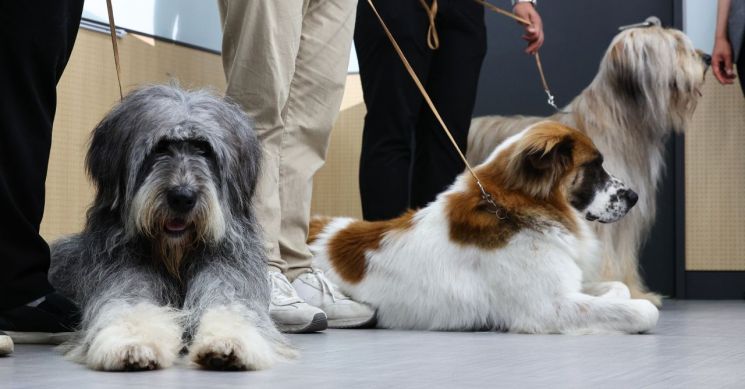 At the press conference announcing the research results on the genetic analysis of native Korean dogs held on the 8th at the Life Sciences Building of Konkuk University in Gwangjin-gu, Seoul, Sapsalgae dogs (from left, Seul-in, Baduk-i, Gyore) are sitting. [Image source=Yonhap News]
The research team also newly decoded the genome sequences of 25 dogs from five Far East Asian breeds, including Sapsal and Jindo dogs, revealing the geographical and temporal origins of native dogs.
The study compared and analyzed whole genome sequences of 211 canid animals, including ancient dogs, wolves, and Asian and European dogs.
According to the findings, native dogs of the Korean Peninsula are divided into Southeast Asian lineages rooted in southern regions and Eurasian lineages originating from northern Central Asia.
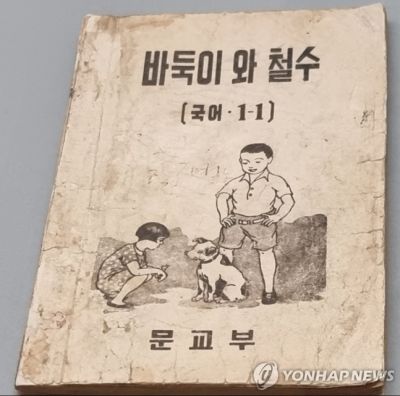 Elementary School 1st Grade Korean Textbook "Baduki and Cheolsu" Immediately After the Establishment of the Government
 [Photo Source=National Museum of Korean Contemporary History·Yonhap News]
Korean native dogs migrated to the Korean Peninsula between approximately 2,000 and 10,000 years ago.
The native ‘Jindo’ and ‘Donggyeongi’ dogs originated from Southeast Asian lineages, while the Sapsal dog is closely related to the Eurasian lineage.
The research team explained, “The timing of a large-scale influx of nomads from the northern Steppe region to the Korean Peninsula around 2800 BCE and the subsequent arrival of rice farming technology developed in Southeast Asia coincide with the origins of Korean native dogs.”
They added, “Since studying dog lineages is an important auxiliary method for inferring ancient human migration routes, these research results are expected to greatly contribute not only to understanding dogs but also to the ethnic and anthropological identity of Koreans.”
© The Asia Business Daily(www.asiae.co.kr). All rights reserved.

![Clutching a Stolen Dior Bag, Saying "I Hate Being Poor but Real"... The Grotesque Con of a "Human Knockoff" [Slate]](https://cwcontent.asiae.co.kr/asiaresize/183/2026021902243444107_1771435474.jpg)

















