June Monetary and Credit Policy Report
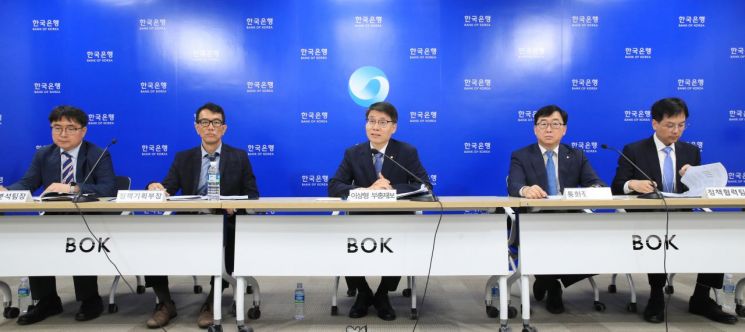
The Bank of Korea decided to maintain the base interest rate at 3.5% last month and plans to operate monetary policy with attention to growth trends, the pace of inflation slowdown, and financial stability going forward.
On the 8th, the Bank of Korea stated in its Monetary and Credit Policy Report, "We will monitor growth trends and operate monetary policy with attention to financial stability, ensuring that the inflation rate stabilizes at the target level (2%) over the medium term."
Although the domestic economy is expected to continue low growth, inflation is projected to exceed the target level for a considerable period. Given the high uncertainty in policy conditions, the Bank intends to maintain a tightening stance for a significant time, focusing on price stability. The necessity for additional rate hikes will be carefully assessed by examining the pace of inflation slowdown, downside risks to growth, financial stability risks, the effects of previous rate hikes, and changes in major countries' monetary policies.
The Bank diagnosed that uncertainty regarding the inflation path remains high. While the domestic consumer price inflation rate (year-on-year) is slowing, the pace of core inflation slowdown is considerably slower compared to previous deceleration periods. The rigidity of core inflation is mainly attributed to the secondary ripple effects of accumulated cost increases such as rising energy prices, as well as favorable consumption recovery trends and employment conditions.
In South Korea, gradual increases in electricity and city gas rates compared to the US and Eurozone may exert additional upward pressure on core inflation in the future. Meanwhile, service consumption continues to rise due to pent-up demand effects, and the labor market remains robust, further contributing to inflationary pressures.
Growth Slowdown Trend... Uncertainty Over Semiconductor Recovery Timing
Despite a recovery in private consumption, the domestic economy is expected to continue its growth slowdown trend due to persistent export sluggishness centered on China and the IT sector. China's economic recovery has been focused on domestic demand following reopening, resulting in limited positive spillover effects through increased exports to China. Additionally, high manufacturing inventories in China and increased self-sufficiency due to supply chain localization efforts have delayed the recovery of intermediate goods import demand.
In particular, semiconductor exports, a key export item for the Korean economy, continue to decline sharply due to falling prices and reduced volumes amid global demand slowdown. While major forecasting institutions expect a rebound in the semiconductor market in the second half of the year, uncertainty remains high regarding the timing of recovery due to high inventory levels compared to the past and potential constraints on durable goods consumption caused by sustained high interest rates.
The Bank of Korea stated, "The domestic economy is expected to gradually improve, led by exports, supported by improved external conditions such as the visible effects of China's reopening and IT sector recovery in the second half of the year. However, weakened household purchasing power and private investment capacity due to high interest rates and inflation, as well as sluggish real estate markets, may exert downward pressure on growth."
Downward Pressure on the Housing Market for the Time Being... Commercial Real Estate Slump
The increased risks in the financial sector following the US Silicon Valley Bank (SVB) incident are also factors to be considered in future monetary policy. The Bank expects the housing market to face downward pressure for the time being, despite a slowdown in the decline of sales and jeonse (long-term lease) prices supported by government deregulation, due to high interest rates and instability in the jeonse market.
The commercial real estate market continues to be sluggish, leading to a significant rise in delinquency rates on real estate-related loans by non-bank financial institutions, increasing the risk of defaults. A substantial portion of project financing (PF) loans from non-bank financial institutions is used for commercial, office, and residential real estate development excluding apartments, and the sluggishness in these markets is causing an increase in delinquency amounts. Additionally, a large portion of loans to self-employed individuals, which surged significantly after COVID-19, are secured by commercial real estate, raising concerns that the downturn in the real estate market could spread to other sectors, according to the report.
The pace of interest rate hikes by major central banks is also a variable. Regarding the future policy rate path in the US, financial markets increasingly expect the Fed to pivot its policy stance from the second half of the year, while many Fed officials believe that high rates need to be maintained for a considerable period. The European Central Bank (ECB) and the Bank of England have recently moderated the pace of tightening but indicated further rate hikes.
The Bank of Korea noted, "Despite the policy rate gap with the US widening to 1.75 percentage points since May and the US dollar strengthening, the won-dollar exchange rate has shown limited movement. However, given the high uncertainty in the policy rate paths of major countries, market participants' expectations regarding domestic and foreign monetary policies may be rapidly adjusted depending on upcoming data releases, potentially increasing upward pressure on the won-dollar exchange rate again."
© The Asia Business Daily(www.asiae.co.kr). All rights reserved.
![Clutching a Stolen Dior Bag, Saying "I Hate Being Poor but Real"... The Grotesque Con of a "Human Knockoff" [Slate]](https://cwcontent.asiae.co.kr/asiaresize/183/2026021902243444107_1771435474.jpg)

















