The Cheongdam and Dogok Apartment Districts in Gangnam-gu, Seoul, have been converted into district unit plans, allowing them to be subject to relaxed height and usage regulations.
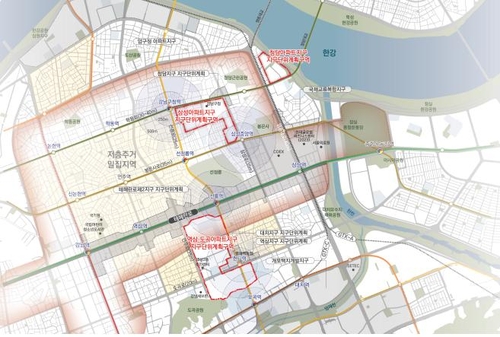
On the 7th, Seoul held a joint urban and architectural committee meeting and announced on the 8th that it had approved the revised 'District Unit Plans for Cheongdam Apartment District, Samsung Apartment District, and Yeoksam-Dogok Apartment District.'
This area was already converted into a district unit plan at the 10th Joint Urban and Architectural Committee in June 2021, and a re-notification was issued in December 2021.
However, since then, there have been many policy changes, such as the mandatory public contribution along the Han River being relaxed from a floor area ratio (FAR) of 15% to around 10%, and the diversification of FAR incentive items, which were reflected in a subsequent review.
Like other apartment districts, the city presented reconstruction guidelines for housing complexes scheduled for reconstruction by 2030, including connectivity with surrounding areas, scenic corridors, and traffic management plans. For other general lots, according to the city's apartment district district unit plan conversion guidelines, mixed-use of non-residential and residential purposes is now possible, and the maximum height is allowed up to 40 meters.
A Seoul city official said, "Through the conversion of the Cheongdam and Dogok Apartment Districts into district unit plans, we expect to flexibly respond to changes in urban and social conditions and establish a harmonious and integrated urban management system with surrounding areas."
At the committee meeting that day, the Gaori Station area on the Ui-Sinseol Line in Gangbuk-gu was newly designated as a district unit planning zone, and the 4.19 Intersection zone was expanded, with the plan also approved.
Both locations became station areas with the opening of the Ui-Sinseol Light Rail Transit. The city expanded and newly designated district unit plans to systematically manage these areas as living centers.
The Gaori Station area introduced recommended uses in connection with local conditions and related plans. Considering the presence of schools such as Duksung Women's University nearby, incentives such as floor area ratio benefits are provided if cultural facilities or employment and startup-related facilities are established within buildings.
For the high-rise zones within the area, a joint development (special designation) possible zone was designated as a management measure for low-rise residential areas. The target site was originally a Type 2 General Residential Area with a maximum FAR of 200% according to Seoul's urban planning ordinance, but with this designation, it is expanded up to 240%.
The 4.19 Intersection zone was expanded to include the area around the 4.19 Democracy Cemetery Station on the Gyeongui-Jungang Line. The high-rise zone here was also designated as a joint development (special designation) possible zone, increasing the FAR cap to 240%. Recommended uses were also reorganized, providing incentives when neighborhood facilities such as cafes are introduced to revitalize the street frontage.
The city expects that through the expansion and new designation of district unit planning zones, the surrounding areas will emerge as living centers.
© The Asia Business Daily(www.asiae.co.kr). All rights reserved.

















