Government: "Need to increase by 300-500 by 2025"
Resuming original discussions as COVID-19 pandemic ends
Medical groups: "Improve treatment of essential personnel first"
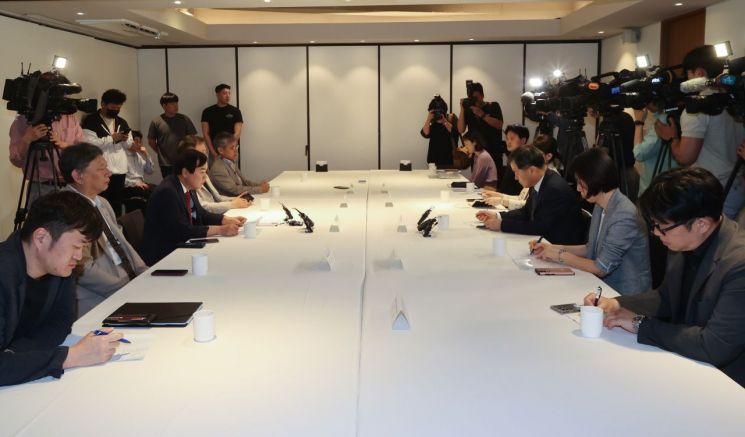 The photo was taken at the 9th Medical Issues Consultative Body meeting held just prior.
 [Image source=Yonhap News]
On the 8th, the government and medical organizations will come together to discuss the issue of expanding medical school quotas. This is the first meeting since the COVID-19 crisis level was downgraded from ‘severe’ to ‘alert.’ In 2020, the government proposed increasing medical school quotas by 400 students annually for 10 years, but after the stabilization of COVID-19, it was agreed in the ‘Medical-Government Agreement’ to revisit the issue with medical organizations from scratch. Since the government insists on expanding medical school quotas starting with the 2025 admissions, while medical organizations prioritize improving the treatment of essential personnel, negotiations are expected to be challenging.
The Ministry of Health and Welfare will hold the 10th Medical Issues Consultative Body (Consultative Body) in the afternoon with the Korean Medical Association (KMA) and other medical organizations. Government representatives such as Lee Hyung-hoon, Director of Health and Medical Policy at the Ministry of Health and Welfare, and medical organization representatives including Park Jin-gyu, Vice President of the KMA, will attend. The Consultative Body is a forum where the government and medical organizations discuss urgent medical issues together, and the main agenda for this meeting is the expansion of medical school quotas.
The government believes that the shortage of medical staff is a key factor behind issues such as emergency room overcrowding, where emergency patients miss the optimal treatment time while searching for beds, and the recent ‘pediatric crisis.’ While the medical school quota has been fixed at 3,058 students for 18 years since 2006, medical demand continues to increase. According to the Organisation for Economic Co-operation and Development (OECD), in 2020, the number of doctors per 1,000 people in Korea was 2.5, ranking near the bottom just above Mexico (2.4). The OECD average is 3.7.
Accordingly, the government plans to increase medical school quotas by 300 to 500 students starting with the 2025 university admissions. Since it takes about 10 years for practicing doctors to be produced, the government considers this an urgent matter. On the 5th, Minister of Health and Welfare Cho Kyu-hong said on SBS Radio, “Although many doctors oppose it, medical demand continues to rise,” and added, “We will push forward with strong determination regarding the expansion of medical school quotas.”
Medical organizations argue that “simply increasing medical school quotas will have adverse effects.” They point out that there will be a shift from less preferred specialties to popular ones such as dermatology, plastic surgery, and psychiatry, and that the increase in the total number of doctors will expand health insurance financial expenditures. In fact, the number of pediatric specialists, one of the less preferred fields, increased by 27.4% from 4,947 to 6,301 in the first quarter compared to 10 years ago, but during the same period, the number of pediatric clinics actually decreased from 2,200 to 2,147. The KMA insists that it is more important to consider why essential personnel are leaving medical sites and to improve those conditions first. A Ministry of Health and Welfare official stated, “Since the issue of expanding medical school quotas is connected to protecting public health, we believe it is a matter that can be sufficiently discussed.”
© The Asia Business Daily(www.asiae.co.kr). All rights reserved.

















