Development of Industrial Complex with Eco-friendly Energy and Smart Facilities
Based on Three Core Strategies: Energy, Digital, and Eco-friendliness
Industrial complexes, which have played a central role in national economic growth for over the past 60 years, are undergoing change. As the climate crisis worsens, not only South Korea but also major advanced countries are sharing and promoting economic policies such as greenhouse gas reduction, leading to a paradigm shift in the industrial environment.
The transformation of industrial complexes is one of the urgent issues in South Korea's industry. Established in the 1960s under government-led five-year economic development plans, these complexes played a key role in the export-driven industrialization era but have entered a path of decline due to aging.
Some industrial complexes have been identified as sources of greenhouse gases and fine dust emissions, stigmatizing them as undesirable facilities within local communities. In reality, industrial complexes occupy only 1.4% of the national land area but account for 45.1% of total greenhouse gas emissions, 38% of fine dust, and 19% of waste.
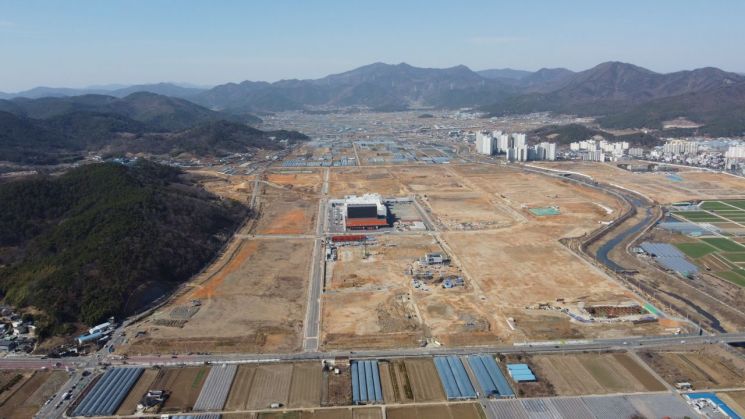 Panoramic view of the Miryang Nano Convergence Smart Green Industrial Complex construction site. [Photo by LH]
In response, since 2021, the government has been promoting the creation of smart-green industrial complexes that incorporate new and renewable energy, as well as smart infrastructure for transportation and logistics, from the initial stages of new industrial complex development. By the end of last year, the Daegu Yulha Urban High-tech Industrial Complex was designated as a smart-green pilot complex, and in April this year, the Miryang Nano Convergence Industrial Complex was also designated as a smart-green industrial complex. The basic plan is based on three core strategies: energy self-sufficiency, digitalization, and eco-friendliness.
Miryang Nano Convergence Complex: Energy Self-Sufficiency and Eco-Friendliness
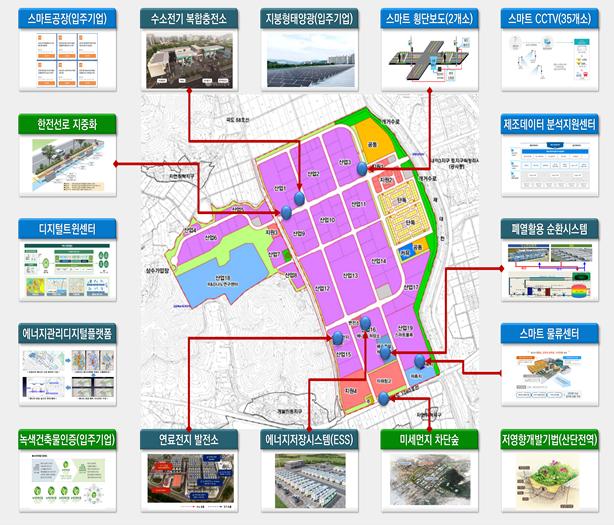
The detailed planning and implementation of these smart-green industrial complexes are being carried out by Korea Land and Housing Corporation (LH). LH has set goals for the Miryang Nano Convergence Smart-Green Industrial Complex to reduce annual carbon dioxide emissions by 26% and achieve an energy self-sufficiency rate of 14%. Part of the energy demand within the complex will be met using renewable energy, and an energy management digital platform utilizing information and communication technology (ICT) will be established to enhance energy management efficiency.
East-West Power is constructing a hydrogen fuel cell power plant (15 MW), and Korea Electric Power Corporation (KEPCO) is carrying out energy storage system (ESS) construction. Once the hydrogen fuel cell power plant construction begins next year, it is expected to boost the attraction of companies related to new and renewable energy power generation projects.
For stable power operation, an ESS and an energy management digital platform for predicting and analyzing real-time energy usage throughout the industrial complex will also be installed. A waste heat utilization circulation system will be established to recycle waste heat generated from the hydrogen fuel cell, ESS, and industrial processes as energy sources, thereby reducing carbon emissions.
As part of the digitalization strategy, smart transportation and safety infrastructure such as personal mobility and hydrogen-electric combined charging stations will be developed. A digital twin center utilizing advanced ICT and an integrated safety system that detects and responds to risk situations through real-time collection and monitoring of various information within the industrial complex will also be established.
The Miryang Nano Convergence Smart-Green Industrial Complex will feature a fine dust blocking forest to reduce fine dust and prevent unauthorized entry and exit. A project to bury power transmission lines underground will be carried out simultaneously to improve aesthetics and prevent natural disasters. Additionally, low-impact development (LID) techniques such as rainwater utilization facilities, building greening, and permeable pavement installation will be introduced to predict and mitigate impacts on the natural ecosystem. The Miryang Nano Convergence Smart-Green Industrial Complex is scheduled for completion in 2030.
Daegu Yulha: Developing a High-tech Knowledge Industry-Centered Complex
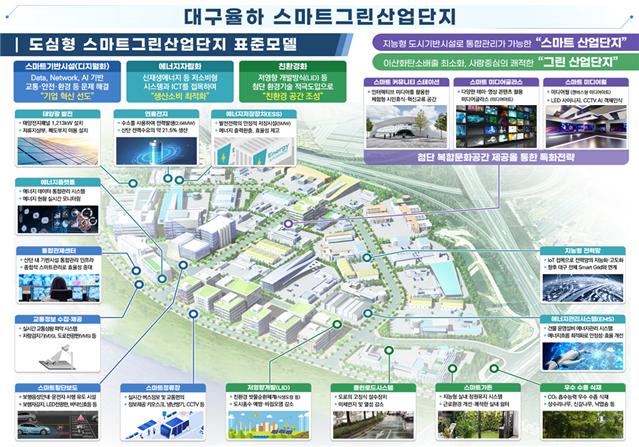
The Daegu Yulha Urban High-tech Industrial Complex is being developed as a smart-green industrial complex with participation from LH and Daegu Urban Corporation. The goals are to improve energy efficiency and achieve a reduction of over 25% in carbon dioxide emissions. To this end, the two organizations plan to create a future-oriented industrial complex centered on high-tech knowledge industries, managing urban infrastructure integrally, minimizing carbon dioxide emissions, and establishing a people-centered, pleasant industrial complex.
Through intelligent infrastructure, services such as smart transportation and safety will be provided, utilizing renewable energy, energy storage systems (ESS), energy platforms, and intelligent power grids. Additionally, an eco-friendly infrastructure combined with green technologies will be proposed as a low-carbon green industrial complex.
Infrastructure will include an integrated control center for comprehensive management, an energy platform that enhances overall energy efficiency of the industrial complex through collection, utilization, and monitoring of energy data (Big Data), and various intelligent infrastructures based on advanced ICT technology to provide diverse smart services (transportation, safety, convenience).
As part of the energy self-sufficiency strategy, renewable energy sources such as fuel cells and solar power generation, along with ESS, will be actively introduced, and a microgrid (independent power grid) will be applied for efficient use of distributed power sources. Low-impact development (LID) techniques and various green technologies such as clean road systems, smart gardens, and green networks will be applied to urban and building environments to create an environmentally friendly industrial complex that responds to climate change. Furthermore, considering the characteristics of the urban location, a complex cultural space (Smart Community Station) is planned above the central park to provide leisure and interaction spaces shared by workers and citizens.
LH to Develop 14 National Industrial Complexes Including Yongin
In addition to the Daegu Yulha Urban High-tech Industrial Complex and the Miryang Nano Convergence Industrial Complex, LH’s smart-green industrial complex development projects are expected to increase significantly. Among the 15 candidate sites for the ‘National Advanced Strategic Industry Specialized Complex’ announced in March, LH was selected as the project implementer for 14 sites. This includes three sites solely implemented by LH (Yongin, Cheonan, Gyeongju) and 11 sites jointly implemented by LH and local corporations (Daejeon, Osong, Hongseong, Goheung, Iksan, Wanju, Changwon, Daegu, Andong, Uljin, Gangneung). Only Gwangju was excluded. Going forward, LH plans to accelerate progress by commissioning ‘survey and design services’ and ‘environmental impact assessment services’ for these 14 sites.
In particular, LH plans to develop the Yongin semiconductor cluster, which has attracted the most attention, as a smart city incorporating ICT. During the survey and design phase, a concept for smart city introduction will be established, and detailed spatial plans will be developed. The concept of a ‘smart-green convergence industrial complex’ combining ICT technology and eco-friendly manufacturing spaces will also be applied. Plans regarding energy use and supply, as well as industrial and domestic water demand, will be further detailed.
Moreover, LH intends to develop new national industrial complexes from the initial stages as smart-green industrial complexes by introducing energy self-sufficiency, smart infrastructure, and eco-friendly development to reduce greenhouse gas emissions and respond to the global shift toward a digital and green economy. In particular, digitalization, energy self-sufficiency, and eco-friendliness will be promoted for tenant companies, infrastructure, housing, support, and public facilities.
An LH official stated, “LH has been designated as the project implementer for 14 national advanced industrial complexes nationwide, including the Yongin system semiconductor national advanced industrial complex. Through the development of national advanced industrial complexes, we will go beyond laying the foundation for fostering national strategic industries and ensure thorough implementation of government policies so that industrial complexes can be developed as eco-friendly complexes that reduce carbon emissions.”
Meanwhile, the success or failure of the smart-green development of the national advanced strategic industry specialized complexes led by LH is expected to determine the future of national industrial revitalization. These complexes are essential industrial hubs needed to respond to global hegemony competition and to upgrade regional key industries.
Existing industrial complexes have shown limitations in infrastructure necessary for advanced industries and in forming industrial ecosystems. As of the end of 2021, 1,257 industrial complexes nationwide housed 113,091 companies, generating an annual production value of 1,104 trillion won and export value of 402.4 billion dollars. These figures represent 63% and 66% of the national totals, respectively. Employment reached 2.27 million, accounting for 47% of the total.
However, recently, industrial complexes have experienced a slowdown in production and employment growth due to the ‘three aging’ phenomena of industrial facilities, infrastructure, and workforce. The average annual growth rate of industrial complex production was 12.4% from 2002 to 2006 but dropped sharply to 2.3% from 2017 to 2021. During the same period, the average annual employment growth rate also fell from 5.6% to 1.0%.
© The Asia Business Daily(www.asiae.co.kr). All rights reserved.



















