Including Economic Hubs Like Shanghai
Sea Level Rise Accelerates Increasingly
Up to 10% of Maximum GDP Could Be Lost
An analysis has revealed that the rate of sea level rise in China is more severe compared to other countries. In particular, since the reform and opening-up, the population has concentrated in coastal cities, making the situation even more serious. There is a warning that the country could lose up to 10% of its Gross Domestic Product (GDP) in the long term.
The British current affairs weekly The Economist reported on the 6th (local time), citing a recent report released by China's Ministry of Natural Resources, stating that "China's coastal sea level has been rising at an average of 4 mm per year since 1993."
During the same period, the global average sea level rise rate was 3.4 mm. Especially last year, China's sea level rose by as much as 10 mm, showing a much steeper increase than usual.
Regarding this, The Economist pointed out, "The rate of global warming and sea level rise varies by coastal region," adding, "China is in an unfortunate situation compared to other countries."
The bigger problem is that most of China's residential areas are concentrated along the coast. Since the full-scale reform and opening-up under Deng Xiaoping's leadership, coastal cities have been developed, attracting populations to those areas.
Moreover, large-scale land reclamation projects by various local governments in China have fueled this trend. As a result, sea level rise poses a significant threat to China's economy.
According to a report jointly prepared by the UK's Climate Change Committee and Chinese climate change expert groups, if carbon emissions continue at the current level, by 2050, China's GDP worth 32 trillion yuan (approximately 5,800 trillion won) could evaporate. This corresponds to about 10% of China's projected GDP in the same year.
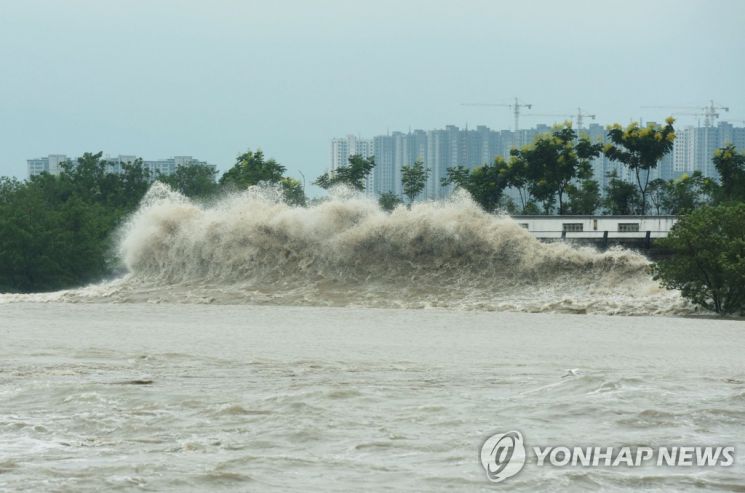 Last year, strong waves generated by Typhoon Muifa in Hangzhou, Zhejiang Province, eastern China, were breaking along the coast. [Image source=Yonhap News]
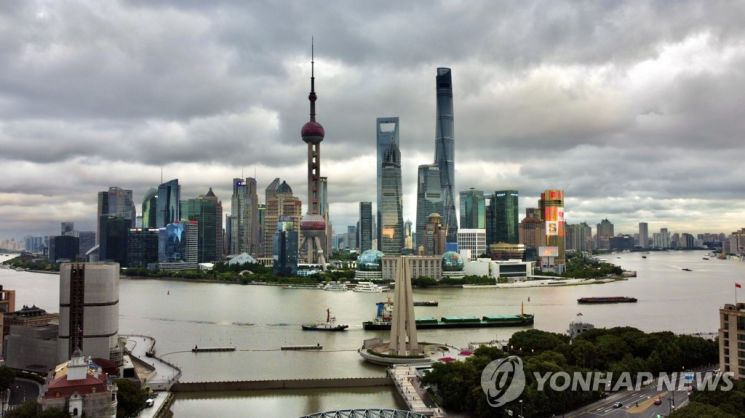
Coastal cities play a role similar to the heart of China's economy. For example, Shanghai, China's commercial hub, is also a coastal city. Most of Shanghai is low-lying, and even its highest point is only 6 meters above sea level, raising concerns that parts of the city could be submerged within decades if sea levels continue to rise.
Even without flooding damage, the unstable climate caused by sea level rise could adversely affect coastal cities. The southern and eastern coasts of China are exposed to about a dozen typhoons annually.
With global warming causing the seas to warm, both the intensity and frequency of typhoons worsen. Differences in air pressure and wind create higher waves, triggering "storm surges."
The Chinese government is also making every effort to slow climate change. Earlier, Chinese President Xi Jinping announced China's carbon neutrality goals at the 75th United Nations General Assembly in 2020, and in June last year, a large-scale renewable energy investment plan was established. The policy aims to reduce carbon emissions peaking by 2030 and achieve full carbon neutrality by 2060.
© The Asia Business Daily(www.asiae.co.kr). All rights reserved.


















