Financial Supervisory Service Establishes 'Three-Line Defense Internal Control' System
Standardizes Pre-Check Items for First-Line Transactions
Builds and Operates Monitoring System for Second-Line Transactions
Prepares Third-Line Post-Inspection System
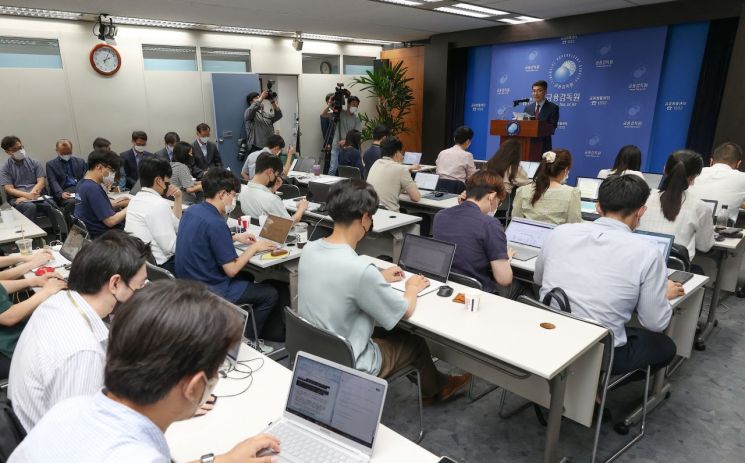
The Financial Supervisory Service (FSS) announced that it will establish internal control measures to prevent abnormal overseas remittance transactions by banks and implement them starting this July.
Since June last year, the FSS identified abnormal foreign currency remittance transactions disguised as trade transactions amounting to a total of $7.22 billion (involving 83 companies) through a comprehensive inspection of the banking sector. Large sums of money, believed to have been converted from virtual assets into cash, were remitted overseas under the guise of trade transactions.
During this process, vulnerabilities in internal controls related to foreign currency remittances were discovered, such as banks neglecting to verify supporting documents related to remittances or failing to detect abnormal transactions despite their repeated occurrence over a long period. Unlike typical advance payments for import funds, abnormal transactions involved newly established small-capital companies, large amounts within a short period, and transactions between different industries.
The FSS formed a task force (TF) together with the Korea Federation of Banks and domestic banks to discuss institutional improvements to prevent abnormal foreign currency remittances and established a 'three-line defense' internal control system.
The 'first line of defense' standardizes pre-transaction verification items. Branches standardized the items that must be verified through supporting documents when handling advance payments for import funds.
The verification items are limited to those that must be confirmed by law or guidelines, such as transaction counterparties, expected import dates, and transaction amounts, minimizing inconvenience to companies in foreign exchange transactions. During the banks' verification process, companies are informed about whether they are subject to reporting requirements to prevent unnecessary administrative penalties such as fines.
The 'second line of defense' involves establishing and operating a post-transaction monitoring system. Standard monitoring criteria are set, and a monitoring system is built to strengthen the head office foreign exchange department's continuous monitoring of abnormal foreign currency remittances.
Common standard monitoring criteria are established across the banking sector, and individual banks build monitoring systems to enhance their ability to detect abnormal foreign currency remittance transactions.
Pattern checks are conducted on large and cumulative transactions related to advance payments for import funds by small and medium-sized enterprises and SOHO (Small Office/Home Office). If the cumulative remittance amount of the inspected companies exceeds a certain threshold over a period, items such as remitter, recipient, goods, amount, customs clearance records, and dispersed remittances are reviewed.
The monitoring system detects monitoring targets and conducts monitoring (pattern checks), sharing the results with the internal control department.
The 'third line of defense' is the establishment of a post-inspection system. It clarifies the responsibilities and roles of the head office internal control department for post-inspections and establishes a post-inspection system including feedback to branches.
The Anti-Money Laundering Department strengthens inspections when suspicious transaction reports (STR) are not filed by branches for suspicious companies identified through the foreign exchange department's monitoring results. Suspicious foreign currency remittance transaction types* such as large remittances by newly established corporations, companies with rapidly increasing remittance performance within a short period, and multiple remittances to the same recipient are added to the STR extraction rules.
The Compliance Department incorporates essential verification items for advance payments of import funds into branch and sub-branch audit items and adds advance payment items to the special inspection POOL. The Inspection Department adds suspicious foreign currency remittance transaction types to the criteria for continuous audits and establishes an item for the appropriateness of advance payment processing during on-site branch inspections. The Sales Promotion Department prepares inspection procedures by the foreign exchange department regarding whether suspicious foreign currency remittance companies are included in branch KPI evaluations and rewards and deducts the corresponding performance.
The FSS stated, "Banks plan to implement the improvement measures in July after revising guidelines, reflecting them in internal regulations, and building IT systems during the second quarter of this year. Some tasks requiring more time, such as IT system development and preparation of work procedures, will be implemented step-by-step as preparations are completed in the third quarter."
It added, "With the establishment of a monitoring system for pattern checks and the preparation of work procedures for post-inspections by internal control departments, the internal control functions related to advance payments in the banking sector will operate systematically, effectively preventing foreign currency remittances while also preventing companies from violating reporting obligations."
© The Asia Business Daily(www.asiae.co.kr). All rights reserved.
![Clutching a Stolen Dior Bag, Saying "I Hate Being Poor but Real"... The Grotesque Con of a "Human Knockoff" [Slate]](https://cwcontent.asiae.co.kr/asiaresize/183/2026021902243444107_1771435474.jpg)
















