Composed of Columnar Joints with Different Directions, Shapes, and Sizes
Presumed Cenozoic Tertiary Volcanic Rock "Excellent Scenery"
The black-hued columnar joints of Odori, Pohang (浦項 烏島里 柱狀節理) are being designated as a natural monument. The Cultural Heritage Administration announced on the 7th that it will finalize the designation after collecting opinions from various sectors for a month and undergoing a review by the Cultural Heritage Committee.
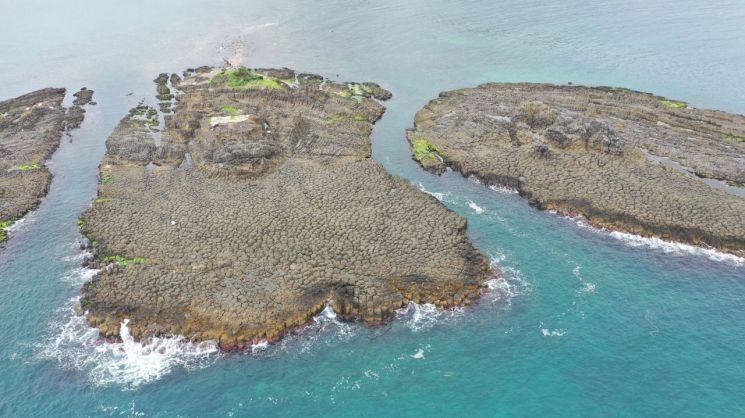
Columnar joints are groups of volcanic rock pillars formed as magma remaining underground during volcanic activity cools, contracts, and cracks. The Odori columnar joints in Pohang consist of an entire island made up of columnar joints of various shapes and sizes oriented in different directions. These include vertical columnar joints in hexagonal or pentagonal shapes and horizontal columnar joints overlapping at angles from 0° to 45°. The Cultural Heritage Administration described this as a "form not well known domestically."
Although it appears that the island is divided into three or four parts on the surface, the directions and shapes of the columnar joints are connected and continuously distributed. Considering the absence of internal discontinuity surfaces, it is presumed to be a single columnar joint formation.
Academia regards these columnar joints in the Pohang, Gyeongju, and Ulsan regions as Cenozoic Tertiary volcanic rocks. It is argued that they were formed through various volcanic activities during the process when the Japanese archipelago, which had been attached to the Korean Peninsula since about 23 million years ago, separated and the East Sea opened.
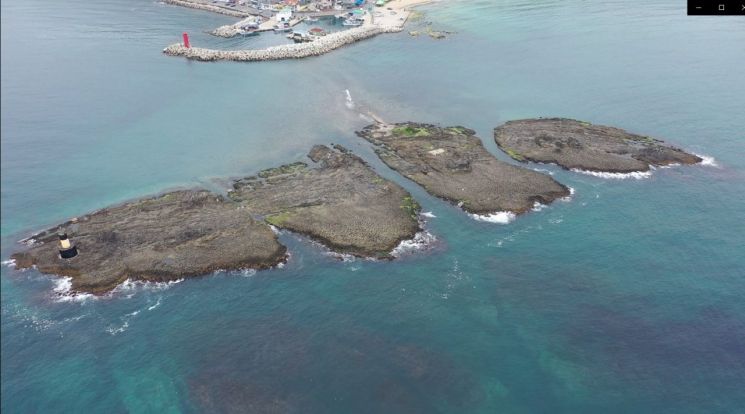
The Cultural Heritage Administration stated, "It has high geological value as it shows the process of forming columnar joints of various shapes, sizes, and directions as magma cools." They added, "The form, which is intensively displayed on a single island close to the mainland and harmonizes with the sea, is also excellent in terms of landscape."
Currently, columnar joints protected as natural monuments include four locations: the Daepo Coast columnar joints in Jungmun, Jeju; the Yangnam columnar joint cluster in Gyeongju; the Daljeonri columnar joints in Pohang; and the Mudeungsan columnar joint formation. All of these have high educational value as they indicate the evolutionary process of coastal landforms divided by long-term wave erosion.
© The Asia Business Daily(www.asiae.co.kr). All rights reserved.


















