Illegality Not Recognized When Requirements for Justifiable Act Are Met
Former Sangji University student council executives who engaged in a physical altercation while attempting to enter the president’s office to demand a meeting with former Sangji University President Kim Moon-gi were acquitted of obstruction of business charges. This verdict comes nine years after the incident and six years after the Supreme Court proceedings began.
According to the legal community on the 7th, the Supreme Court’s 2nd Division (Presiding Justice Min Yoo-sook) upheld the lower court’s acquittal of former Sangji University student council president Yoon Myung-sik (34) and former student council external cooperation director Jeon Jong-wan (34), who were charged with obstruction of business.
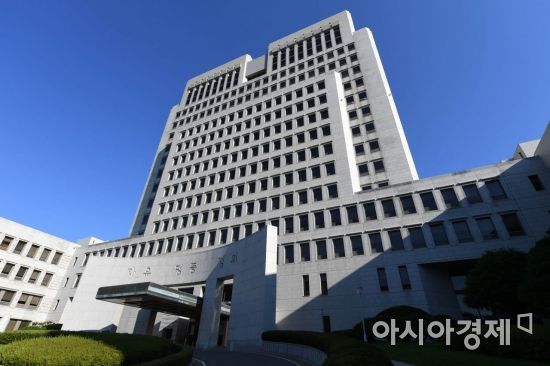
The court stated, "Although there are some inappropriate parts in the lower court’s judgment, the conclusion of the lower court that the defendants’ actions can be recognized as justifiable acts and therefore acquitted the charges in this case is correct, and there is no illegality such as misinterpretation of the law regarding the establishment of justifiable acts."
The two were prosecuted for obstruction of business by force after engaging in a physical struggle with faculty and staff who tried to prevent them from entering the president’s office while demanding a meeting with the president in September 2014, when Kim Moon-gi, who had been detained on charges of private school corruption, returned as Sangji University president after 21 years and a "president resignation movement" was underway on campus.
The first trial ruled, "The defendants exercised force constituting obstruction of business and their actions cannot be considered justifiable," and found them guilty, sentencing each to a fine of 500,000 KRW.
However, the second trial judged, "The acts were carried out for the public interest," and "fall under justifiable acts according to Article 20 of the Criminal Act, thus there is no illegality," acquitting both defendants.
The court reasoned, "At the time of the incident, the student council consistently demanded a meeting with the president while holding assemblies and protests on campus to express opinions on the illegality and unfairness of the president’s appointment. They also followed the application procedures for a meeting through the Student Support Office or the president’s secretariat as requested by the school, but the president’s side considered the students’ assemblies and protests illegal and dismissed the meeting requests for the purpose of the president’s resignation, leading the students to attempt to enter the president’s office or the faculty committee meeting room as a last resort to confront the president directly."
Furthermore, the court noted, "During the attempt to enter, the defendants and other students did not use active violence, and the scuffle with faculty and staff blocking their entry did not escalate into violence or become aggressive. Based solely on the evidence submitted by the prosecution, it is difficult to recognize even an abstract risk of obstruction of business," adding.
The court concluded, "The defendants’ actions in this case meet the requirements of justifiable acts under Article 20 of the Criminal Act, considering the legitimacy of the motive and purpose, the appropriateness of the means and methods, the balance between protected interests and infringed interests, urgency, and subsidiarity, as there were no other means or methods available."
The Supreme Court also judged that their actions constituted justifiable acts, which negate illegality under criminal law.
The court explained, "Since April 1994, when former chairman Kim Moon-gi was detained on charges including bribery related to illegal admissions at Sangji University, the school foundation Sangji Academy has been operated by temporary directors appointed by the Minister of Education, Science and Technology, and conflicts continued between the so-called 'old foundation' involved in school management under the previous board and the campus members involved under the temporary board."
It continued, "When Kim Moon-gi was appointed president of Sangji University on August 14, 2014, the Sangji University Professors’ Association and the student council launched a movement to oust the president, leading to conflicts with Kim Moon-gi and the old foundation side. After Kim’s misconduct, conflicts related to the operation of Sangji University remained unresolved for about 20 years, and the return of Kim, symbolizing the old foundation, worsened the conflict, causing disruption in school management that clearly threatened students’ right to education."
The court stated, "From around September 2014, the defendants consistently sought dialogue with Kim Moon-gi, who reignited conflicts to normalize university operations, but due to the school’s passive attitude, the meetings did not materialize. Considering this purpose and circumstances, it is recognized that the defendants had no other option but to directly meet Kim Moon-gi, and the brief scuffle with those who tried to block them during the meeting attempt is justified in terms of motive, purpose, and appropriateness of means and methods. The balance of legal interests is also sufficiently recognized given that the defendants’ right to learn is constitutionally guaranteed."
It further judged, "Moreover, since infringement of the right to learn was anticipated, urgency is recognized, and it is not the case that no legal remedies exist or that all other remedies must be exhausted before attempting a meeting, so subsidiarity is also acknowledged."
The two were prosecuted on May 28, 2015. The first trial concluded in about four months, and the second trial, which began in late October 2015, ended in January 2017 after about one year and three months. However, the Supreme Court appeal trial lasted over six years from February 2017 to May 2023, resulting in a final acquittal about nine years after the incident.
Meanwhile, in March 2015, the Ministry of Education demanded the dismissal of former President Kim from Sangji Academy due to improper hiring of contract employees and other reasons. Sangji Academy initially imposed a two-month suspension on Kim but passed a dismissal resolution after receiving a warning from the Ministry of Education.
Kim filed an appeal and won a final victory at the Supreme Court in September 2021, on the grounds that the disciplinary action was invalid because Sangji Academy did not hold a disciplinary committee meeting. Kim passed away in December of the same year.
© The Asia Business Daily(www.asiae.co.kr). All rights reserved.

















