Although CF100 is emerging as an alternative to the RE100 campaign, which aims to source 100% of corporate electricity use from renewable energy, only 18% of companies have expressed willingness to participate, indicating low levels of corporate awareness and willingness to engage. CF100 refers to sourcing 100% of the electricity used by a company from carbon-free energy.
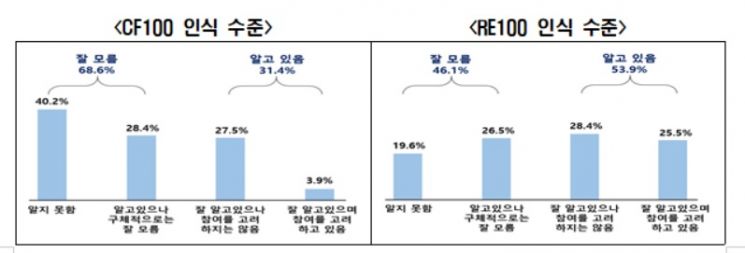
In a survey conducted on the 7th by the Federation of Korean Industries (FKI), commissioned to market research firm Mono Research, targeting the top 500 domestic companies by sales (with 102 companies responding), 31.4% of respondents answered that they are well aware of the exact concept and specific details of CF100. In contrast, more than half responded that they are well aware of RE100. Compared to RE100, which has been steadily promoted since 2014, CF100 is a relatively recent concept, which is interpreted as a difference in corporate awareness levels.
When asked whether they agree on the necessity of the CF100 campaign, 69.6% of companies answered affirmatively, but when asked about their willingness to participate in the CF100 campaign, only 17.6% said they would participate. The main reasons for agreeing on the necessity of the CF100 campaign were ▲considering the manufacturing-centered industrial structure, it is difficult to supply sufficient and stable electricity with renewable energy alone (31.4%), and ▲domestic renewable energy procurement conditions (volume, cost, etc.) are unfavorable, making it realistically difficult to achieve RE100 (29.8%).
On the other hand, reasons for not participating in the CF100 campaign included ▲high uncertainty due to the lack of concrete standards or implementation plans (35.0%), ▲lack of dedicated personnel and additional cost burdens (23.6%), and ▲the 24-hour, 7-day real-time procurement standard being unrealistic under domestic conditions (20.0%), confirming the urgent need for prompt alternative measures.
When asked what kind of policy support or preparations would be necessary from the government if they were to participate in the CF100 campaign, companies requested ▲financial incentives such as tax benefits (38.2%), ▲establishment of CF100-related infrastructure such as measurement equipment for real-time monitoring (26.5%), and ▲institutional arrangements for CF100 implementation such as carbon-free energy dedicated PPAs and certificates (20.6%).
Choo Kwang-ho, Head of the Economic and Industrial Headquarters at FKI, emphasized, “Although a high proportion of companies agree on the necessity of CF100, their reluctance to participate is due to unresolved uncertainties regarding concrete implementation plans.” He added, “To establish CF100 as a campaign that alleviates the burden on our companies in the process of pursuing carbon neutrality, it is necessary for the government to carefully prepare the initial institutional design along with promotional and educational activities to raise awareness.”
© The Asia Business Daily(www.asiae.co.kr). All rights reserved.
![Clutching a Stolen Dior Bag, Saying "I Hate Being Poor but Real"... The Grotesque Con of a "Human Knockoff" [Slate]](https://cwcontent.asiae.co.kr/asiaresize/183/2026021902243444107_1771435474.jpg)
















