Minister of Health and Welfare Cho Kyu-hong SBS Radio Interview
"Efforts to Reflect Medical School Quotas for 2025"
Cho Kyu-hong, Minister of Health and Welfare, stated that the number of doctors in South Korea is at the lowest level among the Organization for Economic Cooperation and Development (OECD) countries and announced plans to expand the quota for medical school admissions.
Minister Cho appeared on SBS Radio's 'Kim Tae-hyun's Political Show' on the 5th and said regarding the expansion of medical school quotas, "As the population ages and demand for health increases, it is certain that the demand for doctors is insufficient," adding, "We will proceed with strong determination." He continued, "The 2024 entrance exam guidelines have been released, so we will make every effort to reflect this in the 2025 medical school quotas."
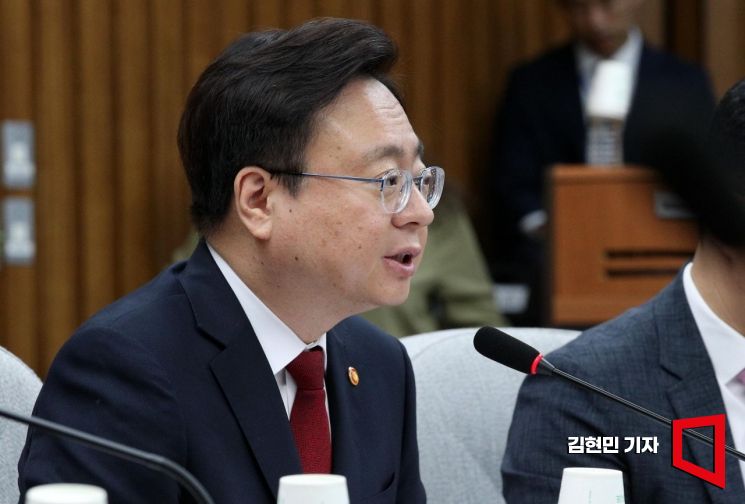 Minister of Health and Welfare Cho Kyu-hong is speaking at the Emergency Medical Care Urgent Measures Party-Government Council held at the National Assembly on the 31st. Photo by Hyunmin Kim kimhyun81@
Regarding the recent incidents where patients wandered in search of available emergency rooms and missed the golden hour, resulting in death?so-called 'emergency room roundabouts'?Minister Cho said, "We deeply regret that similar accidents have repeatedly occurred," and added, "There are various structural problems causing these repeated incidents, but the most important causes are emergency room overcrowding due to mild patients and a shortage of surgeons and hospital beds."
He stated, "Through recent government-party consultations, we plan to establish regional control towers," and explained, "We will establish six regional emergency situation rooms early on, granting priority emergency room allocation authority for severe emergency patients, and for mild patients, we propose transferring them to regional emergency medical centers."
He also added, "Instead of the 119 ambulance teams making phone calls one by one to check bed availability, we plan to support additional information management personnel so that real-time information can be viewed through a comprehensive app."
Regarding the issue of doctor concentration by region and medical specialty, he said, "Even if we increase medical school quotas now, it will take more than 10 years for those doctors to be deployed in the field," adding, "Therefore, we will first expand infrastructure, then through reasonable compensation, enable doctors to voluntarily work in underserved regions or specialties, and we are already implementing measures to ensure working conditions do not hinder essential medical services."
On the avoidance of essential medical specialties such as surgery, thoracic surgery, obstetrics and gynecology, and pediatrics by residents, he said, "The most important issue is the fee system," explaining, "Our country's fee system is a fee-for-service model where the more treatments performed, the more money is earned. As you know, due to low birth rates, the number of pediatric and delivery patients is decreasing, so we need to implement post-compensation systems that can supplement the fee-for-service model. Additionally, for those working in regional areas, we will introduce regional additional fees to provide reasonable compensation and implement measures to minimize disparities between regions and medical specialties."
© The Asia Business Daily(www.asiae.co.kr). All rights reserved.
![Clutching a Stolen Dior Bag, Saying "I Hate Being Poor but Real"... The Grotesque Con of a "Human Knockoff" [Slate]](https://cwcontent.asiae.co.kr/asiaresize/183/2026021902243444107_1771435474.jpg)
















