AI Biomarker 'Lunit Scope'
Joint Research Results Announced with Japan National Cancer Center
Medical AI company Lunit announced on the 5th that its AI biomarker 'Lunit Scope' has demonstrated potential as a biomarker for predicting treatment efficacy in patients with locally advanced rectal cancer (LARC).
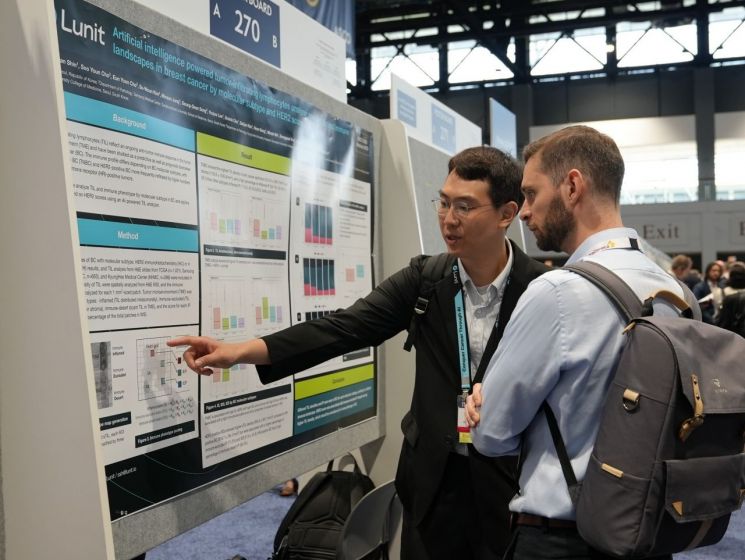 At the American Society of Clinical Oncology (ASCO 2023) held in Chicago, USA, a representative from AstraZeneca (right) is listening to an explanation of Lunit's research results. [Photo by Lunit]
This study was presented at the American Society of Clinical Oncology (ASCO 2023), held in Chicago, USA, from June 2 to 6. ASCO is a cancer conference attended annually by more than 40,000 healthcare industry professionals.
The research team applied Lunit Scope to pathological tissues of LARC patients who underwent preoperative chemoradiotherapy (CRT) and analyzed changes in tumor-infiltrating lymphocytes (TILs), which are immune cells. As a result, they confirmed a strong correlation between TIL changes analyzed by Lunit Scope and pathological complete response (pCR) in LARC patients.
Lunit explained that this study shows that tumor microenvironment analysis using Lunit Scope can be meaningfully applied to predict prognosis after treatment in rectal cancer patients. The study was conducted in collaboration with the National Cancer Center Japan, which plans to utilize Lunit Scope in various upcoming clinical trials.
At ASCO 2023, Lunit also presented two studies analyzing the tumor microenvironment in head and neck squamous cell carcinoma (HNSCC) using Lunit Scope. The research team applied Lunit Scope to analyze immune response changes in immunotherapy treatments, including combination therapy with durvalumab (brand name Imfinzi) for resectable head and neck cancer patients and triple therapy with pembrolizumab (brand name Keytruda) for HPV-positive head and neck cancer patients. The results showed that immune environment changes before and after treatment could be confirmed through Lunit Scope analysis.
Additionally, Lunit announced results applying its AI image analyzer 'Lunit Scope UIHC,' which quantifies target proteins in immunohistochemistry (IHC) pathology slides, to analyze tumor-associated antigen (TAA) expression related to six cancer-associated antigens across 16 cancer types. This study confirmed tumor proportion scores (TPS) of various target protein antigens by cancer type, demonstrating that the Lunit Scope UIHC model could be usefully applied in the future development of antibody-based anticancer drugs targeting new antigen proteins.
Furthermore, Lunit presented results predicting the presence of MET mutations in non-small cell lung cancer (NSCLC) using Lunit Scope on H&E-stained slides. The AI algorithm's predictive performance (AUC) was 0.837, and high predictive accuracy was maintained in validation with independent external data.
Moreover, Lunit presented findings showing a significant correlation between the expression of transforming growth factor beta (TGF-beta), which suppresses tumors, and fibroblast density analyzed by Lunit Scope in patients treated with immunotherapy. Lunit explained that this study emphasizes that analyzing various cells within tumors can be applied to developing personalized therapies targeting specific tumor microenvironments.
Finally, Lunit confirmed that macrophage density, measured by Lunit Scope within the tumor microenvironment, is highly correlated with anticancer activity. This suggests that Lunit Scope could be used in anticancer drug research targeting tumor-associated macrophages (TAMs), which, contrary to their original function, promote cancer growth.
Seobum Seok, CEO of Lunit, said, "At ASCO 2023, Lunit presented various research results related to Lunit Scope, demonstrating that AI-based analytical technology can further advance precision oncology research. We will continue to expand opportunities to ensure that Lunit Scope, which accurately analyzes the tumor microenvironment, is widely utilized in clinical trials for anticancer drug development and eventually in real-world medical settings."
© The Asia Business Daily(www.asiae.co.kr). All rights reserved.

















