No Change in Position but Agreement on Normalizing Korea-Japan Relations and Responding to North Korea
Agreement on Measures to Prevent Recurrence at Korea-Japan Defense Ministers' Meeting
South Korea and Japan have decided to resolve the 'Patrol Aircraft Conflict,' which has dragged on for four and a half years since the end of 2018 amid disputes over the truth and battles of pride. Although both sides maintain their claims that the other party was at fault, it is interpreted that they agreed to focus on future-oriented cooperation rather than determining right or wrong.
On the 4th, Defense Minister Lee Jong-seop of South Korea and Japanese Defense Minister Hamada Yasukazu held talks on the sidelines of the 20th Asia Security Conference (Shangri-La Dialogue) ongoing in Singapore and agreed to focus on establishing measures to prevent the recurrence of the patrol aircraft conflict.
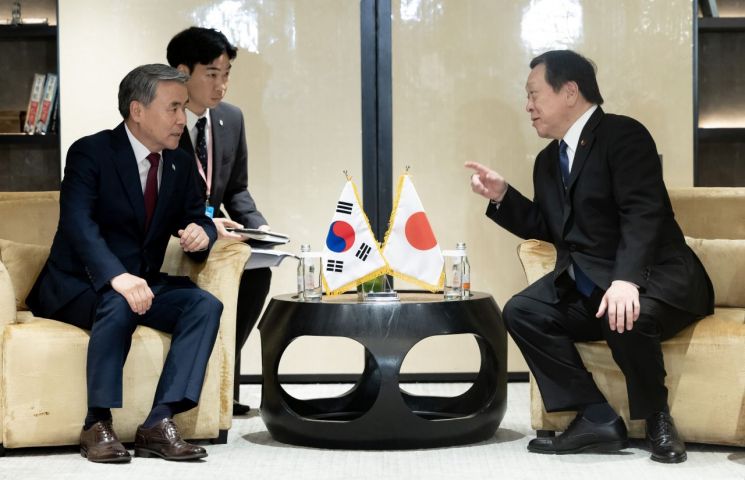 Defense Minister Lee Jong-seop, attending the 20th Asia Security Conference (Shangri-La Dialogue), is holding a bilateral meeting with Japanese Defense Minister Hamada Yasukazu at the Shangri-La Hotel in Singapore on the 4th (local time).
 [Photo by Yonhap News]
The patrol aircraft conflict was triggered on December 20, 2018, when the South Korean Navy's Gwanggaeto the Great warship, searching for a North Korean fishing boat that had been shipwrecked in the East Sea, was accused by Japan of targeting the nearby Japanese Maritime Self-Defense Force P1 patrol aircraft with a fire-control radar. At that time, Japan released a video filmed inside the patrol aircraft as evidence, while South Korea denied any radar targeting and countered that the patrol aircraft flew low and threateningly near the Gwanggaeto the Great. Subsequently, Japan conducted a total of four threatening flights by patrol aircraft until January of the following year but denied "any low-altitude close flights" in response to South Korea's protests. This incident worsened Korea-Japan relations, and exchanges between the defense authorities were completely suspended.
The positions of both sides remain unchanged to this day. Defense Minister Lee Jong-seop stated at the National Assembly's National Defense Committee in March, "It is true that the Japanese patrol aircraft conducted threatening flights," adding, "Our position is that we did not target the radar."
Japanese Defense Minister Hamada also told Japanese reporters after meeting with Minister Lee on the same day, "The Ministry of Defense's position remains the final view." The Ministry of Defense's final view is that "the South Korean warship targeted the Japanese patrol aircraft with radar, and South Korea repeatedly makes claims that are completely different from the facts, alleging that the Self-Defense Force patrol aircraft conducted threatening flights."
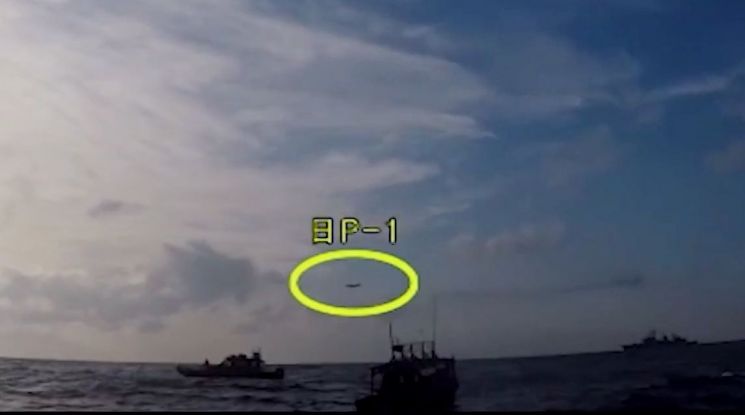
Although the defense authorities of South Korea and Japan have not changed their original positions to the end, the decision to put the conflict behind them is interpreted as a result of the agreement between President Yoon Suk-yeol and Japanese Prime Minister Kishida Fumio to normalize and improve bilateral relations. A Ministry of Defense official said, "Since the two heads of state agreed to build trust for improving relations, the defense sector must also respond to the national direction," adding, "Therefore, it was agreed to maintain both sides' positions as they are and to establish measures to prevent recurrence."
The fact that North Korea's nuclear and missile threats have become too advanced to ignore is also cited as a background for South Korea and Japan joining hands. North Korea launched ballistic missiles 34 times last year alone, and this year, it has raised its technological level by launching a solid-fuel intercontinental ballistic missile (ICBM) in April, which can drastically reduce launch preparation time. On this day, the defense ministers of South Korea and Japan jointly condemned North Korea's ballistic missile launches as "a serious violation of United Nations Security Council resolutions" and formed a consensus to build trust and strengthen cooperation between their defense authorities.
© The Asia Business Daily(www.asiae.co.kr). All rights reserved.
![User Who Sold Erroneously Deposited Bitcoins to Repay Debt and Fund Entertainment... What Did the Supreme Court Decide in 2021? [Legal Issue Check]](https://cwcontent.asiae.co.kr/asiaresize/183/2026020910431234020_1770601391.png)

















