Trilateral Defense Ministers' Meeting in Singapore
South Korea, the United States, and Japan have agreed to activate a system within this year to share North Korean missile warning information in real time.
On the 3rd, Defense Minister Lee Jong-seop of South Korea, U.S. Secretary of Defense Lloyd Austin, and Japanese Defense Minister Hamada Yasukazu held a trilateral defense ministers' meeting at the Shangri-La Hotel in Singapore.
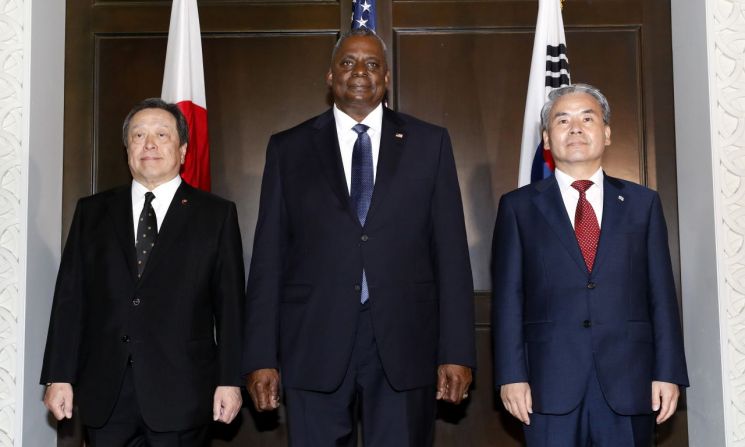 On the 3rd (local time), at the Shangri-La Hotel in Singapore, Defense Minister Lee Jong-seop (right), U.S. Secretary of Defense Lloyd Austin (center), and Japanese Defense Minister Hamada Yasukazu are taking a commemorative photo before the trilateral defense ministers' meeting between Korea, the U.S., and Japan.
 [Image source=Yonhap News]
The three ministers agreed to activate a real-time warning information sharing system within this year to enhance detection and assessment capabilities against North Korean missiles. Previously, at the trilateral summit held in Phnom Penh last November, South Korea, the U.S., and Japan agreed on real-time sharing of North Korean missile warning information. Specific matters will be discussed through working-level consultations.
Currently, South Korea and the U.S., and the U.S. and Japan share information in real time. However, such a system has not been established between the South Korean military and the Japan Self-Defense Forces. Using the trilateral information sharing agreement (TISA) signed in 2014, information is shared through the U.S. The method involves South Korea or Japan delivering North Korean nuclear and missile information they have collected to the U.S. Department of Defense, which then provides it after approval from the supplying country.
Additionally, the three ministers welcomed the recent normalization of the South Korea-Japan military information protection agreement (GSOMIA) and reached a consensus on the importance of building defense-related trust among regional countries.
Regarding North Korea’s launch of military reconnaissance satellites using ballistic missile technology, they stated, "North Korea’s so-called satellite launches, which are actually long-range ballistic missile launches, constitute a serious violation of United Nations Security Council resolutions prohibiting any launches using ballistic missile technology." They strongly condemned this and declared that they will firmly respond in cooperation with the international community while enhancing trilateral cooperation.
They urged the international community to implement the UN Security Council resolutions. Emphasizing the importance of continued international efforts to suppress, prevent, and eradicate North Korea’s illegal maritime transshipment, they called on North Korea to immediately cease its irresponsible actions that raise tensions on the Korean Peninsula and in the region and to comply with all relevant UN Security Council resolution obligations.
Furthermore, they reaffirmed their plan to strengthen the trilateral response posture against North Korea’s nuclear and missile threats and to regularize anti-submarine warfare exercises and maritime missile defense drills that contribute to deterring North Korean threats.
The three ministers stated their solidarity with Ukraine against Russia’s brutal and unjustifiable war of aggression, noting that this war is a serious violation of territorial integrity and sovereignty and undermines the entire structure of the international order.
Regarding the Taiwan Strait issue, they expressed concern over actions inconsistent with international law, including the United Nations Convention on the Law of the Sea, and emphasized the importance of fully respecting the international order, including freedom of navigation and overflight and other lawful uses of the seas.
© The Asia Business Daily(www.asiae.co.kr). All rights reserved.
!["The Woman Who Threw Herself into the Water Clutching a Stolen Dior Bag"...A Grotesque Success Story That Shakes the Korean Psyche [Slate]](https://cwcontent.asiae.co.kr/asiaresize/183/2026021902243444107_1771435474.jpg)
















