‘The Era of Political Panic, Where Should We Go?’ Symposium
Deciding Among Regional Proportional Representation + Single-Member District System,
and Urban-Rural Mixed Electoral District System
"Fundamental political change is necessary to lead social consensus on changes in the international situation and strategies for new technologies, new industries, and public welfare."
On the 2nd, Kim Jong-min, a member of the Democratic Party of Korea, introduced this in his keynote speech at the symposium titled "The Era of Political Panic, Where Should We Go?" held at the Daejeon Christian Federation Volunteer Hall Convention Hall. He emphasized the need to reform the electoral system to create politics that can unite, suggesting a mixed system combining regional proportional representation with single-member districts, or a mixed urban-rural system, to build a consensus that both ruling and opposition parties can agree on.
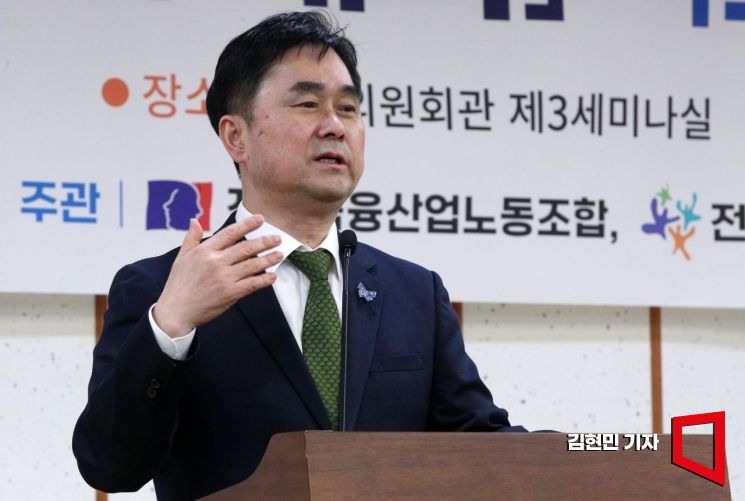 Kim Jong-min, a member of the Democratic Party of Korea, is giving a greeting at the National Assembly forum titled "Electoral Reform for Working People" held on the 13th at the National Assembly Members' Office Building in Yeouido, Seoul. Photo by Kim Hyun-min kimhyun81@
He stated, "The international situation is characterized by the clash between the United States and China, requiring a readjustment of national strategy. The Korea-Japan relationship faces issues not only with contaminated water and forced labor but also with what stance we should take in the reorganization of the international order. Domestically, in the era of artificial intelligence (AI) and new industries, jobs are fundamentally threatened, and social consensus is needed on welfare and funding issues," adding, "For national consensus to be achieved, politics must take the lead, but currently, politics is failing to fulfill that role."
Referring to the results of a public opinion survey conducted by the National Assembly’s Special Committee on Political Reform involving 500 citizens, Kim said, "Ultimately, the survey results suggest not choosing either the single-member district system or the large multi-member district system exclusively, but rather mixing both to leverage their strengths," and added, "We need to create a consensus that can be agreed upon between the Democratic Party’s proposal of combining regional proportional representation with single-member districts and the People Power Party’s proposal of a mixed urban-rural system." Regarding this, he explained, "Introducing regional proportional representation requires a decisive reduction of proportional seats to one-quarter, one-third, or one-half of the total seats, and if moving toward a mixed urban-rural system, it is necessary to determine the extent to which the large multi-member district system will be applied."
During the discussion, topics included how European small powers such as the Netherlands, Sweden, and Finland, which had been mired in left-right conflicts, overcame labor and left-right confrontations through social grand compromise and advanced into leading welfare states, surpassing pioneer countries like the United States, the United Kingdom, and France. It was emphasized that the key to this success was the power of coalition majorities rather than single-party majorities, highlighting dialogue and compromise politics, coalition majorities, and electoral reform as core tasks for political reform in Korea.
Meanwhile, Choi Un-yeol, former Democratic Party lawmaker and chair of the symposium, explained in a phone interview with this publication that the purpose of the event was to discuss "how to overcome the extreme fandom politics that have become so rampant."
© The Asia Business Daily(www.asiae.co.kr). All rights reserved.
![Clutching a Stolen Dior Bag, Saying "I Hate Being Poor but Real"... The Grotesque Con of a "Human Knockoff" [Slate]](https://cwcontent.asiae.co.kr/asiaresize/183/2026021902243444107_1771435474.jpg)
















