Economic Growth Rate Turns Positive at 0.3%
Private Consumption Supports Despite Semiconductor Export Slump
Per Capita Gross National Income $32,886
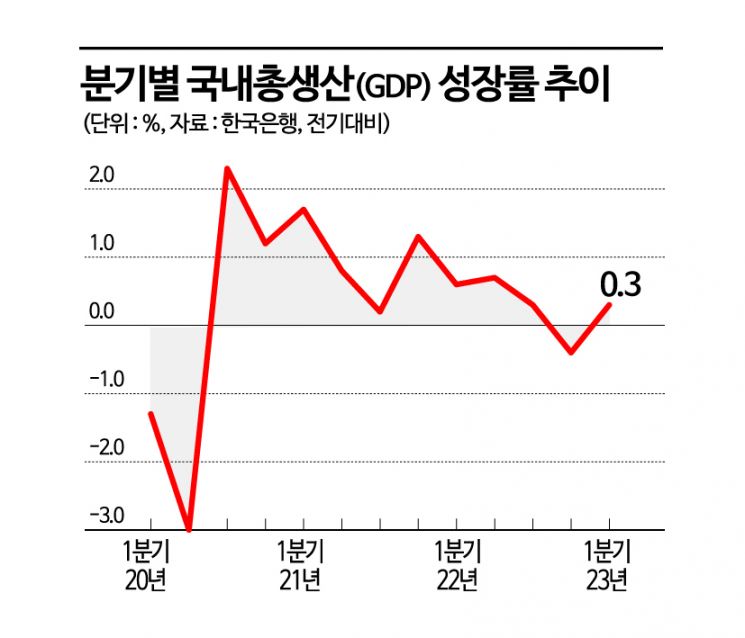
In the first quarter of this year, the South Korean economy grew by 0.3%, avoiding negative growth for two consecutive quarters. Although exports continued to be sluggish, private consumption increased after the end of COVID-19 quarantine measures, boosting the growth rate. The Bank of Korea maintained its previous forecast that the economy would continue to show sluggish growth in the 0% range until the first half of the year, then recover in the second half, resulting in an annual growth rate of 1.4%.
The Bank of Korea announced on the 2nd that the real Gross Domestic Product (GDP, preliminary figure) growth rate for the first quarter was 0.3% compared to the previous quarter. This figure is the same as the flash estimate released on April 25. Quarterly real GDP recorded growth rates of 0.7%, 0.8%, and 0.2% in the first, second, and third quarters of last year, respectively, but turned negative at -0.3% in the fourth quarter due to a sharp decline in exports. However, thanks to private consumption in the first quarter of this year, the economy narrowly avoided negative growth.
Earlier, the Bank of Korea forecasted 0.8% growth in the first half and 1.8% growth in the second half, resulting in an annual growth rate of 1.4%. Shin Seung-cheol, head of the Bank of Korea’s Economic Statistics Department, said on the day, "Unlike the past period of high growth, we have entered a low-growth trend, and the potential growth rate has also declined, which is why the first quarter showed growth in the 0% range." He added, "We expect a sluggish trend until the first half, followed by a 'low in the first half, high in the second half' pattern with growth rates rising year-on-year in the second half."
Looking at expenditure items, private consumption in the first quarter increased by 0.6%, centered on services such as entertainment, culture, food, and accommodation. Government consumption increased by 0.4% due to increased social security in-kind benefits. Construction investment grew by 1.3% due to expansion in building construction. On the other hand, facility investment sharply declined by 5.0%, mainly in machinery such as semiconductor equipment.
Compared to the flash estimate, construction investment was revised upward by 1.1 percentage points, and private consumption by 0.1 percentage points. Facility investment was revised downward by 1.0 percentage point. Exports increased by 4.5% due to strong performance in transportation equipment despite declines in semiconductors. Imports rose by 4.2% due to increased chemical products but did not keep pace with export growth.
The contribution of private consumption to the first quarter growth rate was analyzed at 0.3 percentage points. Net exports pulled down the growth rate by 0.2 percentage points. In a situation where the trade balance deficit continues due to sluggish exports such as semiconductors, private consumption at least helped raise the growth rate.
Nominal Gross National Income (GNI) in the first quarter increased by 2.7% compared to the previous quarter. The real GNI growth rate was 1.9%, exceeding the real GDP growth rate (0.3%). Real GNI is an indicator representing the real purchasing power of income earned by nationals domestically and abroad, meaning the actual income in hand. The GDP deflator, which indicates the overall price level in South Korea, rose by 1.4% year-on-year.
The total savings rate in the first quarter (33.4%) rose by 0.7 percentage points from the previous quarter as the growth rate of gross national disposable income (2.6%) exceeded the growth rate of final consumption expenditure (1.5%). The gross domestic investment rate was 32.1%, falling by 1.5 percentage points due to the decrease in facility investment.
According to the '2022 National Accounts (preliminary)' released on the same day, real GDP grew by 2.6% last year. Although construction and facility investments decreased and the growth of exports and imports slowed, the expanded increase in private consumption supported the growth trend.
Last year, nominal GDP was KRW 2,161.8 trillion, growing 3.9% from the previous year. However, with the won-dollar exchange rate rising 12.9% last year, the dollar-denominated GDP decreased by 7.9% year-on-year to USD 1,673.3 billion. Per capita Gross National Income (GNI) was KRW 42.487 million, up 4.5% from the previous year, but in dollar terms, it fell by 7.4% from USD 35,523 to USD 32,886.
© The Asia Business Daily(www.asiae.co.kr). All rights reserved.


















