Gangnam Apartment Sales Over 100 Units for 4 Consecutive Months
Driving Price Increases in Surrounding Areas and Reversing Sentiment
Significant Seoul Jeonse Supply Remains a Variable
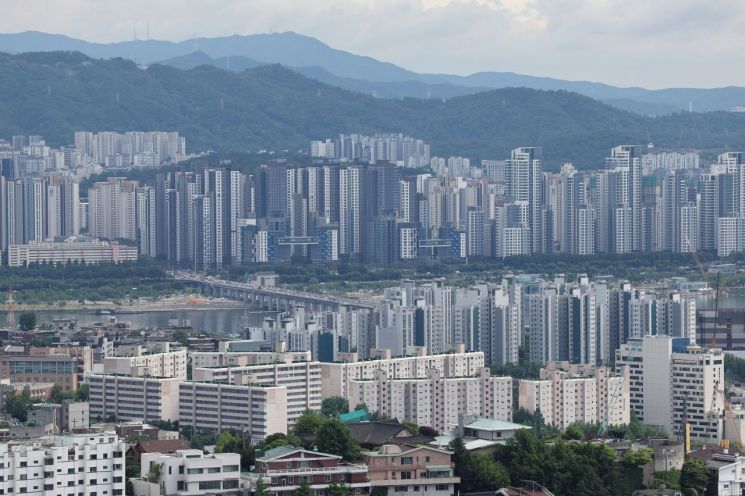
The volume of apartment transactions in Gangnam-gu, Seoul, known as the "barometer of housing prices," has exceeded 100 units for four consecutive months. The revived buying momentum in Gangnam is driving up prices in surrounding areas, bolstering the theory that Seoul's housing prices have hit bottom.
According to the Seoul Real Estate Information Plaza on the 4th, the number of apartment transactions in Gangnam-gu in May was recorded at 105. This marks the fourth consecutive month from February to May that Gangnam-gu's transaction volume has surpassed 100 units.
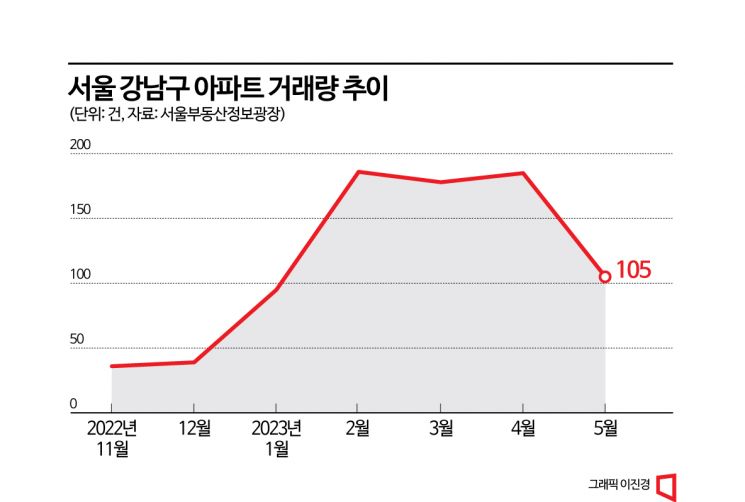
This is a different trend from last year when the transaction freeze was severe due to the US interest rate hikes. From June last year to January this year, Gangnam-gu's transaction volume did not reach 100 units for eight consecutive months. In fact, in September, October, November, and December, the volume was in the 30s.
However, with the government's easing of real estate regulations, the market has revived and transaction volumes are gradually recovering. Although Gangnam-gu remains a regulated area along with Seocho, Songpa, and Yongsan districts, it has benefited from the lifting of the ban on mortgage loans for apartments priced over 1.5 billion KRW.
Recently, there has been strong buying activity among people in their 30s for Seoul apartments, but in Gangnam, where housing prices are the highest nationwide, there is a noticeable trend of more buyers in their 40s who have greater assets. An analysis of transaction data by age group from January to April by the Korea Real Estate Board shows that while the 40s age group accounts for 27% of buyers in Seoul, it accounts for 38% in Gangnam.
Gangnam is called the barometer of housing prices and is a leading area that influences the mood of the real estate market not only in Seoul but nationwide. Changes in Gangnam's market sentiment are leading to rising housing prices in Seoul. In the fifth week of May, Seoul apartment prices rose for the second consecutive week, with more districts experiencing price increases than decreases. This week, the districts with rising prices in Seoul include Songpa, Seocho, Gangnam, Mapo, Yongsan, Seongbuk, Dongjak, Gangdong, and Jung-gu, totaling nine areas. When combined with the seven districts with stable prices?Seongdong, Dongdaemun, Nowon, Eunpyeong, Seodaemun, Geumcheon, and Yeongdeungpo?the total is sixteen, which is double the eight districts with declining prices?Jongno, Gwangjin, Jungnang, Gangbuk, Dobong, Yangcheon, Gangseo, Guro, and Gwanak.
The Korea Real Estate Board explained, "After the quick sale of urgent listings, local prices are showing a gradual upward trend," adding, "Buying inquiries continue mainly in preferred areas and major complexes, slightly expanding the price increase."
Yoon Ji-hae, Research Team Leader at Real Estate R114, said, "With Seoul apartment transaction volumes showing an upward trend and improvements confirmed in various aspects such as subscription competition rates and unsold units, it seems reasonable to focus on a soft landing," but added, "However, since a large number of move-ins are scheduled in the metropolitan area in June, which will exert downward pressure on the jeonse (long-term deposit lease) market, it will be difficult for the sales market to avoid negative impacts."
© The Asia Business Daily(www.asiae.co.kr). All rights reserved.
![Clutching a Stolen Dior Bag, Saying "I Hate Being Poor but Real"... The Grotesque Con of a "Human Knockoff" [Slate]](https://cwcontent.asiae.co.kr/asiaresize/183/2026021902243444107_1771435474.jpg)












