New Dialogue Channels Established with Japan on Semiconductors and Energy
Strengthening Critical Mineral Development in Indonesia and Vietnam
"Positive Signs for Exports... Improvement Trend to Continue"
Deputy Prime Minister and Minister of Economy and Finance Choo Kyung-ho stated on the 2nd, "We will increase the number of flights between Korea and Japan to around 1,000 per week by the summer peak season to expand people-to-people exchanges between the two countries."
Deputy Prime Minister Choo made this announcement at the Ministerial Meeting on External Economic Affairs held at the Government Seoul Office Building. This is part of a plan to quickly produce economic follow-up results from bilateral summit meetings with 12 countries held on the occasion of the G7 (Group of Seven) summit.
Choo explained, "We will establish and restore dialogue channels with Japan in the semiconductor, energy, and science and technology sectors to strengthen supply chain cooperation," adding, "We will build cooperation between institutions of both countries within this year to accelerate economic cooperation for joint entry of companies from both countries into third countries."
With key Indo-Pacific countries such as Indonesia, Vietnam, Australia, and Canada, Korea will actively promote cooperation in the development, investment, and research of critical minerals. Through these countries, the plan is to support the entry of Korean companies into the clean energy and nuclear power sectors. Initially, support will be provided for exports in nuclear power, clean energy, and urban development sectors, including the export of Korean Small Modular Reactors (SMRs) to Alberta, Canada, the Canadian green hydrogen project, and Indonesia's new capital relocation.
Choo stated, "This year, we will sign a basic agreement for the External Economic Cooperation Fund (EDCF) worth $4 billion over four years (2023?2026) with India, and we will promote the expansion and renewal of the existing basic agreement with Vietnam to expand cooperation in infrastructure development such as transportation and water resources." He added, "We plan to launch a 'Supply Chain and Industrial Policy Dialogue' with the European Union (EU) within this year to strengthen communication channels regarding EU supply chain and environmental legislation." Furthermore, humanitarian and economic support will be provided, including equipment and goods support for Ukraine and the prompt enforcement of the EDCF grant agreement.
Regarding the conclusion of the Indo-Pacific Economic Framework (IPEF) supply chain agreement, Deputy Prime Minister Choo expressed expectations that risks to Korea's economic supply chain will be further alleviated. He said, "We will proceed with domestic procedures for formal signing and strengthen legislative efforts on the three supply chain laws (Supply Chain Basic Act, Materials, Parts, and Equipment Act, and Resource Security Special Act)."
Negotiations for Korea's accession to the Digital Economy Partnership Agreement (DEPA) are expected to be completed within this month. The improvement negotiations for the Free Trade Agreement (FTA) with the United Kingdom will complete necessary domestic procedures such as reporting to the National Assembly within this month, after which negotiations will begin focusing on areas of mutual interest such as digital and rules of origin.
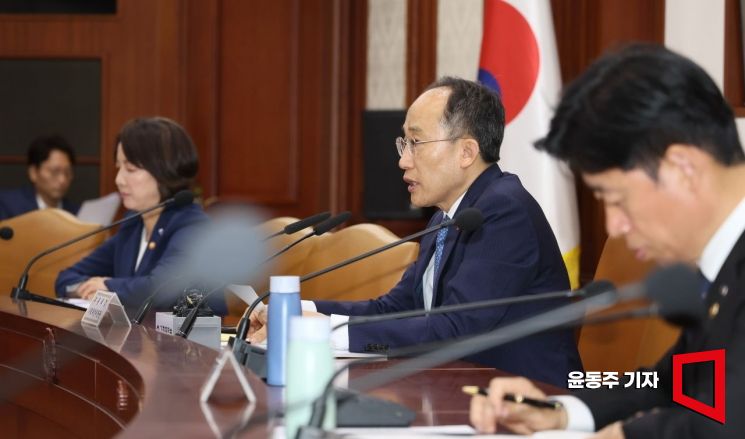 Deputy Prime Minister for Economy Choo Kyung-ho is delivering opening remarks at the Ministerial Meeting on External Economy and the UAE Investment Cooperation Committee held at the Government Seoul Office in Jongno-gu, Seoul on the 2nd. Photo by Yoon Dong-ju doso7@
Positive Signs of Export Recovery... Enhancing Export Vitality
Meanwhile, Deputy Prime Minister Choo commented on Korea's exports, saying, "Although exports continued to decline in double digits due to a decrease in working days in May, some positive signs are emerging," and added, "It is expected that this export improvement trend will continue." According to the Ministry of Trade, Industry and Energy on the previous day, May exports decreased by 15.2% compared to the previous year, marking eight consecutive months of decline.
He emphasized, "Exports to China recorded the highest level this year, and semiconductor export volumes expanded despite price declines, improving exports compared to April," adding, "Automobiles and secondary batteries, including cathode materials, which are supporting exports this year, also continued their export growth, resulting in the average daily export amount in May exceeding $2.4 billion for the first time since October last year, showing improvement compared to April."
However, Deputy Prime Minister Choo said, "Considering ongoing external uncertainties such as the global economic slowdown, we will strengthen follow-up measures after the summit, such as attracting investment and expanding economic cooperation, and broaden the base of trade to enhance economic vitality and strengthen the momentum for export recovery."
At the same event, through the 2nd Korea-UAE Investment Cooperation Committee, Choo explained, "Since the announcement of the UAE's $30 billion investment plan in Korea at the Korea-UAE summit in January, the two countries have discovered investment opportunities worth $2 billion in just over four months," adding, "We will further strengthen investment cooperation to accelerate the inflow of UAE investment funds into Korea."
© The Asia Business Daily(www.asiae.co.kr). All rights reserved.
![Clutching a Stolen Dior Bag, Saying "I Hate Being Poor but Real"... The Grotesque Con of a "Human Knockoff" [Slate]](https://cwcontent.asiae.co.kr/asiaresize/183/2026021902243444107_1771435474.jpg)
















