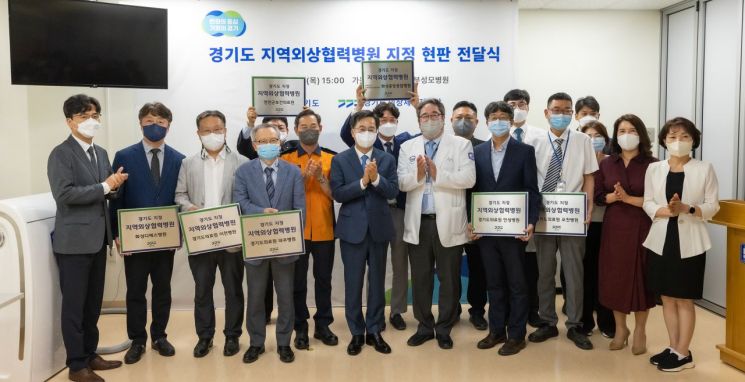
 Gyeonggi Province Governor Kim Dong-yeon is taking a commemorative photo after designating eight hospitals, including Hwaseong Central General Hospital, as regional trauma cooperative hospitals and presenting plaques at Uijeongbu St. Mary's Hospital of Catholic University on the 1st.
Gyeonggi Province will significantly expand the number of regional trauma cooperative hospitals that assist with emergency treatment and patient handover for severe trauma patients being transported to regional trauma centers, increasing from the existing 2 to 8 hospitals.
Regional trauma cooperative hospitals play a role in ensuring that severe trauma patients do not die during long-distance transport by providing urgent care such as airway maintenance, and then transferring the patients to regional trauma centers via helicopter or ambulance.
On the 1st, Gyeonggi Province announced on the 2nd that it delivered designation certificates and plaques for regional trauma cooperative hospitals to 8 hospitals, including Catholic University Uijeongbu St. Mary's Hospital and Hwaseong Central General Hospital.
Previously, Gyeonggi Province was the first in the nation to designate Gyeonggi Provincial Medical Center Icheon Hospital and Paju Hospital as regional trauma cooperative hospitals in December 2021. This time, Hwaseong Central General Hospital, Hwaseong DS Hospital, Yangpyeong Hospital, Gyeonggi Provincial Medical Center Anseong Hospital and Pocheon Hospital, and Yeoncheon County Health Medical Center?6 hospitals in total?were newly designated as regional trauma cooperative hospitals.
The newly designated hospitals are areas with a high incidence of severe trauma patients but face difficulties in ground transport to regional trauma centers or have weak emergency medical infrastructure. After establishing transport and treatment guidelines together with the Gyeonggi Trauma System Support Group and fire services, the newly designated cooperative hospitals plan to begin full operation starting in October this year.
Gyeonggi Governor Kim Dong-yeon said, "Recently, a patient in his 70s in Yongin was involved in a traffic accident and, after searching 11 hospitals, unfortunately passed away. It was very regrettable." He added, "Today, it seems a good system has been created to reduce medical disparities between regions and to treat severe trauma patients. I ask the regional trauma centers to build good cooperative relationships with the newly designated hospitals."
He continued, "How to expand public medical centers in the northern Gyeonggi region, which is most vulnerable to severe trauma, cerebrovascular, and cardiovascular issues, is a matter that requires considerable thought," and emphasized, "We will quickly gather expert opinions to create a sustainable northern medical system. Strengthening medical services is essential and core to the development of the northern region."
To reduce trauma mortality among residents, Gyeonggi Province began operating specialized severe trauma treatment centers, regional trauma centers, in two locations in southern and northern Gyeonggi: Ajou University Hospital in 2016 and Catholic University Uijeongbu St. Mary's Hospital in 2018.
Since then, the province has actively promoted projects to reduce trauma mortality among Gyeonggi residents, including ▲introducing emergency medical helicopters (Doctor Helicopters) to shorten transport times for severe trauma patients (2019), ▲launching the Gyeonggi Trauma System Support Group for policy support (2019), ▲establishing the nation's only 24/7 Doctor Helicopter transport system (2022), and ▲piloting regional trauma cooperative hospitals in Icheon and Paju for the first time nationwide (2022).
As a result of these efforts, the preventable trauma mortality rate in Gyeonggi Province, analyzed by the Gyeonggi Trauma System Support Group, decreased by 5.0 percentage points from 17.0% in 2017 to 12.0% in 2020.
This means that 50 more lives can be saved out of every 1,000 trauma deaths.
Going forward, Gyeonggi Province plans to expand regional trauma cooperative hospitals, which will serve as the focal point of the trauma system, to the northern Gyeonggi region where geographic conditions and resources are poor. The goal is to reduce the preventable trauma mortality rate in northern Gyeonggi, which was 16% in 2020, to the Gyeonggi Province average of 12%, and to establish an organic relationship with fire services and others who are the main players in the transport system to reduce blind spots in trauma care.
© The Asia Business Daily(www.asiae.co.kr). All rights reserved.
![Clutching a Stolen Dior Bag, Saying "I Hate Being Poor but Real"... The Grotesque Con of a "Human Knockoff" [Slate]](https://cwcontent.asiae.co.kr/asiaresize/183/2026021902243444107_1771435474.jpg)
















