Pursuing Passage of 74 Regulatory Reform Bills
Yoon's Core Agenda 'Regulatory Reform' Tasks
Many Pending in National Assembly... Persuading Standing Committee Chairs and Ruling-Opposition Whips
Prime Minister Han Duck-soo is set to engage in persuasion efforts to secure the passage of 74 regulatory reform bills centered on easing economic penalties. He plans to meet directly with the chairpersons of each standing committee and the ruling and opposition party floor leaders within this month to emphasize the necessity and urgency of passing the bills.
According to the Prime Minister's Office on the 2nd, Prime Minister Han recently instructed at an executive meeting that the regulatory reform bills with slow progress in the National Assembly be categorized by standing committee. He also expressed his intention to personally present the purpose of easing economic penalties and the blueprint for regulatory reform to each relevant standing committee, and to engage directly in detailed legislative persuasion and negotiations.
The Prime Minister's proposal to make direct contact with each standing committee comes as the general election period approaches. If the extreme confrontation and political strife between the ruling and opposition parties continue for a long time as they are now, the processing of many contentious regulatory reform bills could be delayed. Lawmakers, mindful of voter sentiment, have been reluctant to review reform bills with sharp conflicts of interest or pass contentious bills around the time of the general election and the national audit. This leads to paralysis of legislative functions and delays in policy decision deadlines.
The Prime Minister's Office also plans to meet with Kim Do-eup, the chairman of the Legislation and Judiciary Committee, to urge the swift processing of bills pending in that committee if necessary, including those related to economic penalty easing and involving the chairpersons and floor leaders of the relevant standing committees. Since the economic penalty easing bills span most committees such as the Industry and Trade Committee, Political Affairs Committee, Science, ICT, Broadcasting and Communications Committee, Strategy and Finance Committee, Culture, Sports and Tourism Committee, and Environment and Labor Committee, it is expected that the Prime Minister will sequentially contact the floor leaders of more than ten standing committees.
Previously, the government viewed existing economic penalty laws as suppressing corporate activities and negatively affecting foreign investment attraction, and has been pushing for regulatory improvements. The government’s stance is that if even minor compliance obligations are controlled by penalties based on a penalty-centric approach, it could become an obstacle to private economic activities.
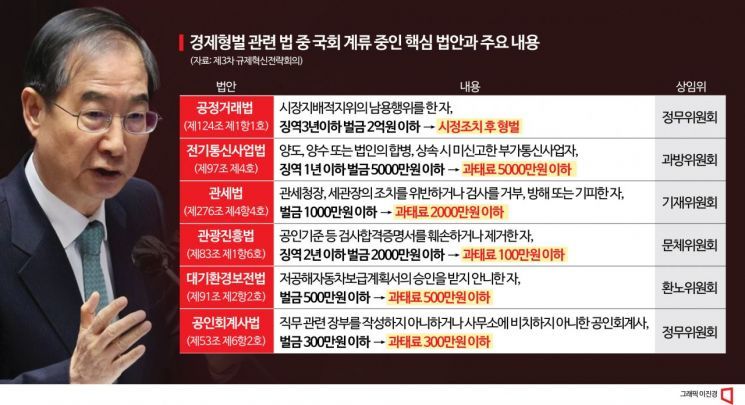
A representative example is the penalty provisions of the Fair Trade Act. Excessive penalization for violations under the Fair Trade Act has been criticized by the business and legal communities, calling for a reduction in the scope of criminal penalties. Accordingly, the government is working to improve the penalty provisions stipulated in Article 124, Paragraph 1, Subparagraph 1 of the Fair Trade Act. This provision punishes abuse of market dominance with imprisonment of up to three years or a fine of up to 200 million won. The government plans to amend this to require corrective measures first before imposing penalties in cases where a market-dominant business operator unfairly obstructs the participation of other businesses, so-called ‘exclusionary abuse.’ This also requires bill review through the National Assembly’s Political Affairs Committee.
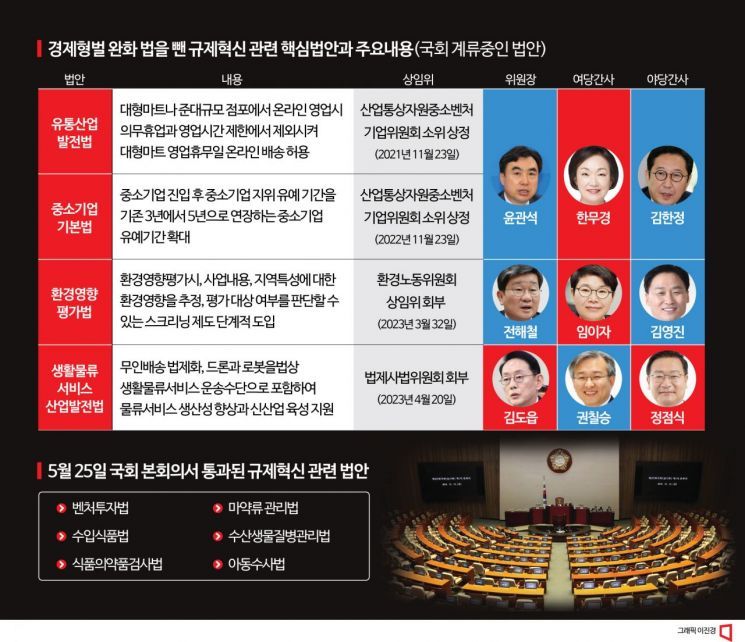
Including the easing of economic penalties, there are currently a total of 74 regulatory reform bills stalled in the National Assembly. As of April, there were 80 bills, but six bills (Venture Investment Act, Narcotics Control Act, Imported Food Act, Aquatic Animal Disease Control Act, Food and Drug Inspection Act, and Child Investigation Act) were passed at the plenary session on May 25.
This includes the ‘Distribution Industry Development Act,’ which allows online delivery on days when large supermarkets are closed. This bill is currently under review by the Industry, Trade and Small and Medium Enterprises Committee subcommittee. Some opposition lawmakers still oppose it, causing the bill’s discussion to stagnate. The ‘Framework Act on Small and Medium Enterprises,’ which extends the SME grace period from three to five years, and the ‘Environmental Impact Assessment Act,’ which improves the stepwise procedure to determine whether an environmental impact assessment is required, are also pending. The ‘Living Logistics Service Industry Development Act,’ which aims to legalize unmanned delivery, has passed the Land, Infrastructure and Transport Committee and been referred to the Legislation and Judiciary Committee, but its submission to the committee has been delayed. The Prime Minister’s Office plans to directly persuade to prevent delays in the passage of regulatory reform bills agreed upon by both ruling and opposition parties.
Prime Minister Han’s active stance on passing regulatory reform bills stems from his judgment that regulatory policies intended to correct market failures are instead causing greater costs. He has repeatedly emphasized that ‘regulatory innovation is directly linked to raising the economy’s potential growth rate.’ A Prime Minister’s Office official said, “If the laws are not amended, the effects of regulatory innovation cannot be felt. The Prime Minister is strongly determined to persuade the legislature so that regulatory reform bills, starting with those with little disagreement between ruling and opposition parties, can be passed quickly.”
© The Asia Business Daily(www.asiae.co.kr). All rights reserved.


















