The Hidden Side of the World's No.1 Franchise Kingdom
11,844 Domestic Franchise Brands
More Than 3,000 in the US and 1,300 in Japan
COVID-19 Startup Boom, Record 330,000 Franchise Stores
79.7% of Brands in Food Service Sector
Franchise Headquarters Growing, Store Owners' Profit Margins Declining
Need for Win-Win Solutions Between Headquarters and Store Owners, Brand Growth
South Korea is the country with the most franchise brands in the world. It is truly a 'kingdom' with about 10,000 franchise brands, surpassing the United States, which owns famous global franchise brands like McDonald's and KFC (around 3,000), and Japan, a paradise for food lovers (around 1,300). The industries are diverse, including not only food service such as coffee, chicken, tteokbokki, and pizza, but also unmanned convenience stores, laundromats, yoga studios, massage shops, and baseball practice centers. There are 330,000 franchise owners who have opened franchise stores trusting these brands. The biggest advantage of franchises is that you can easily start a business whenever you want. Starting a business requires experience and many trials and errors, which take considerable time and cost, but the franchise headquarters develop menus and products on behalf of the franchisees and supply ingredients on time, making it more convenient than independent startups. However, behind this convenience lie risks such as market saturation and limited flexibility. Experts emphasize that headquarters should research and devise ways and operational strategies to coexist with franchisees.
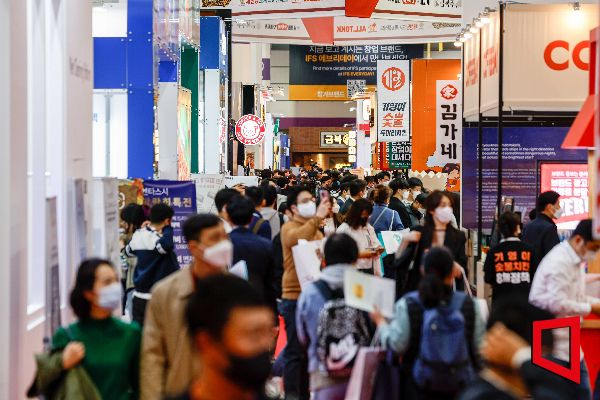 Visitors attending the 'IFS Franchise Seoul' held last year at COEX in Gangnam-gu, Seoul, are viewing various franchise companies. Photo by Jinhyung Kang aymsdream@
Record High 330,000 Franchise Stores... Profit Margins for Each Owner Decline
According to the Fair Trade Commission on the 2nd, the number of domestic franchise brands reached 11,844 as of the end of 2022 based on registered disclosure documents. The number of domestic franchise brands, which was only 5,741 in 2017 before COVID-19, gradually increased to 6,052 in 2018 and 6,353 in 2019, then grew by 58.1% from 7,094 in 2020 to 11,218 in 2021 as the impact of COVID-19 began.
With the enforcement of the mandatory direct store operation bill on November 19, 2021, only brands with experience operating direct stores for more than one year can register as franchise brands. As a result, the total number of brands last year increased by only 5.6% compared to the previous year, returning to the average growth rate, but the number of domestic franchise brands is still on the rise. By industry, food service accounts for the highest proportion at 79.7%, followed by service industries at 15.2% and wholesale and retail industries at 5.1%.
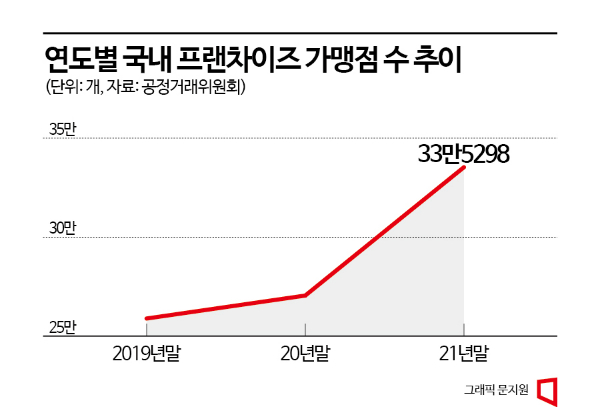
As the number of franchise brands increased, the number of franchise stores naturally grew as well. According to the 2022 franchise business status based on disclosure documents by the Fair Trade Commission, the number of franchise stores nationwide as of the end of 2021 was 335,298, a 24.0% (64,813 stores) increase from the previous year, surpassing 300,000 for the first time. The problem is that while the headquarters have grown with the increase in franchise stores, the profit margins of franchise owners have not increased but rather decreased.
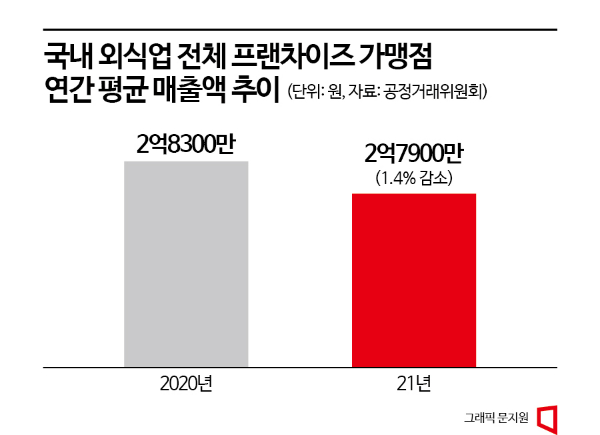
As of the end of 2021, the average sales of all franchise stores were about 310 million KRW, showing little change from the previous year, but food service and wholesale/retail industries each decreased by 1.4% due to social distancing policies caused by COVID-19. Among them, the average sales per food franchise store were 279 million KRW, down 1.4% from the previous year, with chicken, Korean food, and pizza decreasing by 2.2%, 6.0%, and 6.5%, respectively.
Abuse and Unfair Trade from Headquarters to Franchise Stores Also Rampant
Considering soaring prices and increases in electricity and gas bills, the situation for self-employed franchise owners is becoming even more difficult. On top of that, some franchise headquarters have been criticized for abusing their power by supplying goods to franchise stores at prices higher than market prices or by shifting marketing costs onto them.
At a recent 'Franchise and Agency Unfair Damage Testimony Meeting' held at the National Assembly Members' Office Building in Yeouido, Seoul, the beef brisket specialty franchise Ichadol was reported to have designated company-logoed wet wipes, napkins, and paper cups as 'essential items' and forced franchise stores to purchase them. Testimonies revealed that even items unrelated to store operations, such as hair ties, mirrors, and bag hooks, were included in these essential items, causing public outrage inside and outside the industry. According to Ichadol franchise owners, the products supplied as essential items by the headquarters were priced significantly higher than those sold in the market. For example, 1,000-piece wet wipes were sold at about 29,000 KRW, nearly twice the market price of 15,000 KRW, and 8,000-piece napkins were supplied at 34,000 KRW, 50% higher than the market price of 23,000 KRW.
Franchise owners complain that headquarters generate profits by shifting damages onto franchise stores. Although they are in a subordinate position to the headquarters, they have no proper collective bargaining rights or negotiation rights, leaving them vulnerable to unilateral abuse.
Previously, Mega Coffee became the center of controversy when the headquarters hired soccer national team player Son Heung-min as a promotional model at the end of last year and demanded that franchise stores bear half of the total advertising cost of 6 billion KRW, including the advertisement. In response, some Mega Coffee franchise owners are currently discussing forming a franchise owners' association.
Fair Trade Commission Takes Action... Focus on Improving 'Essential Item Designation' Practices
As cases of unfair damage between franchise headquarters and franchise owners accumulate, the Fair Trade Commission has taken action. The commission has identified 'improving essential item transaction practices' as its top priority this year and announced plans to revise the standard disclosure documents for franchise headquarters.
This improvement aims to prevent franchise headquarters from excessively designating essential items and unilaterally raising prices to earn differential franchise fees. Essential items refer to products supplied by franchise headquarters to franchise stores, such as sauces and cooking oil, to maintain franchise uniformity. Differential franchise fees mean the distribution margin franchise owners pay for essential items, which exceed the appropriate wholesale price.
On the 8th of last month, at the 'Fair Franchise Practice Campaign Launch Ceremony' held at the Korea Chamber of Commerce and Industry, Fair Trade Commission Chairman Han Ki-jung stated, "The commission will start an investigation into the food service industry, where many disputes over essential items occur, and will impose sanctions if unfair practices are found. We plan to improve related systems to promote transparent disclosure and reasonable designation and operation of essential items."
Professor Lee Eun-hee of Inha University's Department of Consumer Studies advised, "Franchise owners experience a decrease in operating profits due to their relationship with headquarters even when business is good, which is a problem. Headquarters should research ways to increase franchise owners' profit margins and move toward coexistence to reduce franchise store closures and ensure the survival of the brand itself."
© The Asia Business Daily(www.asiae.co.kr). All rights reserved.
![Clutching a Stolen Dior Bag, Saying "I Hate Being Poor but Real"... The Grotesque Con of a "Human Knockoff" [Slate]](https://cwcontent.asiae.co.kr/asiaresize/183/2026021902243444107_1771435474.jpg)













