Post-COVID-19 Workforce Recruitment Decline
Fails to Meet Increased Demand
"Due to Concerns from Creditors like Korea Development Bank," Some Say
A passenger opened the emergency exit of an airplane, causing other passengers to suffer from breathing difficulties. Over 200 passengers boarded and disembarked due to an aircraft malfunction. The plane even took off without loading the luggage of about 260 passengers. Foreign objects were found in the in-flight meal, breaking three passengers' teeth. Pilots are likely to go on strike for the first time in 18 years. All these incidents occurred within just one month at a single airline. Asiana Airlines is shaking.
Various interpretations have emerged regarding the continuous occurrence of incidents and accidents. Some say that after COVID-19, there was no workforce replenishment, so the airline could not prepare for the increased demand. There are also talks blaming the creditors such as KDB Industrial Bank. The management is said to be so preoccupied with 'reading the creditors' mood' that it is difficult to even take care of basic matters like safety and service.
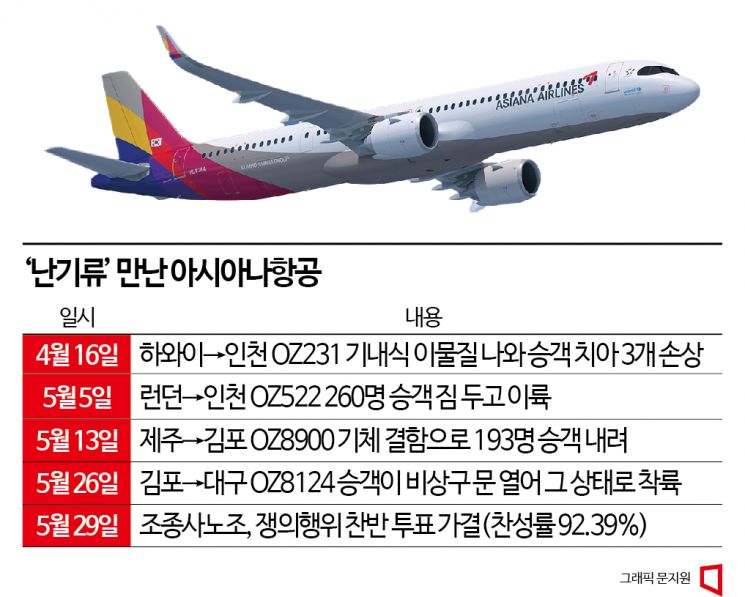
On the 26th, an Asiana Airlines passenger plane’s emergency exit opened while landing over Daegu Airport after departing from Jeju Airport. Passenger A (33), who was seated next to the emergency exit, pulled the lever and opened the door. He stated during the pre-arrest interrogation, “I opened the door because I felt suffocated and wanted to get off quickly.”
Also, on the 13th, a problem occurred with the slide fixing frame, an emergency landing device, on the Jeju-to-Gimpo flight, forcing 193 passengers who had boarded the plane to return to the airport. Although another aircraft was deployed and meal coupons were issued, the delayed notification caused inconvenience to the passengers. On the 5th, a passenger plane flying from London, UK, to Incheon took off without loading the luggage of about 260 passengers due to a problem with the power transmission device that prevented proper loading of luggage. Last month, on a flight from Hawaii to Incheon, foreign objects were found in the in-flight meal, resulting in passengers’ teeth being broken.
Internal conflicts are also escalating. The Asiana Airlines pilots’ union held a strike countermeasure committee inauguration ceremony on the 7th, the union’s founding anniversary, and will begin strike actions. A union official stated, “We plan to conduct a law-abiding struggle by properly following rules such as attendance briefings and reviewing flight preparation documents.” The reason pilots are striking is due to conflicts over this year’s wage increase rate. The pilots’ union proposed a wage increase in the 10% range, while the management offered a 2.5% increase. The union argued that wages have been frozen for the past 10 years, and that wages from 2019 to 2021, when COVID-19 caused difficulties, were also frozen as part of shared hardship, so now they must receive their fair share.
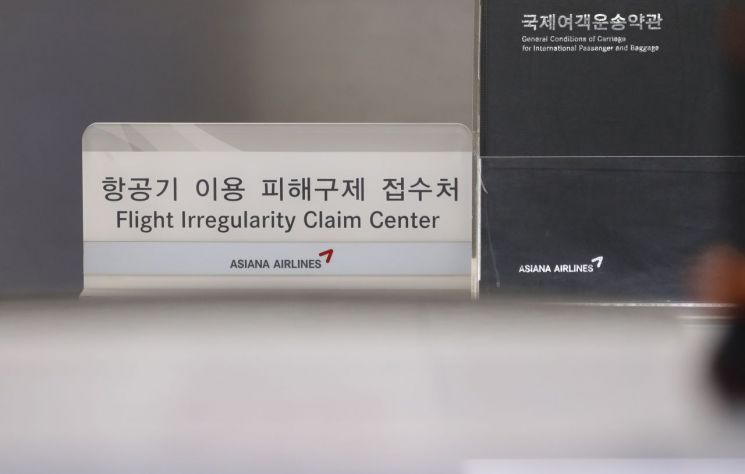
There are claims that excessive intervention by creditors such as KDB Industrial Bank triggered the dispute. A union official said, “While other airlines are raising wages by at least 10%, the management keeps repeating that it is difficult to raise salaries because they are under the creditors (Industrial Bank).” It is reported that the management proposed a 7% wage increase in October last year but it was all ‘rejected.’ Former Asiana Airlines CEO Jeong Seong-gwon presented 6%, 5%, and 4% increase proposals consecutively to the Industrial Bank but did not receive positive responses. There are even rumors that he was subjected to ‘insulting remarks.’ Jeong resigned in December last year for ‘health reasons.’
There is also an analysis that the root cause of all problems is the ‘lack of leadership.’ It is said that the management finds it difficult to demonstrate leadership in a situation where they must consider the creditors such as the Industrial Bank for all decisions, from the merger to wage increase rates. Professor Lee Geun-young of the Department of Aviation Operations at Korea National University of Transportation said that the management likely felt job insecurity during the merger process and added, “Because it is an environment where important aspects like ‘safety management’ in aviation cannot be properly managed, various accidents and difficulties in wage negotiations occur.”
However, the Industrial Bank is also in a difficult position. The company’s financial structure must be improved before the merger with Korean Air. Asiana Airlines received 3.6 trillion won in public funds from the Industrial Bank and the Export-Import Bank of Korea. However, its financial condition has not improved. The debt ratio in the first quarter of this year rose by 189.2 percentage points compared to the end of last year, reaching 1671.2%. Ultimately, the prerequisite for solving all problems is for the company to make money. The reason for a company’s existence is profit generation. Corporate officials who cannot generate profits are suffering.
© The Asia Business Daily(www.asiae.co.kr). All rights reserved.
![Clutching a Stolen Dior Bag, Saying "I Hate Being Poor but Real"... The Grotesque Con of a "Human Knockoff" [Slate]](https://cwcontent.asiae.co.kr/asiaresize/183/2026021902243444107_1771435474.jpg)

















