Presiding Over Export Strategy Meeting After Over Three Months... Focused Discussion on 'Cluster' Development
Urging Global Workforce and Research Collaboration... "Not Partnership but Alliance"
Government to Foster Global Standards Through Regulatory Relaxation and Targeted Support
President Yoon Suk-yeol stated on the 1st, "Economic crises must be overcome through productivity improvement, and the only way to improve productivity is through advanced science and technology." He indicated that advanced science and technology would be used as a foothold to expand export capabilities, identifying clusters?concentrated bodies where research and support institutions create knowledge and technology?as targets for selective and focused support. In particular, he promised detailed regulatory easing, saying, "To ensure the successful operation of clusters, unreasonable regulations must be boldly lifted, and a fair compensation system based on a free market economy must be legislated."
On the same day, President Yoon presided over the 5th Export Strategy Meeting at 'Seoul Startup Hub M+' located in Magok-dong, Gangseo-gu, Seoul, expressing the government's commitment to fostering global advanced industry clusters by stating, "The government's role is to lead investment using government finances to attract private investment."
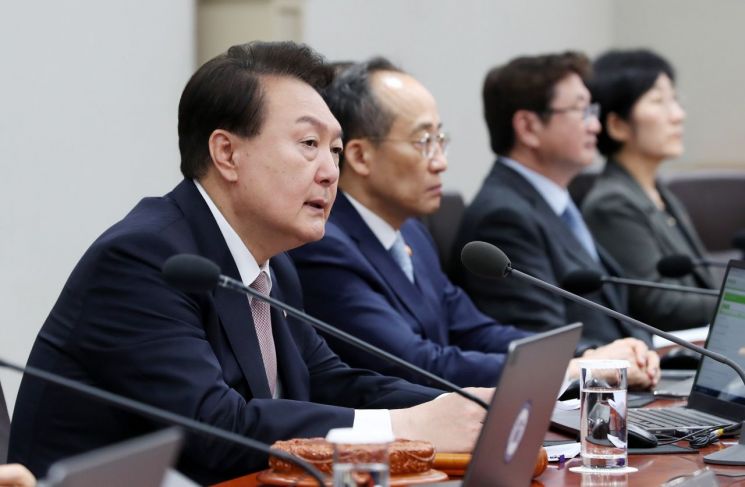
Presiding over Export Strategy Meeting after 100 Days... Choosing to Foster 'Clusters' to Expand Export Capabilities
This meeting was arranged based on discussions on the Boston cluster during President Yoon's state visit to the United States in April, aiming to establish a 'Korean-style cluster.' President Yoon explained, "We have held export strategy meetings focusing on support for companies and policy, but now we need to discuss strengthening advanced industry competitiveness to enhance our export capabilities."
The export strategy meeting, presided over by President Yoon 99 days after the 4th meeting on April 23, was aligned with the 'Advanced Industry Global Cluster Strategy Meeting.' This reflects the intention to intensively foster clusters as a new foundation for increasing exports. In the previous meeting, President Yoon set a goal to achieve 'export plus' this year, raising the annual export volume to $685 billion (approximately 890 trillion KRW).
President Yoon also linked advanced industries to national security. He said, "Whether in bio-digital fields or quantum science, advanced science and technology always attract the attention of defense and security officials who closely monitor how to develop and invest in these areas." He added, "Since national security is directly connected to advanced science and technology, we must consider how to share information with the private sector and how to broaden the scope of information sharing in a desirable way."
He also called for the activation of international exchanges of clusters based on an alliance concept beyond mere partnerships. President Yoon emphasized, "The Boston advanced industry cluster grew as a result of a fair compensation system that promotes innovation, combined with the government's leading strategy added to the industry-academia joint research ecosystem." He stressed, "Our clusters must also have an ecosystem where top professionals can collaborate organically."
He also urged the creation of research cooperation models. President Yoon said, "The government must also pay attention and invest significantly in the cooperation system among international research institutions so that clusters are not only domestic but also internationally connected." He added, "It is difficult to achieve good results by working only among ourselves. Our researchers must collaborate with overseas researchers and companies." He further elaborated, "The 'bio alliance' between Korea and Boston, discussed during the recent U.S. visit, should be concretized through digital bio research cooperation models between Seoul National University Hospital and MIT." He also conveyed the message that a fair market order and a fair compensation system based on it are essential to securing international competitiveness in industry. The implication is that only when market order and compensation systems are fair can top talents from various fields such as advanced industries, engineering, medicine, law, and finance gather and produce results.
Government Announces Regulatory Easing and Tax Support in Line with President Yoon's Directives... "Cluster Policies Have Been Inadequate So Far"
During the discussion on the same day, follow-up measures for cluster and bio achievements after the state visit to the U.S. were also discussed. Participants agreed on the need to create a world-class open and convergent startup ecosystem. They also expressed opinions that regulatory relief and large-scale investment are necessary to develop bio as a second semiconductor growth engine.
In line with President Yoon's directive for institutional improvement, the government announced measures such as easing regulations on resident business types and strengthening tax benefits and financial support for bio companies. The core is to avoid 'government-led quantitative growth' and induce 'private-led qualitative growth.' Instead of distributing funds across dozens of clusters, the government plans to select and intensively support competitive clusters. The goal is to improve the environment of innovative clusters based on 12 national strategic industries, including semiconductors, bio, and secondary batteries, to the highest level.
The background for the government's cluster fostering plan is the judgment that previous policies have not been effective. Currently, there are about 1,800 to 1,900 domestic clusters, including industrial complexes. However, none possess the high level of innovation seen in Silicon Valley. Kim Beom-seok, Director of Policy Coordination at the Ministry of Economy and Finance, evaluated, "If we assess our cluster policies, they have been characterized by budget-splitting, supplier-oriented approaches, and insufficient efforts toward advancement and self-sustainability."
President Yoon also visited Boston, home to the world's top bio cluster, and met with MIT scholars in April. At that time, he urged, "We must deeply consider what role clusters should play, where to prioritize the 30 trillion KRW national research and development funds, and how to ensure that this leads to private investment."
© The Asia Business Daily(www.asiae.co.kr). All rights reserved.
















