Ministry of the Interior and Safety's 'Alarm Non-Receipt Areas' Interpretation Confusion
"Major Issue as Trust in Government Agencies Becomes Difficult"
Regarding the false alarm disaster text message of the 'Alert Warning' sent to the Seoul area on the morning of the 31st of last month, the Seoul Metropolitan Government and the Ministry of the Interior and Safety (MOIS) are engaged in a blame game, raising suspicions about the management system.
Amid criticism that inconsistent message dispatch during an emergency caused confusion, concerns about the disaster system are also intensifying due to conflicting explanations from both sides.
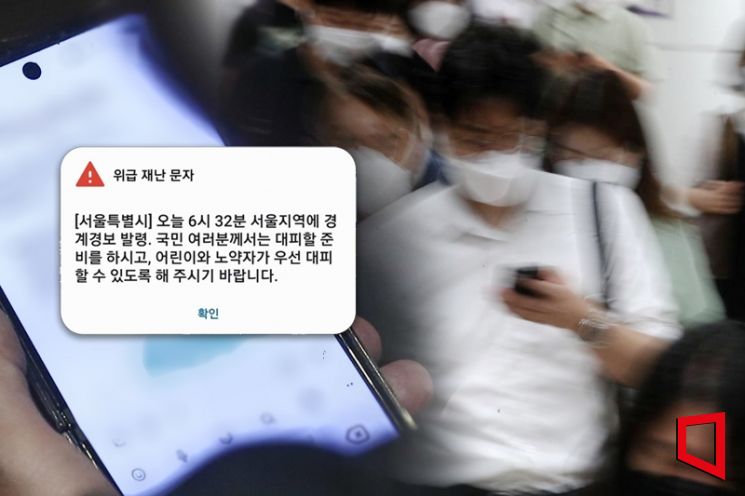
At around 6:29 a.m. on the 31st of last month, immediately after the North Korean projectile launch, the Seoul Metropolitan Government and MOIS alternately sent disaster text messages with conflicting content. On that day, residents in the Seoul area received urgent disaster messages three times over 44 minutes: 'Alert Warning Issued (Seoul Metropolitan Government) → False Alarm Correction (MOIS) → Alert Warning Lifted (Seoul Metropolitan Government),' causing confusion due to differences in message content.
Subsequently, the Seoul Metropolitan Government and MOIS engaged in a blame game. While MOIS claimed it was a false alarm by the Seoul Metropolitan Government, Seoul stated that it was a preemptive response in an emergency situation and denied that it was a false alarm.
The conflicting positions of the Seoul Metropolitan Government and MOIS appear to be due to communication confusion. After the news of North Korea’s projectile launch, MOIS issued an alert warning for Baengnyeong and Daecheong-myeon and broadcasted a command message stating, 'At the current time, an actual alert warning has been issued for Baengnyeong-myeon and Daecheong-myeon. Areas not receiving the alert should issue an actual alert warning on their own.'
The confusion arose from differing interpretations of the term 'areas not receiving the alert.' The Seoul Metropolitan Government judged that the Seoul area fell under 'areas not receiving the alert' and issued an alert warning via disaster text messages. However, MOIS’s position is that 'areas not receiving the alert' referred to 'areas within Baengnyeong-myeon and Daecheong-myeon that did not receive the alert,' and that Seoul misinterpreted this.
 Seoul Mayor Oh Se-hoon is greeting after stating the position of Seoul City regarding the emergency disaster alert text message sent by the city related to the space launch vehicle claimed by North Korea on the morning of the 31st at the city hall briefing room. 2023.5.31 Photo by Yonhap News
The Seoul Metropolitan Government tried to confirm whether the Seoul area was classified as an 'area not receiving the alert' by calling the MOIS Central Control Center but could not reach them, and judged the situation as urgent, thus sending the disaster text message. However, MOIS stated that the original command was sent commonly to 17 cities and provinces, but Seoul was the only one that sent the disaster text message.
Ham Eun-gu, a professor in the Department of Fire and Disaster Safety at Korea Open Cyber University, pointed out, "There is a system where MOIS distributes information to local governments and affiliated agencies when information comes from the Joint Chiefs of Staff, but it seems there are still issues with interpretation of wording and other deficiencies."
He added, "Later, when really important information comes like a boy who cried wolf, (the public) may lose trust in government agencies and instead turn to portals, which could cause a major problem," expressing concern that "ultimately, the public will suffer the damage."
© The Asia Business Daily(www.asiae.co.kr). All rights reserved.
![User Who Sold Erroneously Deposited Bitcoins to Repay Debt and Fund Entertainment... What Did the Supreme Court Decide in 2021? [Legal Issue Check]](https://cwcontent.asiae.co.kr/asiaresize/183/2026020910431234020_1770601391.png)
















