Completion in November with an Investment of Over 600 Million Won
Annual Dividend Yield of 4-6%
As part of Daegu City's and the government's carbon neutrality policy, citizen-led solar power plants 10 to 13 will be established in the parking lot and rooftop of the Daegu-Gyeongbuk Research Center of the Electronics and Telecommunications Research Institute (ETRI) located in Dalseong-gun, Daegu.
This project is distinctive from previous solar power plants in that the Electronics and Telecommunications Research Institute (ETRI), a government-funded research institute, sympathized with the purpose of establishing the power plant and actively participated as a land provider, making the construction of the power plant possible.
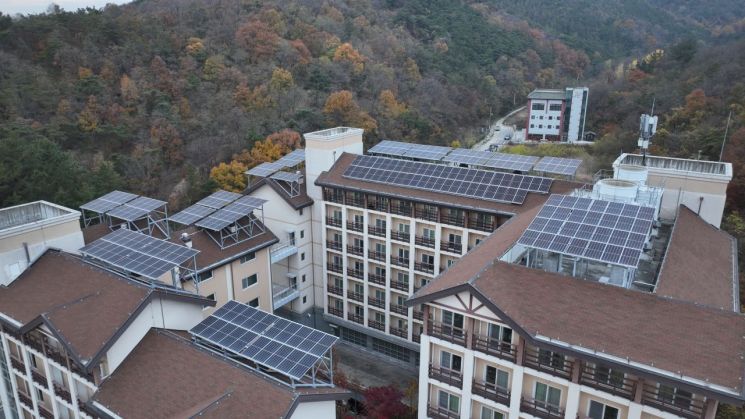
The power plants will be built on four ETRI sites (parking lot and rooftop) with a solar power generation capacity of 395 kW. The Dalgubeol Citizen Solar Power Cooperative plans to raise construction funds through member investments and citizen funds targeting citizens. Once fundraising is complete, construction will begin, starting with the 10th plant to be completed in August this year, followed by the completion of plants 11 to 13 by November.
Citizen solar power plants are projects where citizens (members) invest funds to lease land from public institutions or private entities by paying a fixed rent, install solar power facilities, and generate profits. The profits generated from electricity sales are distributed to the investing citizens at a rate of approximately 4% to 6% based on their investment amount.
To participate in the construction of citizen solar power plants, Daegu citizens must invest at least 100,000 KRW per person per account (up to 100 accounts, 10 million KRW limit) in the cooperative to obtain membership status. Afterward, they can participate in the citizen fund for power plant construction with one account (1 million KRW) per plant, up to a maximum of 20 accounts (20 million KRW).
As part of achieving citizen-led carbon neutrality by 2050, Daegu City established a long-term plan in March 2021 to activate the Daegu-type citizen solar power plants. Going forward, the city plans to discover various business models such as youth participation type, youth-led type, and silver solar type, aiming to install 500 sites (50 MW generation capacity) by 2050. The city will closely cooperate with related organizations such as civic groups, cooperatives, and the Daegu-Gyeongbuk regional headquarters of the Korea Energy Agency to expand the project.
Currently, in the Daegu area, since installing the first citizen solar power plant (generation capacity 30 kW) at the upper park of Suseong Lake in 2008, a total of nine plants have been installed and operated. All the electricity produced is sold to Korea Electric Power Corporation, contributing to Daegu City's carbon neutrality challenge.
Jung Hyun-soo, president of "Anyone Can Have Solar Power," which supports the construction and operation of citizen solar power plants, said, "Practicing carbon-neutral living is essential to respond to the climate crisis, and citizen-built solar power plants are expected to greatly contribute to Daegu's carbon neutrality."
Kwon Geum-yong, head of the Energy Industry Division of Daegu City, said, "We thank the Electronics and Telecommunications Research Institute for providing the land in agreement with the purpose of the project, and we will further promote citizen-led citizen solar power plant projects."
© The Asia Business Daily(www.asiae.co.kr). All rights reserved.

















