1-Day Advanced Industry Global Cluster Development Plan
Clusters Reach 1,900 but Results Remain Minimal
"Top-Level Cluster Development"... Residential Conditions Also Improved
"Core Technologies of Biopharmaceuticals" Added to National Strategic Technologies
Increased Concentration of Companies, Research Institutes ⇔ Legal, Accounting Institutions
 A view of Kendall Square centered around the Massachusetts Institute of Technology (MIT) in the eastern United States. Kendall Square is the core area of the Boston-Cambridge bio-cluster and is considered one of the most innovative areas on the planet. Photo by MIT
The government has decided to ease industry regulations to allow business support service companies such as legal and accounting firms to move into clusters, and to strengthen tax benefits for advanced technologies by adding core technologies of biopharmaceuticals to national strategic technologies. This is intended to create a 'Korean version of Kendall Square' through the advancement of existing clusters rather than the previous method of government-led creation of new clusters. Kendall Square, known as the "most innovative 1 square mile (2.9 km²) on Earth," is a bio cluster in Boston, USA, housing over 1,000 bio companies and venture capital firms including Moderna and Pfizer, as well as universities, hospitals, startup spaces, coffee shops, restaurants, and parks.
Growing Clusters with a Private Sector-Led Quality Growth Strategy
On the 1st, the government discussed the 'Plan to Foster Advanced Industry Global Clusters' at the 'Advanced Industry Global Cluster Strategy Meeting (5th Export Strategy Meeting)' chaired by President Yoon Suk-yeol.
The plan focuses on avoiding "government-led quantitative growth" and instead inducing "private sector-led qualitative growth." Rather than distributing funds evenly across dozens of clusters, the government intends to select competitive clusters and provide concentrated support. The goal is to improve the environment of innovative clusters based on 12 national strategic industries, including semiconductors, bio, and secondary batteries, to the highest level.
The background for the government’s cluster development plan is the judgment that previous policies have not been effective. Currently, there are about 1,800 to 1,900 domestic clusters, including industrial complexes. However, none possess the high level of innovation seen in Silicon Valley. Kim Beom-seok, Director of Policy Coordination at the Ministry of Economy and Finance, evaluated, "Our cluster policy was characterized by budget-splitting, supplier-oriented approaches, and insufficient efforts toward advancement and self-sustainability."
President Yoon also visited Boston, home to the world’s top bio cluster, in April and met with MIT scholars. According to a written briefing from the presidential office, President Yoon said in his closing remarks that "We need to deeply consider what role clusters should play, where to prioritize the 30 trillion won scale of national R&D funds, and how to lead private investment going forward."
Easing Regulations and Increasing Tax Benefits... Securing Top Talent Starts with Urban Planning
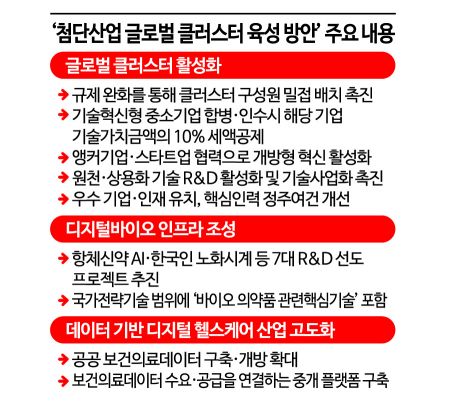
Accordingly, the government is moving to ease regulations to foster world-class clusters. First, to support local governments’ cluster development plans, regulations on land use changes and development/management plans will be relaxed. Previously, companies that did not fit the cluster’s nature were not allowed to move in. It was difficult to receive services such as legal, accounting, and consulting within clusters. Once regulations are eased, business support service companies will be able to enter core cluster sites. The government also plans to provide vouchers for startups to use these services.
Tax support within clusters will also be strengthened. The tax credit benefits for technology-innovative small and medium enterprises (SMEs) when conducting mergers and acquisitions (M&A) will be expanded. Under the current system, SMEs receive a tax credit of 10% of the technology value amount they hold. The government plans to adjust the formula so that companies can recognize a higher technology value amount. Additionally, companies investing in private mother funds or venture/startup companies will receive corporate tax deductions according to the amount invested, and the scope of tax reductions for foreign technicians or researchers employed by promising cluster institutions will be expanded.
Support measures for attracting external top talent have also been prepared. Institutions that attract overseas PhD-level researchers will receive significantly increased cash support. Foreigners employed by companies, research institutes, or universities within clusters will receive additional points when applying for top talent visas, and outstanding science and technology talents will receive extra points to encourage permanent residency and naturalization. For holders of the Science Card issued to foreign outstanding researchers, restrictions on stay and spouse employment will also be eased.
This policy also includes customized urban planning. There have been criticisms that cluster policies have focused only on site selection and company relocation, making it difficult to attract talent. The government will prioritize increasing dormitories within clusters led by local governments, expanding special supply opportunities, and reducing acquisition taxes on company housing. Additionally, urban design and public design experts will be involved in cluster planning to create attractions such as sightseeing and recreational spots. Plans also include improving educational conditions and creating complex cultural spaces where shopping and leisure activities are possible.
Adding 'Biopharmaceuticals' to National Strategic Technologies... Up to 35% Tax Credit
Another key pillar of this cluster development strategy is bio. The government will build digital infrastructure in the bio sector and advance the data-based digital healthcare industry.
First, to promote private investment by strengthening financial support for bio companies, core biopharmaceutical technologies such as animal cell culture and purification technologies will be added to the scope of national strategic technologies under the Restriction of Special Taxation Act. Currently, large and medium-sized companies investing in national strategic technologies can receive a 15% tax deduction on their investment amount, and SMEs can receive 25%. Especially this year, there is an additional 10% deduction on the increase compared to the average investment amount over the past three years, so the tax credit benefit can reach up to 35% for SMEs.
Furthermore, a mega fund of about 1 trillion won will be established by 2025 to invest in the entire cycle of innovative biopharmaceuticals, including R&D, clinical trials, exports, and M&A, such as the 'Global Open Innovation Fund (200 billion won + α)' which focuses on joint research and technology commercialization between domestic and overseas pharmaceutical companies and research institutes.
The COVID-19 mRNA (messenger RNA) vaccine, rapidly developed within a year based on data analysis, is a major success case of digital bio and has become a turning point for bio overall, including new drug development. To create similar success stories domestically, the government will promote seven leading digital bio R&D projects, including 'Antibody Design AI' for rapid design of next-generation drugs and the 'Doctor Answer 3.0' project for predicting and managing rare diseases and cancer through genetic testing.
The government will also promote the 'Boston-Korea Project' to strengthen global cooperation in digital bio. This project aims to develop technology and train personnel through joint research between leading research institutions in Boston, USA, which have solid know-how and research capabilities based on successful cases, and domestic hospitals possessing abundant medical data (East Asian data).
Additionally, the government plans to mandate the opening and sharing of bio data funded by national finances in the second half of this year, revise guidelines to promote private sector use of health insurance data, and open data. Customized incentives will be introduced to promote standardization of electronic medical records (EMR) data in private medical institutions, and an intermediary platform connecting supply and demand for healthcare data will be established.
© The Asia Business Daily(www.asiae.co.kr). All rights reserved.


















