Government to Build National Integrated Bio Big Data for 1 Million People by 2032
Prompt Introduction of Simplified Claims for Indemnity Insurance Planned
Medical Community and Civil Society Express "Concerns Over Data Leakage"
Another key aspect of the government’s ‘Advanced Industry Global Cluster’ development plan announced on the 1st is the opening of medical data. Although high-quality medical data has been secured based on the National Health Insurance and excellent hospital infrastructure, its disclosure and utilization have been extremely limited due to the sensitive personal information it contains. The government’s plan is to significantly open this data to medical institutions and companies through the establishment of public health medical data and to lead to research and the development of innovative products and services tailored to Korean characteristics.

Building an ‘Integrated Big Data’ of 1 Million People
The government plans to collect and build a ‘National Integrated Bio Big Data’ containing clinical, genomic information, and personal health information of 1 million people by 2032. Through this year’s pilot project, data from more than 25,000 rare disease and genomic epidemiology survey subjects, which have already been built, will be disclosed in the first half of the year, and data built every three years will be sequentially opened. Specifically, the plan is to build about 450,000 clinical and rare disease genomic data by 2026, followed by 1 million cases by 2029, and to fully open the integrated data by 2032.
The scope of diseases targeted for the construction of the ‘K-CURE’ data created by the Ministry of Health and Welfare will also be expanded. K-CURE is a health medical data model integrating clinical and cancer public libraries, currently holding public and clinical data on 10 types of cancer. Cardiovascular and respiratory diseases will be added by 2026, and standardized clinical information on the top 10 cancers specialized for Koreans will be gradually built and opened within each medical institution’s cloud. The collected data can be used for disease-specific policy research at medical institutions and research facilities. In addition, data collected and produced through national research and development (R&D) projects and database (DB) construction projects will be mandated to be opened and shared starting from the second half of this year, and guidelines of the National Health Insurance Service and the Health Insurance Review & Assessment Service will be revised to promote private sector use of health insurance data and expand data opening.
Creating a ‘Virtuous Cycle’ to Induce Voluntary Private Sector Data Opening
The plan also includes building a data ecosystem where private companies and medical institutions can voluntarily open and utilize data. First, to promote the standardization of electronic medical records (EMR) in medical institutions, the government will activate a certification system and introduce customized incentives such as additional points when supporting national projects. Furthermore, the scope of genomic information testing and utilization will be expanded, and the range of direct-to-consumer (DTC) genetic testing, which allows medical consumers to apply for tests directly to testing companies without going through medical institutions, will be continuously expanded.
The establishment of a ‘broker platform’ connecting the supply and demand of health medical data is expected to increase the convenience of utilizing medical data and create a virtuous cycle with more active use. Considering the sensitivity of the data, the public institution Health and Medical Information Service will support data exploration, matching, and analysis, and monitor appropriateness through pseudonymization and other methods. After a pilot introduction centered on clinical data from the ‘Medical Data-Centered Hospitals,’ which currently involve 41 medical institutions, participation will be gradually expanded to private hospitals.
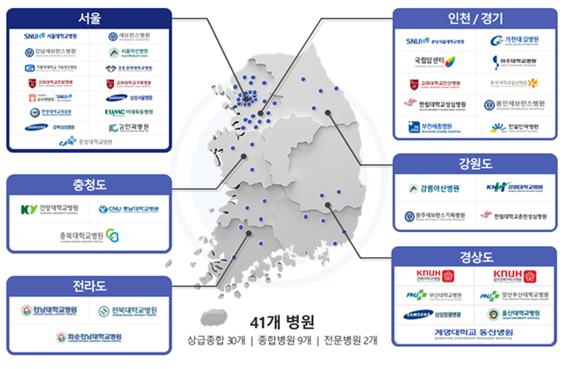 Participation Status of Medical Data-Centered Hospitals. [Data provided by the Ministry of Health and Welfare]
Regulatory Improvements such as Simplified Claims for Actual Loss Insurance... Key Issue: Opposition from Medical Community and Civil Society
Efforts to improve related systems and infrastructure using health medical data will also accelerate. The ‘third-party transmission request right’ will be introduced first this year for data held by public institutions with low sensitivity, and the transmission request right for personal medical data will be introduced from next year. To expedite the introduction of computerized claims for actual loss insurance, related legal amendments will also be promptly pursued.
However, there are concerns from the medical community and civil society regarding the rapid opening of medical data. The Korean Medical Association, the Korean Hospital Association, and the Korean Dental Association jointly issued a statement opposing the bill related to simplifying actual loss insurance claims, stating, “We firmly oppose any bill that prioritizes the interests of private insurance companies over the convenience of the public.” The Free Medical Movement Headquarters also criticized, saying, “Medical information is among the most sensitive information that can easily identify individuals and causes serious problems if leaked,” and “Transferring citizens’ medical and health information for private insurance is an act that directly infringes on the public interest.” Since medical data contains sensitive personal information, the future challenge is to prevent leaks and ensure it leads to actual medical service and industry development. A Ministry of Health and Welfare official said, “Patient medical records are sensitive, so utilizing medical data is premised on thorough and safe pseudonymization and use,” adding, “We will create a system for safe utilization and gradually expand it.”
© The Asia Business Daily(www.asiae.co.kr). All rights reserved.


















