The U.S. House of Representatives has passed a dramatically reached agreement to raise the federal government's debt ceiling in order to avoid default.
The Republican-majority House held a plenary session at 8:30 p.m. local time on the 31st and approved the agreement with 314 votes in favor and 117 against. The House is narrowly controlled by the Republicans with a margin of 222 to 213. The passage of the agreement in the House came dramatically just five days before the default deadline set by the U.S. Treasury.
Although there were internal objections within the Republican Party regarding the insufficient scale of budget cuts and opposition voices from hardline Democrats, the bill passed smoothly. President Joe Biden and House Speaker Kevin McCarthy, a Republican, had reached a principle agreement on raising the debt ceiling over the past weekend, but political uncertainty remained over whether the bill could pass without delay before the default deadline due to strong opposition.
Foreign media evaluated that by passing the debt ceiling increase agreement in the House, where opposition was concentrated, the U.S. has cleared the most important hurdle to prevent a default crisis. Since there is less opposition to the agreement in the Senate than in the House, the bill is expected to be processed smoothly. The Senate voting schedule is not yet decided, but as of now, a vote on the night of the 2nd is the most likely.
John Thune, known as the second-ranking Republican in the Senate, said in an interview with Bloomberg News on the same day, "We will ensure the bill passes by the night of the 2nd, ahead of the default deadline." If President Joe Biden signs the bill passed by the Senate before the default deadline, the controversy over the debt ceiling will end.
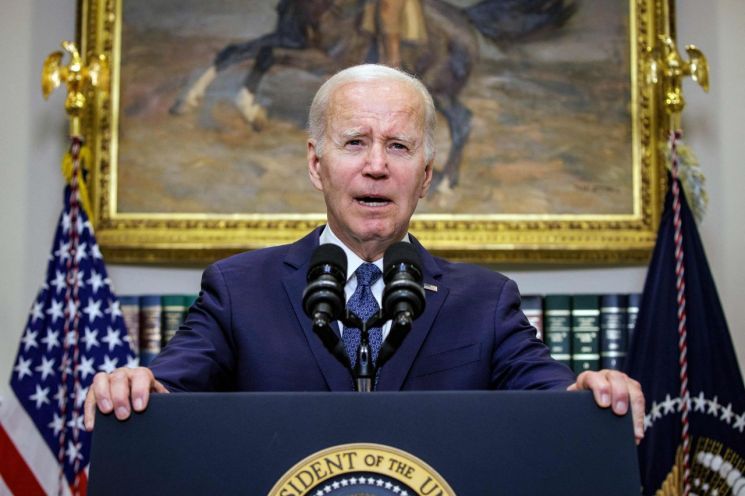 U.S. President Joe Biden spoke on the final agreement to raise the debt ceiling on the 28th of last month (local time) in the Roosevelt Room of the White House in Washington, DC.
 [Image source=AFP Yonhap News]
The bill agreed upon by both sides (Fiscal Responsibility Act of 2023) includes raising the debt ceiling for two years, freezing spending until next year, and increasing spending by 1% in 2025. Instead of immediately raising the federal government debt ceiling, which had already been reached at $31.4 trillion (approximately 42 quadrillion won) in January, the bill postpones the increase until January 1, 2025, while freezing discretionary spending (spending that the executive branch and Congress have discretion to budget and review) for the 2024 fiscal year, excluding items such as defense, and limits the budget increase to a maximum of 1% in 2025.
Considering the impact of a U.S. default crisis on the global economy, this bill is expected to soon pass the Senate, and the debt ceiling is likely to be raised again in the future as it has been in the past. However, the repeated breakdowns in negotiations between both sides and the last-minute chicken game that increased the default risk are expected to leave aftereffects such as a loss of credit in the U.S. economy and a decline in political leadership.
© The Asia Business Daily(www.asiae.co.kr). All rights reserved.

















