Waste Not Collected by Expedition Team Piles Up
"Cutting Company Logos and Discarding Tents"
Everest, the highest mountain in the world and known as the "dream mountain" for mountaineers, is suffering from trash and waste.
On the 1st (local time), foreign media such as 'Yahoo News' reported that 'Camp IV,' the highest camp on Everest, is covered with abandoned tents, waste, and other plastic trash.
This year marks the 70th anniversary of humans reaching the summit of Everest. On May 29, 1953, New Zealand climber Edmund Hillary and Sherpa Tenzing Norgay first conquered the summit of Everest, and since then, numerous expeditions have headed to Everest.
The problem lies in the increasing human footsteps to the summit, which has led to accumulating trash. Because of this, more mountaineers are concerned about environmental pollution on Everest.
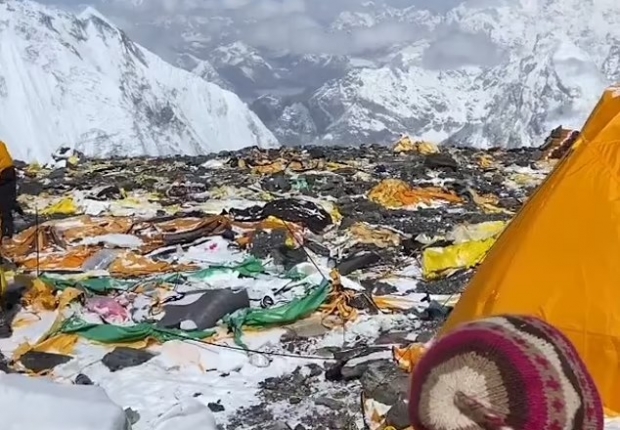
As an example, Sherpa Minga Tenzing, who has reached the summit of Everest nine times, recently posted a video on his social media (SNS) showing the trash-filled highest camp on Everest, calling it "the dirtiest camp I have ever seen."
He pointed out, "During the climb of Everest, I saw numerous trash items such as tents, oxygen tanks, bowls, spoons, and sanitary pads," and added, "I even saw several times climbing teams cutting off company logos and abandoning tents."
Garrett Madison, an American mountain guide who recently completed his 13th Everest ascent, raised his voice for the need for strict regulations to reduce waste on Everest. He emphasized, "There needs to be a monitoring procedure to ensure that every team collects their trash after climbing Everest."
The Nepalese government, which manages Everest, has introduced a $4,000 "waste deposit" system since 2014. Everest expeditions pay this amount before departure, and if they collect waste from the summit, the deposit is refunded. However, it is known to be very difficult for local officials to monitor the base camp at the Everest summit, which is at an altitude of 8,000 meters.
The Nepalese government designates May 29 every year as "World Everest Day" and conducts cleaning campaigns in the Himalayas. In 2019, 11 tons (t) of trash were collected, and in 2021, 27.6t were collected. Last year, the amount of trash collected in just two months reached 33.8t. The amount of trash is steadily increasing.
© The Asia Business Daily(www.asiae.co.kr). All rights reserved.

















