SK, LG, Hanwha, LS, and Others Across Industries
Mobilizing Future Growth Business Capabilities
Participating Through Mergers, Acquisitions, and Collaborations
Large corporations are increasingly entering the electric vehicle (EV) charging business regardless of their industry. Not only automakers but also solar power companies and oil refiners are actively expanding their businesses. Their business styles vary, including mergers and acquisitions and collaborations with other companies. There is a forecast that the global EV charging market will grow to about 450 trillion won in seven years. Many companies have chosen EV charging as their future core business.
Hanwha Q CELLS, responsible for Hanwha Solutions' solar power business, recently showcased EV chargers at the Busan Climate Industry International Expo. The business started in May last year. The plan is to supply electricity generated by solar modules to electric vehicles. To support this EV charging business, they also created a new brand called 'Hanwha Motive.' Hanwha currently operates or is constructing about 200 EV charging stations.
They are also conducting power brokerage business simultaneously. A Hanwha Q CELLS official said, “The domestic power market is shifting from a centralized system to a distributed energy model,” adding, “We are proactively entering the distributed energy business where power producers supply and trade electricity directly with consumers, evolving into a total energy solution company.”
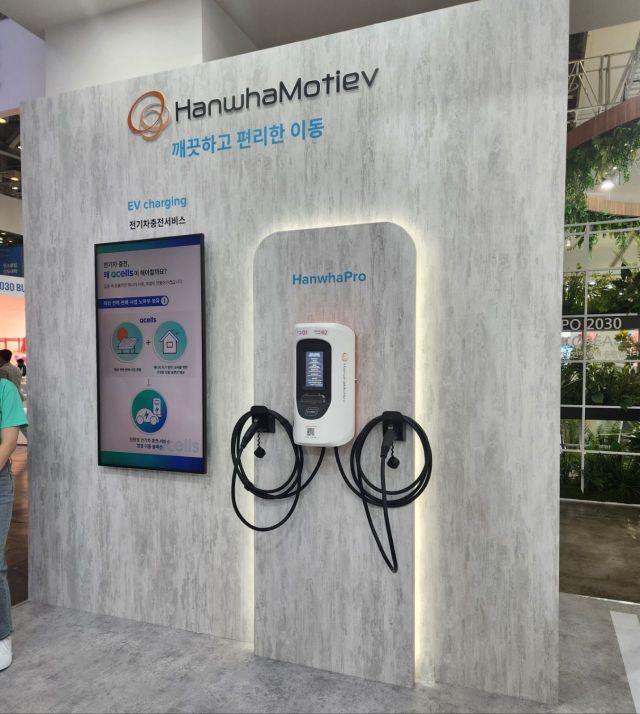 From the 25th to the 27th of last month, the electric vehicle charger 'Hanwha Motive' was exhibited at the Hanwha Solutions booth at the Climate Industry International Expo held in Busan.
 [Photo by Choi Seoyoon]
Some large corporations have entered this market early through aggressive mergers and acquisitions (M&A). SK and LG are representative examples. In April 2021, SK Group acquired a 55.5% stake in Signet V, an EV charging equipment company. The resulting company is SK Signet, which operates ultra-fast chargers.
SK Networks acquired SS Charger, the largest private rapid charger operator in Korea, and renamed it SK E-Link. This company operates about 2,000 chargers. SK Energy opened its first Energy Super Station in February last year at the Parkmi gas station in Geumcheon-gu, Seoul. This business operates under a government regulatory sandbox pilot program, and once regulations such as the Electricity Business Act are revised, it will be possible to immediately supply eco-friendly power generated by 300 kW fuel cells to gas station EV chargers.
LG-affiliated companies have also aggressively entered this business. LG Electronics acquired the charger company Apple Mango and renamed it Hypercharger. They are expanding the EV charging solution business in collaboration with GS. GS Caltex has already partnered with Korea Electric Power Corporation (KEPCO) since 2020 to provide charging services nationwide by installing over 8,600 KEPCO chargers at more than 2,800 gas stations and liquefied petroleum gas (LPG) stations.
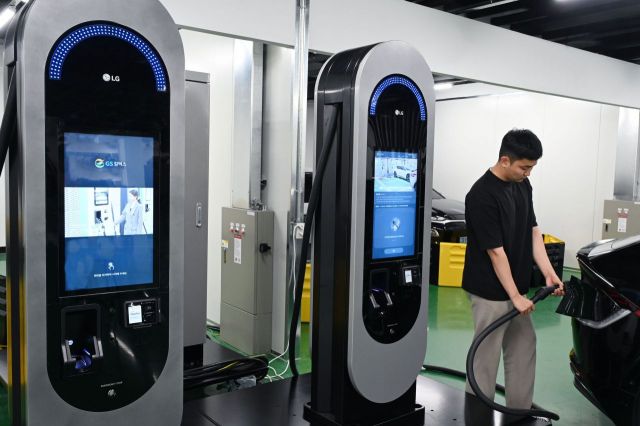 LG Electronics announced that it has officially launched its electric vehicle (EV) charging solution business, starting EV charger production on the 25th of last month. The photo shows an LG Electronics researcher demonstrating charging an electric vehicle using a Hi-Be Charger. [Photo by LG Electronics]
LS Group is mobilizing the capabilities of its key affiliates, including LS Cable & System, which manufactures high-voltage cables. LS Group Chairman Koo Ja-eun said at an executive seminar in July last year, “LS must find hidden opportunities in the materials and components sectors within the industrial ecosystem led by batteries, electric vehicles, and semiconductors,” adding, “By 2030, we will balance the ratio of existing and new businesses to 50:50.”
The holding company LS Corporation established LS E-Link with a 50% investment from E1 and started the EV charging business using about 350 E1 gas stations nationwide as bases. LS Cable & System is mass-producing Korea’s first 800V high-voltage EV winding (a form of coiled electric wire). They manufacture high-voltage harnesses (wiring that transmits electrical signals to various EV components) and battery packs for electric vehicles. LS Electric possesses stable smart power facility technology in the power distribution sector.
Hyundai Motor Company and Kia announced earlier this month that their affiliate, Korea Electric Vehicle Charging Service, will raise 30 billion won through a paid-in capital increase and plans to install 3,000 ultra-fast chargers nationwide by 2025.
The reason large conglomerates are actively engaging in the EV charging business through their affiliates is due to the bright market outlook. Although estimates vary by market research firms, analyses suggest that the global EV charging market will grow from as low as 100 trillion won to as high as 450 trillion won. German consulting firm Roland Berger forecasts that this market will grow 491% from $55 billion (about 77 trillion won) in 2023 to $325 billion (about 450 trillion won) in 2030.
However, the period when companies will actually generate profits is still a few years away. Analysts say that for companies to start making significant profits, the number of electric vehicles must reach at least 2 million. The Ministry of Trade, Industry and Energy has set a goal to achieve 2 million eco-friendly future vehicles in South Korea by the first half of 2027. As of the end of last year, the cumulative number of EVs in South Korea was about 402,000.
© The Asia Business Daily(www.asiae.co.kr). All rights reserved.


















