Activation of New Drug Development Through Affiliates and Subsidiaries
GC Cell, Dong-A ST, LG Chem, HLB, etc. Driving Efforts
Neurobo, Aveo... Direct Acquisition of Listed Companies Also Underway
As the domestic pharmaceutical and biotech industry grows, more companies are aiming to enter the global market. While companies like Celltrion are adopting strategies to increase profits at the sales stage through direct sales, recently, there has been a surge in cases of acquiring or investing in shares of U.S. companies or directly establishing companies in the U.S. to activate research and development (R&D) there. This strategy has become one of the core approaches for entering the U.S. market.
Artiva Therapeutics, a U.S. affiliate of GC Cell (GC셀), will reveal the first human dosing data of the chimeric antigen receptor (CAR)-natural killer (NK) cell therapy 'AB-101,' developed through technology transferred from GC Cell, at the American Society of Clinical Oncology (ASCO) held in Chicago from June 2 to 6.
Artiva was established in 2019 by the GC Green Cross Group to develop and commercialize NK cell therapies in the U.S. It received CAR-NK platform and other NK cell therapy candidate materials from GC Green Cross LabCell, the predecessor of GC Cell. As of the end of March, GC Cell holds a 35.6% stake, and combined with Green Cross Holdings' 19.3%, they hold a majority stake.
In addition to AB-101, GC Cell has licensed various CAR-NK therapies to Artiva for development, including 'AB-201' targeting human epidermal growth factor receptor (HER)-2, 'AB-202' targeting CD19, and 'AB-205' targeting CD5. With AB-101 taking the first step in human clinical trials, development appears to be entering a full-fledged phase. Furthermore, GC Cell's predecessor, GC Green Cross Cell, established a wholly owned subsidiary, Novacell, in 2020, which continues to develop CAR-T cell therapies targeting solid tumors.
Currently, besides GC Cell, various domestic companies such as Dong-A ST, LG Chem, and HLB are securing subsidiaries or affiliates in the U.S. to leverage these advantages. Overseas expansion through such affiliates or subsidiaries is evaluated to have roughly three major benefits.
First, it can serve as a foothold for U.S. Food and Drug Administration (FDA) approval, one of the biggest weapons for global market penetration. Conducting clinical trials directly in the U.S. from the early development stage allows for trials better aligned with regulatory frameworks. Since regulatory authorities in each country prefer different clinical trial methods and data standards, precise development from the early stages becomes possible. Another advantage is that companies can focus on 'selection and concentration' by designating core areas. Typically, pharmaceutical and biotech companies that have grown to a certain scale build pipelines for various diseases and often face difficulties in simultaneous development. However, by establishing corporations specialized in each disease, an environment focused solely on research for specific diseases can be created.
Lastly, technology exports, a crucial commercialization strategy, can be facilitated. When individual pipelines are outsourced to different companies, transferring the entire company?including related research personnel and assets?during the technology export process can make technology export smoother.
Dong-A ST secured management rights of Nasdaq-listed NeuroBo Pharmaceuticals, with which it had cooperated by licensing a candidate drug for diabetic neuropathy in 2018, through collaboration with E&Investment in 2021. In December last year, it acquired a 65.5% stake, making NeuroBo a subsidiary, and is focusing on developing treatments for non-alcoholic steatohepatitis (NASH), which has yet to see effective therapies.
To this end, in September last year, Dong-A ST transferred global development and sales rights outside Korea for 'DA-1241,' a type 2 diabetes and NASH treatment, and 'DA-1726,' an obesity and NASH treatment, which it had been developing. In exchange for these pipelines, it acquired convertible preferred shares of NeuroBo worth $22 million and secured a majority stake through additional share acquisition. Among these, DA-1241 recently received FDA approval for Phase 2 clinical trials targeting NASH patients, and DA-1726 is expected to apply for approval to start Phase 1 clinical trials in the second half of this year.
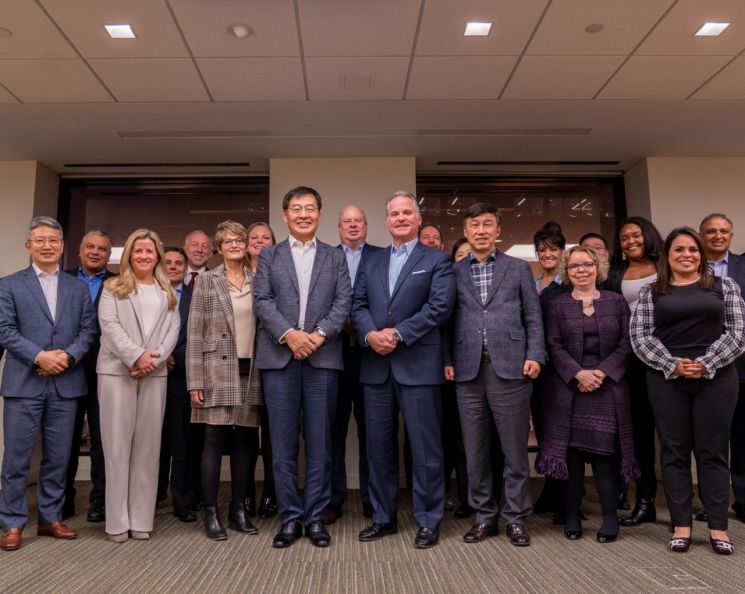 Vice Chairman Shin Hak-cheol of LG Chem (fourth from the left in the front row), Michael Bailey, CEO of Aveo (fifth from the left in the front row), Son Ji-woong, President of LG Chem Life Sciences Division (far left in the front row), and other executives and employees of LG Chem and Aveo are posing for a commemorative photo.
 [Photo by LG Chem]
LG Chem completed the acquisition of Aveo Pharmaceuticals, a cancer drug development company, in January after initiating the acquisition process last year. Aveo, also listed on Nasdaq since 2010, received FDA approval for 'Fotivda' as a kidney cancer treatment in 2021. Since Aveo's products are already on the market, its performance has been included in LG Chem's consolidated results since February, boosting LG Chem's life sciences division's first-quarter sales to 278 billion KRW, a roughly 28% increase year-on-year.
LG Chem plans to enhance its global competitiveness in oncology through Aveo. In the mid to long term, it intends to transfer preclinical-stage cell therapies and immune checkpoint inhibitors currently developed by its life sciences business division to Aveo. Under this strategy, LG Chem's life sciences division will focus on discovering promising oncology compounds, preclinical and early clinical development, and commercialization process development, while Aveo, with its clinical development and sales expertise in the U.S. market, will handle late-stage clinical development and commercialization of oncology pipelines. Notably, since Aveo already has a substantial sales network in the U.S., it plans to leverage this for direct sales.
HLB, which promotes a 'HLB ecosystem' and pursues new drug development through various affiliates, is considered particularly active in this strategy. Most of its U.S. expansion is conducted through subsidiaries. The targeted anticancer drug 'Rivoceranib,' aiming for FDA new drug approval as a first-line treatment for liver cancer, is managed in terms of approval and sales by its U.S. subsidiary Elevar Therapeutics. Recently, Elevar also obtained a pharmaceutical sales license from the New Jersey Department of Health. Another group new drug development company, HLB Therapeutics, operates subsidiaries for each core pipeline. The neurotrophic keratitis (NK) and dry eye treatment 'RGN-259' is developed by ReGenTree, and the glioblastoma anticancer drug 'OKN-007' is developed by Oblato.
© The Asia Business Daily(www.asiae.co.kr). All rights reserved.



















