The research team led by Professor Youngduk Seo of the Department of Chemistry at UNIST has discovered the phenomenon and principle of a sustainable ‘nanocrystal bidirectional optical switch,’ a core technology for the ‘3D optical quantum memory’ to be used in the quantum computing era.
This achievement was published online on May 31 (4 p.m. local time in London, UK; midnight on June 1 Korean time) in the world-renowned journal Nature (Impact Factor: 69.504).
UNIST stated that this research could lead to new advancements in fields such as 3D optical quantum memory, bio-nano probes, and super-resolution nanoscopy using avalanche nanoparticles (ANP).
In January 2021, the research team discovered the avalanche phenomenon and avalanche nanoparticle materials that emit extremely strong light amplified through a chain reaction within ultrafine nanocrystals doped with lanthanide metals, which was selected as a cover paper in Nature.
Dr. Changhwan Lee, a postdoctoral researcher at Columbia University who participated in that study, induced a chain reaction that emits extremely amplified light from avalanche nanoparticles.
Following the previous study, this applied research confirmed that avalanche nanocrystals have new characteristics and applications. Specifically, they discovered an optical switch phenomenon that can be artificially and infinitely repeatedly toggled on and off, and its application to ‘3D optical quantum memory.’
Organic dyes and fluorescent proteins have been widely used in various applications such as optical memory, nanopatterning, and bioimaging.
However, these fluorescent molecules have a fatal drawback of a short lifespan because they blink randomly when exposed to light and eventually completely fade away. This process is called ‘photobleaching.’
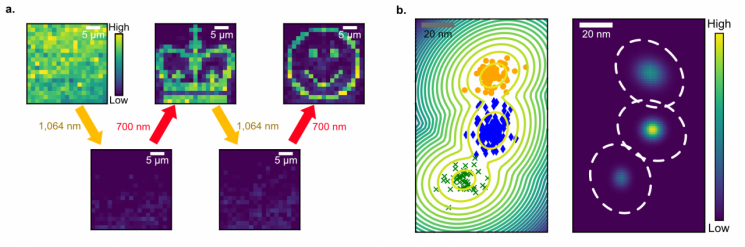 Results of repetitive write-erase experiments with various nanopatterns (left), super-resolution nanoimaging for implementing nanocrystal optical switches.
Unlike the photobleaching phenomenon of these fluorescent molecules, nanoparticles doped with lanthanide metals showed exceptional photostability.
In the paper titled “Indefinite and bidirectional near-infrared nanocrystal photoswitching,” published today in Nature, the research team successfully achieved this goal of photostability.
Using near-infrared light, they were able to repeatedly test the turning on and off of nanocrystals thousands of times in various surrounding environments and aqueous conditions without showing signs of thermal denaturation.
Dr. Changhwan Lee of Columbia University said, “We can control light with a single wavelength using a simple compact laser and also switch light to another wavelength. It is important to note that near-infrared light can deeply penetrate materials such as biological tissues and inorganic chemical substances while minimizing phototoxicity and light scattering.”
Additionally, the research team experimentally confirmed how the repeated writing and erasing of nanopatterns by particles on a 3D substrate can be utilized in potential applications.
Professor Youngduk Seo of the Department of Chemistry explained, “This indefinitely repeatable bidirectional optical switch will be developed into an optical quantum memory device to store the vast amounts of data generated by future ultra-high-performance quantum computers. It will have enormous data storage capacity while operating much faster, more accurately, and more precisely.”

The research team believes that the origin of the observed optical switch phenomenon so far is due to extremely small ‘atomic crystal defects’ that cannot be visualized even with advanced transmission electron microscopy (TEM).
These atomic crystal defects can shift the avalanche threshold of avalanche nanocrystals higher or lower and increase or decrease signal brightness by using different light wavelengths.
The team is studying potential applications in optical quantum memory, super-resolution nanoscopy, bio-nano imaging, and biosensors.
Moreover, together with machine learning and computational models, they plan to further enhance the properties of these crystals using a ‘nanoparticle synthesis robot’ at the Molecular Foundry of the Berkeley Lab.
Exploring whether other nanoparticles exhibiting similar photo-switching characteristics can be created is also a goal of future follow-up research.
This research was supported by the Global Research Laboratory program of the National Research Foundation of Korea under the Ministry of Science and ICT, the UNIST Research Settlement Fund project, and the Multidimensional Carbon Materials Research Group project of the Institute for Basic Science.
© The Asia Business Daily(www.asiae.co.kr). All rights reserved.

![Clutching a Stolen Dior Bag, Saying "I Hate Being Poor but Real"... The Grotesque Con of a "Human Knockoff" [Slate]](https://cwcontent.asiae.co.kr/asiaresize/183/2026021902243444107_1771435474.jpg)
















