[100 Days in Office] 6 of 16 Pledge Tasks Achieved
First Metropolitan Local Government to Introduce Step System for Sports Instructors Draws Attention
Active Efforts for Joint Bid of 2038 Gwangju-Daegu Asian Games
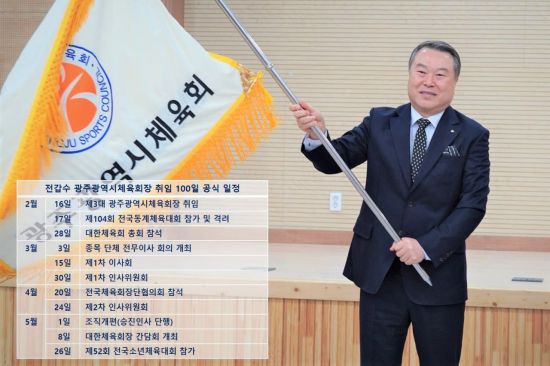
Jeon Gap-su, President of the Gwangju Metropolitan City Sports Council, who has reached his 100th day in office, emphasized, “Before being the president of the Gwangju Sports Council, I will unite the wisdom and strength of all sports organizations and athletes as their representative to develop Gwangju into an advanced sports city that coexists with its citizens.”
He also added, “Since all pledged projects are important for the development of sports in Gwangju, I will faithfully carry them out.”
During the past 100 days, President Jeon has participated in various events inside and outside the region, observed and encouraged competitions, toured sports facilities managed by the city sports council, and strengthened communication and harmony with executives and staff of sports organizations, club members, athletes, and coaches.
For the first time among metropolitan local governments, a seniority-based pay system was implemented to improve the treatment of 83 community sports instructors belonging to the five district sports councils in Gwangju. Previously, they had received poor treatment due to the single wage system not recognizing their experience, but to improve this, a living wage supplement was provided, the seniority system was introduced, and meal allowances were increased.
The introduction of the seniority system has been praised as a turning point that instilled pride in community sports instructors who guide sports activities at schools and sports facilities and are responsible for citizens’ health, significantly improving the quality of community sports services. Through active administrative consultations with the city, additional city funds were secured.
In February, a general assembly of delegates was held, increasing the number of executives (directors) from 50 to 70 and passing amendments to the articles of association to clarify disqualifications for executives. This laid the foundation for the advancement of sports administration.
After about three years of suspension due to COVID-19, meetings of the executive directors of sports organizations resumed, and a council of executive directors was formed. Park Do-seong, Executive Director of the Equestrian Association, was appointed as the council president. A space was prepared within the National Life Hall for executive directors to handle their duties or use as a meeting place, laying the groundwork for closer communication with sports organizations. Efforts will also be made to increase the monthly activity allowance for executive directors and to expand the number of specialized sports coaches for the National Sports Festival events.
Active steps have been taken to jointly bid for the 2038 Gwangju-Daegu Asian Games. On March 29, Jeon Gap-su, President of the Gwangju Sports Council, Park Young-gi, President of the Daegu Sports Council, and other officials from Gwangju and Daegu visited the Korean Sport & Olympic Committee to submit the Asian Games hosting plan.
At the joint workshop of the Korean Sport & Olympic Committee and the National Council of City and Provincial Sports Council Presidents, where about 100 people including Lee Ki-heung, President of the Korean Sport & Olympic Committee, city and provincial sports council presidents, and heads of member sports organizations gathered to discuss key issues in sports, Jeon requested, “Please support the sincere wishes and efforts of our local residents to ensure the Asian Games can be hosted.”
Discussions are also underway with Gwangju Metropolitan City to hold the National Sports Festival in Gwangju to expand sports infrastructure and promote regional sports development. Gwangju previously hosted the 88th National Sports Festival in October 2007, which was 16 years ago as of this year. The bid to host the National Sports Festival in Gwangju reflects the hopes of local sportspeople for sports revitalization and is being discussed through various channels including Gwangju Metropolitan City and the Korean Sport & Olympic Committee.
Furthermore, through multiple consultations with Lee Jeong-seon, Superintendent of Gwangju Metropolitan Office of Education, school sports facilities have been fully opened to citizens, with the current gymnasium opening rate for elementary, middle, and high schools approaching 97.7%.
Citizens can freely exercise during the opening hours designated by school principals, with 149 school auditoriums and 207 school playgrounds currently open to the public. The full opening of school sports facilities has alleviated inconveniences caused by insufficient sports facilities and greatly contributed to enhancing citizens’ quality of life and revitalizing community sports activities.
Additionally, by operating youth programs through sports clubs, the existing Gwangju-type sports clubs have been expanded to establish a virtuous cycle system among school, community, and professional sports. Three more clubs were selected in the Ministry of Culture, Sports and Tourism’s designated sports club contest, bringing the total to 10 designated sports clubs, a remarkable achievement.
In particular, in the “2023 Designated Sports Club Special Program and Professional Athlete Support Project” contest, a total of approximately 940 million KRW was secured, and programs are being organized and operated by skill level, such as beginner and intermediate classes, to allow anyone in the community to participate.
Preparations have begun for the successful hosting of the 2025 World Archery Championships scheduled to be held in Gwangju. Starting with the handover of the championship flag at the World Archery Championships in Germany this August, close cooperation with Gwangju Metropolitan City is being maintained, and efforts are being made to gather the capabilities of sportspeople for successful hosting, including facility inspections.
Moreover, among the 16 pledged tasks of the second elected term, six are being actively pursued, steadily achieving the fulfillment of promises. Continuous efforts are also underway to support the establishment of school sports teams and create jobs for sportspeople. In the mid to long term, plans are being formulated and implemented to establish the Gwangju Sports Scholarship Foundation, build a large-scale sports complex, and revise sports promotion ordinances for financial independence.
© The Asia Business Daily(www.asiae.co.kr). All rights reserved.

















