Increasing Anxiety Over Consecutive Platform Service Failures
Issue Identified via Twitter... Calls for Revival of Real-Time Search Rankings
On the 31st, Naver, the largest portal in South Korea, was temporarily paralyzed. This was due to a sudden surge in traffic caused by the accidental sending of disaster alerts. Following last year's KakaoTalk outage, repeated instability in major platform services has increased public anxiety. Users are turning to social networking services (SNS) to track real-time issues and are calling for the revival of real-time search terms (silgeom).
At around 6:40 a.m. that day, the Naver mobile app experienced a temporary outage lasting about five minutes. The main screen displayed a message saying, "Service is unavailable due to a temporary network error," and "Please try again shortly."
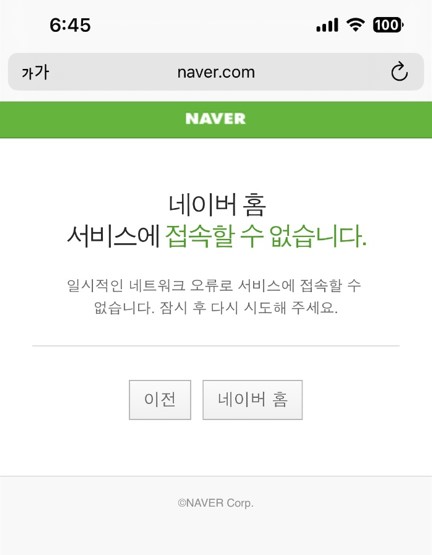 On the 31st at around 6:40 AM, a temporary outage occurred for about 5 minutes on the Naver mobile app.
 [Photo by Naver app capture]
The service disruption was caused by a sudden spike in access traffic due to disaster alerts. At 6:32 a.m., the Seoul Metropolitan Government issued a warning alert for the Seoul area and sent urgent disaster messages instructing evacuation. Because no specific information was provided about the reason for the warning or evacuation locations, users flocked to the portal. A Naver official explained, "Traffic surged more than tenfold compared to usual," adding, "Unlike predictable events such as year-end holidays or the World Cup, it is unusual for server usage to spike so sharply in such a short time as it did today."
Despite the service being restored, users expressed anxiety. The sudden disaster alert combined with the paralysis of the national portal heightened fear. Critics pointed out that if this had been a real disaster situation rather than a false alarm, a temporary service error could have led to fatal consequences.
Last October's KakaoTalk outage caused by a fire at the Pangyo data center also contributed to distrust. At that time, many services including the national messenger KakaoTalk and KakaoT experienced outages, but users faced confusion as they could not immediately confirm the outage status or recovery progress. This year, KakaoTalk has experienced two service outages as well.
Users are turning their attention to SNS platforms like Twitter because real-time communication is more active there. In fact, on that day, Twitter's real-time trends included keywords such as "North Korean missile," "evacuation alert," "nearest shelter," and "Ministry of the Interior and Safety." When Kakao experienced service outages last year, it also announced the outage status via Twitter.
Some voices are calling for the revival of the portal's real-time search term service. Currently, Naver and Kakao provide trend services that show users' frequently mentioned interests on their portals, but they do not cover all real-time issues. The controversy over the revival of silgeom stems from the fact that real-time trends are not reflected and political issues are excluded. A Naver official said, "Trend topics are currently under full review," adding, "We are considering various measures to enable rapid service restoration even in sudden situations."
© The Asia Business Daily(www.asiae.co.kr). All rights reserved.
![Clutching a Stolen Dior Bag, Saying "I Hate Being Poor but Real"... The Grotesque Con of a "Human Knockoff" [Slate]](https://cwcontent.asiae.co.kr/asiaresize/183/2026021902243444107_1771435474.jpg)











