Consolidation of Overlapping Central and Local Welfare Projects
Robust Welfare for the Vulnerable, Gradually Expanding to the Middle Class
Social Service Costs Shared by Government Finance and Income Levels
On the 31st, the Presidential Office stated, "Social services will be financially supported by the government, but a structure will be created where numerous innovative private entities compete." The intention is to phase out populist welfare systems that distribute cash indiscriminately and to establish a foundation for a sustainable structure by improving the quality of social services.
Social Affairs Secretary Ahn Sang-hoon said at a briefing held at the Yongsan Presidential Office on the same day, "Cash welfare will be focused heavily on vulnerable groups, and social services will be gradually universalized for the entire population by selecting priority areas."
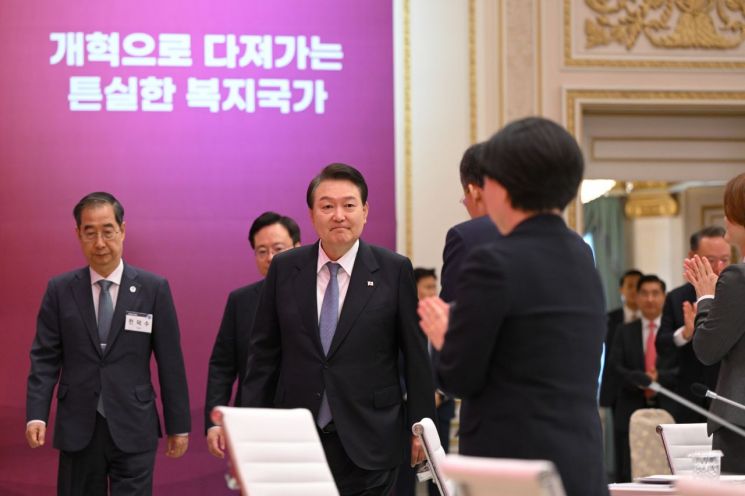
Regarding the Social Security Strategy Meeting held at the Blue House State Guest House that morning, Secretary Ahn explained, "At today's meeting, ministers and vice ministers from 15 ministries, heads of departments and bureaus, the Social Security Committee, the Low Birthrate and Aging Society Committee, and experts from related major committees attended together to report on the welfare state strategy and key tasks of the Yoon Seok-yeol administration and to hold discussions. We discussed strategies and tasks to properly implement the welfare philosophy and policy direction of the Yoon Seok-yeol government, which aims to realize a sustainable welfare state, into social security policies handled by all ministries."
First, regarding the current welfare system and social services, he diagnosed, "The current welfare state of the Republic of Korea is suffering from serious low birthrate, aging, and changes in the policy environment such as the Fourth Industrial Revolution. However, there is a bigger problem. Cash welfare has been expanded without principles for the sake of gaining votes during elections. Service welfare has been neglected, relying solely on finances, making it difficult to improve quality and workers' treatment."
On the direction of welfare and social service improvements under the Yoon Seok-yeol administration, he introduced, "We will improve the quality of services and create good jobs so that growth and virtuous cycles can be achieved. We will package and simplify the welfare projects, which are currently scattered with about 1,000 projects by the central government and 10,000 by local governments, so that any citizen can easily understand and utilize them through structural reorganization."
He added, "We will introduce some co-payments for social services currently provided mainly to vulnerable groups to expand them to the middle class, and create an investment environment for private innovative companies in the social service sector through active regulatory improvements utilizing welfare technology."
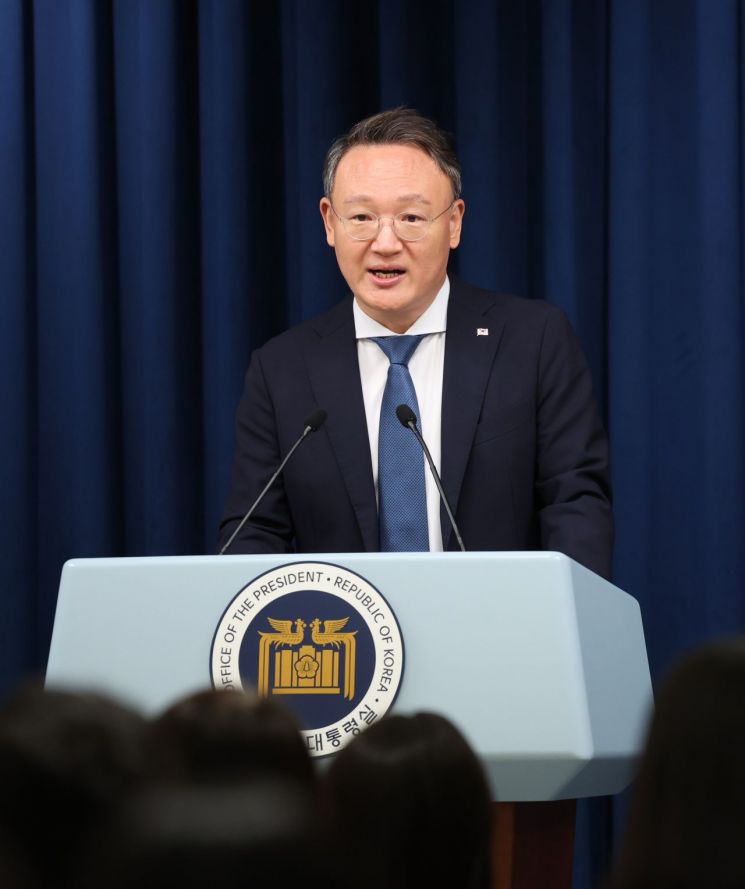
In response to a reporter's question asking whether "guaranteeing robust social services for vulnerable groups and expanding them to the middle class are conflicting concepts," a senior official from the Presidential Office explained, "Looking at countries that have properly established sustainable welfare states, cash welfare tends to focus on vulnerable groups, while social services are expanded to the entire population," emphasizing that this is not a conflict but a mixed policy area.
Regarding the cash welfare system, which is likely to undergo restructuring, the official said, "Looking back at various policy proposals that emerged through multiple election processes, many were centered on income-guarantee cash welfare, which easily gains votes. However, at least during the Yoon Seok-yeol administration, even if it is popular or gains votes nationwide, distributing cash to everyone as universal support will be strictly avoided."
When asked about specific implementation plans related to President Yoon Seok-yeol's remarks in his opening speech at the meeting about consolidating over 1,000 central government policies and 10,000 local government policies including social services, the official replied, "We want citizens to know which areas they can benefit from and enable administrative officials in welfare fields to do so. The central ministries can fully manage this, and local governments will be recommended to cooperate." To prevent departmental selfishness during policy consolidation, expert research and analysis will be applied. The official added, "President Yoon said that departmental selfishness is worse than accepting bribes, and he expects good cooperation among ministries."
Regarding concerns that citizens' service cost burdens might increase due to competitive private participation in social security services, the official stated, "Most social welfare services in Korea are finance-centered and privately commissioned. It is difficult for private competition to enter. The government creates programs and commissions them at low cost, and the commissioned organizations execute them. For services to be advanced and for workers' treatment to improve, service quality must be enhanced, which inevitably increases costs."
The plan is for the government to bear part of these costs through finances and for co-payments to be adjusted according to income levels. The intention is to raise service quality while matching the cost burden to income levels. For example, in the case of hiring caregivers, the government plans to provide higher-quality caregiving services than existing ones through government financial support and co-payments.
© The Asia Business Daily(www.asiae.co.kr). All rights reserved.


















