Experts Analyze 'Technology Level Will Decline'
"There Is Room for Improvement in the Future," They Point Out
What kind of capabilities does the military reconnaissance satellite No. 1, reportedly launched by North Korea on the 31st, possess? Experts express skepticism about whether it is capable of performing actual military missions.
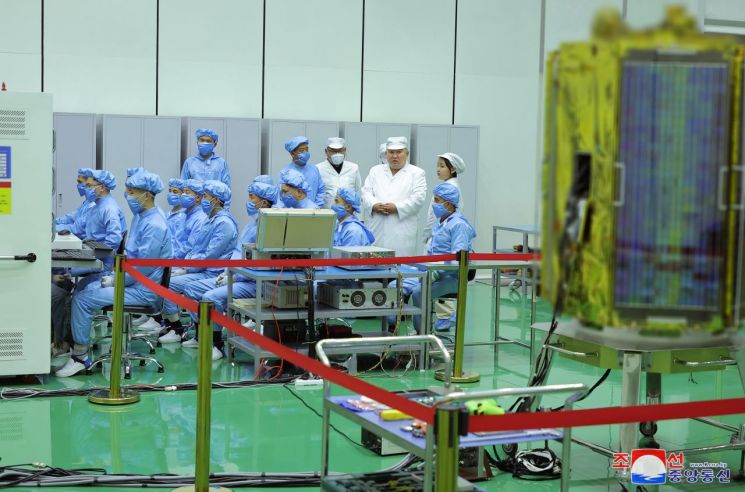 North Korea "Kim Jong Un Inspects Military Satellite No. 1... Approves Future Action Plan"
(Pyongyang, Korean Central News Agency=Yonhap News) North Korean State Affairs Commission Chairman Kim Jong Un reportedly conducted on-site guidance for the Reconnaissance Satellite Launch Preparation Committee project, according to the Korean Central News Agency on the 17th. The agency stated, "Comrade Kim Jong Un provided on-site guidance for the Emergency Satellite Launch Preparation Committee project on the 16th" and "approved the committee's future action plan." Meanwhile, Kim Jong Un's daughter Kim Ju-ae accompanied him during the on-site guidance, following her visit to the Space Development Bureau last month. 2023.5.17
[For Use Only in the Republic of Korea. No Redistribution]
nkphoto@yna.co.kr
(End)
<Copyright (c) Yonhap News Agency, Unauthorized Reproduction and Redistribution Prohibited>
North Korea has never disclosed specific performance details or specifications of this satellite. However, when reporting on Kim Jong-un’s on-site inspection on the 17th, they released actual photos of the satellite. It was a small satellite estimated to be less than 1 meter in size and weighing under 500 kg. Its shape is hexagonal, with four solar panels installed on the top.
Lee Chun-geun, Honorary Research Fellow at the Science and Technology Policy Institute, pointed out, "Considering the size and technological situation of the disclosed satellite, it is unlikely to be high-performance." Military reconnaissance satellites require a resolution of at least under 1 meter, meaning that a 1m by 1m area on the ground corresponds to one pixel in the image. This level of resolution is necessary to distinguish objects on the ground. They must import space-grade high-definition digital camera pixel sensors (CCDs) produced only by the United States, France, and Germany. These are special components manufactured to withstand radiation and electromagnetic waves in zero-gravity and vacuum conditions. Naturally, because they are used for military technology, their export and import are strictly controlled.
North Korea, as well as China, cannot purchase these components due to sanctions. To compensate, satellites must be made as large as possible to achieve high-definition imaging. This is why Chinese reconnaissance satellites are all large in size. However, North Korea’s military reconnaissance satellite No. 1 is less than 1 meter, making it difficult to consider it high-performance. The honorary research fellow said, "There are rumors that China buys large quantities of general-purpose components and uses only some that survive space environment testing, but considering various factors, it is hard to say the resolution is within 3 meters."
In fact, North Korea released black-and-white satellite images of the Yongsan Presidential Office area and Seoul-Incheon region on December 18 last year, claiming it was an experiment for reconnaissance satellite development, but the quality was poor, worse than images taken by commercial satellites.
Also, judging from the launch site and ground facilities, the honorary research fellow analyzed that North Korea hurried the launch under pressure from the supreme leader’s reprimand without sufficient technical preparation. The launch site equipment shown on North Korean TV was not properly automated, and various equipment for operating military reconnaissance satellites could not be imported due to international sanctions, raising doubts about whether a ground station was even established. He said, "Judging from Kim Jong-un’s recent inspection, it seemed more like a reprimand than encouragement," adding, "It appears they rushed too much without technical readiness due to South Korea’s Nuri rocket launch and South Korea-U.S.-Japan military exercises."
There is also analysis suggesting potential for future development. Woo Sung-hyun, Director of the Satellite Research Institute at the Korea Aerospace Research Institute (KARI), said, "North Korea’s satellite is estimated to be a small satellite under 300 kg, but it is difficult to assess the performance of its payload based solely on the released photos." However, he explained, "The adoption of a hexagonal modular design instead of the conventional rectangular structure seems to ensure accessibility while maximizing internal space, indicating a design aimed at future expansion to medium-sized satellites."
© The Asia Business Daily(www.asiae.co.kr). All rights reserved.

















