JCS "North Korea Launches Space Rocket Early This Morning"
Falls 200km West of Eocheongdo
North Korea "Lost Thrust Due to Abnormality in Stage 2 Engine"
On the 31st, one space launch vehicle fired by North Korea from the Dongchang-ri area in North Pyongan Province toward the south flew abnormally and then crashed. The so-called military reconnaissance satellite launch, which North Korea announced as the 'Manlijeong-1,' failed.
The Joint Chiefs of Staff stated, "At around 6:29 a.m. on the same day, North Korea launched one so-called space launch vehicle from the Dongchang-ri area in North Pyongan Province toward the south, which fell into the sea about 200 km west of Eocheongdo."
Our military has been identifying and recovering an object presumed to be part of the space launch vehicle fired by North Korea from the western sea near Eocheongdo since around 8:05 a.m. that day.
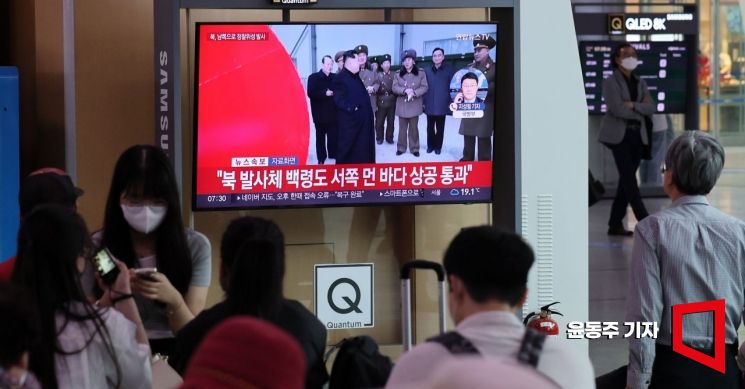 On the 31st, when North Korea launched a space projectile southward, citizens in the waiting room of Seoul Station, Jung-gu, Seoul, were watching related news. Photo by Yoon Dong-joo doso7@
Earlier, North Korea disclosed that immediately after the launch, the first-stage propulsion unit would be dropped into the open sea of the West Sea about 230 to 300 km west of Daecheon Port in Chungnam, the fairing (satellite protective cover) would be dropped into the open sea of the southwestern sea about 270 to 330 km west of Jeju Naval Base, and the second-stage propulsion unit would fall into the sea about 700 to 1000 km east of Luzon Island in the Philippines.
However, the launch vehicle passed over the distant sea west of Baengnyeongdo and fell abnormally into the sea about 200 km west of Eocheongdo. Eocheongdo is an island located about 60 km west of Gunsan, Jeonbuk.
North Korea also acknowledged the failure of the satellite launch vehicle. The National Aerospace Development Administration of North Korea stated through the Korean Central News Agency on the same day, "At 6:27 a.m. on the 31st, the military reconnaissance satellite 'Manlijeong-1' was launched from the West Sea Satellite Launch Site in Cholsan County, North Pyongan Province, mounted on the new satellite carrier rocket 'Chollima-1.' The 'Chollima-1' lost thrust and crashed into the West Sea due to abnormal ignition of the second-stage engine after the normal flight and separation of the first stage."
The second-stage engine mentioned by North Korea is a high-altitude engine. It is an engine that operates outside the atmosphere in a vacuum state. Considering that North Korea mentioned problems occurring after the separation stage of the first and second-stage engines, there is a possibility that the second-stage engine itself had an issue. Lee Chun-geun, an honorary research fellow at the Korea Institute of Science and Technology Policy, said, "If the problem is with the separation of the engine stages, it can be resolved in a short time, but North Korea likely has not actually tested the second-stage high-altitude engine in a vacuum state, so it may take a long time to find a solution."
North Korea also announced plans for a re-launch. A spokesperson for the National Aerospace Development Administration said, "We will urgently conduct a detailed investigation and explanation of the serious defect, devise scientific and technological measures to overcome it, undergo various tests, and carry out the second launch as soon as possible."
Meanwhile, if the military recovers the object presumed to be part of the space launch vehicle on the same day, it is expected to confirm the performance of the propulsion engine, the use of foreign parts, and the technological level. In 2016, the military recovered the launch vehicle of Kwangmyongsong-4 and concluded that the fairing had no measures against shock, vibration, or soot to protect the satellite, indicating that the purpose was not to launch a satellite.
© The Asia Business Daily(www.asiae.co.kr). All rights reserved.

















