Statistics Korea April Industrial Activity Trends... Industrial Production Down 1.4%, Consumption Down 2.3%
Manufacturing Inventory Ratio Hits Highest Level Since 1985 Statistics Began
Last month, domestic production and consumption decreased, while the manufacturing inventory ratio also reached its highest level since statistics began. The economic trend still shows no signs of recovery.
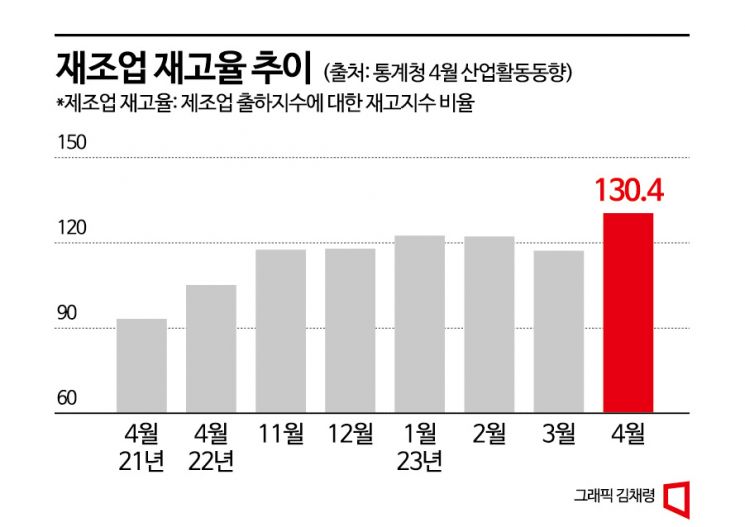
According to the April Industrial Activity Trends released by Statistics Korea on the 31st, the manufacturing inventory ratio (inventory index/shipment index × 100) last month was 130.4%, up 13.2 percentage points from the previous month. This is the highest figure since Statistics Korea began compiling manufacturing inventory ratio statistics in 1985. Kim Bo-kyung, the Economic Trend Statistics Commissioner at Statistics Korea, explained, "Although production decreased by 1.2% this month, shipments decreased more sharply by 4.6%, leading to a larger increase in inventory. As shipments declined, the inventory ratio rose significantly. In particular, the sharp decrease in semiconductor shipments caused the inventory/shipment ratio itself to increase."
Total industrial production decreased by 1.4% compared to the previous month, as production increased in construction but declined in public administration, mining and manufacturing, and services. This is the largest decline in 14 months since February last year (-15.3%). Notably, public administration production plummeted by 12.4% compared to the previous month, reflecting reduced public health expenditures related to COVID-19 due to the 'endemic' status of the disease. Service sector production decreased by 0.3%, mainly in wholesale and retail trade and transportation and warehousing.
Mining and manufacturing production increased in telecommunications and broadcasting equipment (13.4%) due to rising domestic demand for mobile phones overseas. However, production decreased in machinery equipment (-6.9%) and pharmaceuticals (-8.0%), resulting in a 1.2% decline compared to the previous month. Compared to the same month last year, production increased in automobiles (16.6%) but decreased in semiconductors (-20.2%) and chemical products (-20.5%), leading to an 8.9% overall decline.
The retail sales index (seasonally adjusted), which indicates consumption trends, fell by 2.3% compared to the previous month. After a strong increase in retail sales in February (5.1%), growth slowed in March (0.1%) and then turned negative. Kim Bo-kyung analyzed, "The change in weather conditions caused clothing purchases, which usually concentrate in March and April, to be brought forward to February due to the end of COVID-19, creating a base effect." Sales also declined in non-durable goods such as food and cosmetics (-1.2%) and durable goods such as telecommunications equipment, computers, and passenger cars (-1.7%).
Facility investment increased by 0.9% compared to the previous month, as investment in machinery such as telecommunications equipment decreased (-0.6%) but investment in transportation equipment such as aircraft increased (5.9%). Construction performance increased by 1.2% compared to the previous month due to growth in building construction (2.4%), although civil engineering construction decreased (-2.4%).
The coincident composite index, which reflects the current economic situation, rose by 0.2 points compared to the previous month. In contrast, the leading composite index, which forecasts future economic conditions, fell by 0.2 points compared to the previous month, marking a decline for six consecutive months. Kim Bo-kyung stated, "The economic trend remains difficult, and there are significant uncertainties in forecasting the timing of an economic rebound."
© The Asia Business Daily(www.asiae.co.kr). All rights reserved.
![Clutching a Stolen Dior Bag, Saying "I Hate Being Poor but Real"... The Grotesque Con of a "Human Knockoff" [Slate]](https://cwcontent.asiae.co.kr/asiaresize/183/2026021902243444107_1771435474.jpg)
















