Intel Announces Return to Foundry in 2021... WSJ "Faces Challenges"
Pat Gelsinger CEO "Intel Hopes to Grow Faster"
Intel, a leading U.S. semiconductor company, has challenged Samsung Electronics by declaring its intention to become the No. 2 player in the foundry (semiconductor contract manufacturing) market by 2030. However, it is facing difficulties after failing to attract major clients such as Qualcomm and Tesla. Since CEO Pat Gelsinger's return to Intel and the announcement of re-entering the foundry business in 2021, the company has been focusing on strengthening its business capabilities, but achieving its goals does not seem easy.
The Wall Street Journal (WSJ) reported on the 30th (local time) in an article titled "Once powerful Intel struggles to get out of the mud," citing sources that Qualcomm and Tesla considered but ultimately abandoned plans to entrust Intel with semiconductor production.
In Qualcomm's case, discussions were halted due to Intel's technical shortcomings. In early last year, Intel's foundry business delegation visited Qualcomm headquarters and met with CEO Cristiano Amon, but in June and December of the same year, Intel failed to meet critical business commitments necessary for mass semiconductor production. Ultimately, Qualcomm's management judged it difficult to entrust Intel with the production of the required smartphone semiconductors, and business talks stopped.
Tesla reportedly discontinued its review because Intel could not provide the extensive semiconductor design services offered by other foundry companies. Tesla had considered entrusting Intel with data and image processing semiconductors necessary for autonomous vehicle operation at the end of 2021. Tesla has been a long-time customer of Samsung Electronics' foundry and recently started working with TSMC as well. However, Intel was unable to provide the semiconductor design-related support Tesla received from Samsung Electronics and TSMC, leading to the halt of discussions.
WSJ assessed that although CEO Gelsinger is trying to lift the company through large-scale expansion such as new factory investments, "the foundry business has faced obstacles over the past two years."
So far, Intel's major foundry business client is the Taiwanese fabless semiconductor company MediaTek, focusing on producing semiconductors for relatively low-tech smart TVs and Wi-Fi modules. Intel has also contracted with hard drive manufacturer Seagate. CEO Gelsinger stated that Intel's foundry business has attracted more than $4 billion (approximately 5.3 trillion KRW) in business.
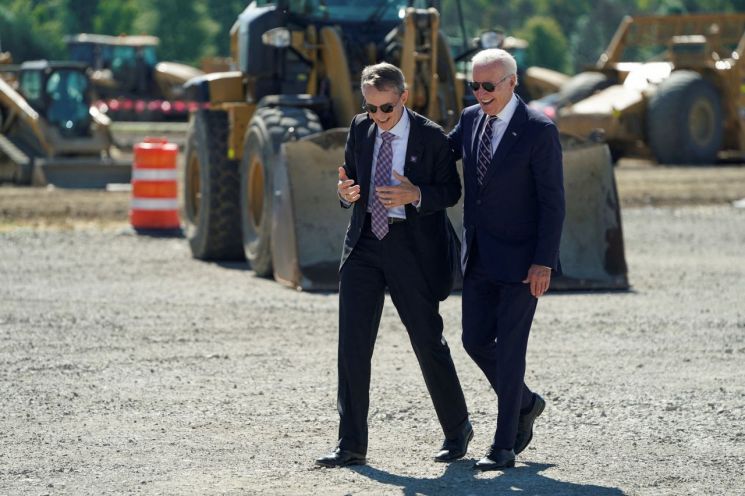 Intel CEO Pat Gelsinger walking together with U.S. President Joe Biden (right)
 [Image source=Reuters Yonhap News]
Intel has yet to secure contracts with major global clients such as Apple and Nvidia. However, Nvidia is collaborating with Intel as part of a government support program. WSJ quoted multiple industry insiders saying, "Many potential customers have supply contracts with TSMC and Samsung Electronics and are cautious about working with unproven foundries."
Earlier, Intel's management set a goal to become the "No. 2 in the industry" by 2030, following TSMC. WSJ reported, citing Intel's internal estimates, that annual sales to major clients could reach $20 billion to $25 billion around 2030.
To become the industry's No. 2, Intel must surpass Samsung Electronics, which currently holds the No. 2 position in the foundry market. According to market research firm TrendForce, Samsung Electronics' market share in the fourth quarter of last year was 15.8%, with a 42.7 percentage point gap behind the No. 1 TSMC (58.5%). Since launching its foundry division in 2017, Samsung Electronics' annual revenue exceeded $20 billion for the first time last year. Samsung Foundry's average annual revenue growth rate from 2018 to 2022 was 15.6%.
In an interview with WSJ, CEO Gelsinger said that TSMC, Samsung Electronics, and Intel will all show growth from now until 2030, but "(Intel) hopes to grow much faster than those two."
Meanwhile, since CEO Gelsinger's appointment, Intel's stock price has fallen about 30%, contrasting with the Philadelphia Semiconductor Index, which rose 10% during the same period. TSMC's market value is more than four times that of Intel, and Nvidia's market value is about eight times larger. Nvidia's market capitalization surpassed $1 trillion on the day.
© The Asia Business Daily(www.asiae.co.kr). All rights reserved.


















