Failed to Enter 'Nangongbullak'
Directly Establishes Headquarters in China
Secures Over 50 Pipelines
Clinical Successes in RSV and Cancer Vaccines
Expands Production Capacity Including Factory Acquisition
Possibility of Establishing a Factory in Korea Emerges
Moderna, a messenger ribonucleic acid (mRNA) vaccine and therapeutic developer that rapidly grew during the COVID-19 pandemic, is preparing a new growth strategy as it enters the endemic phase of infectious diseases. While venturing into new markets such as China, which it had previously been unable to penetrate, Moderna is also reorganizing its pipelines beyond COVID-19 and actively seeking survival strategies for the endemic phase by securing production footholds in various regions.
Moderna recently established a new corporation in Shanghai, China. Named Moderna (China) Biotech Co., Ltd., it has a capital of $100 million (approximately 130 billion KRW). Since the onset of the COVID-19 pandemic, Moderna has continuously strived to enter the Chinese market, including setting up a branch in Hong Kong last year. However, China’s policy of exclusively using domestically produced vaccines such as Sinopharm and Sinovac has hindered Moderna’s market entry. Pfizer, which licensed COVID-19 vaccine production through Fosun Pharma, has also failed to enter mainland China.
However, as COVID-19 cases surge again in China, signaling a resurgence, Moderna appears to be seeking another opportunity to enter the market. Zhong Nanshan, a leading Chinese infectious disease expert and academician of the Chinese Academy of Engineering, recently warned that "by the end of June, weekly COVID-19 infections could reach 65 million, marking a second major wave." While Chinese pharmaceutical companies like Sinovac are releasing new vaccines and therapeutics, many Chinese still prefer foreign vaccines, traveling to Hong Kong to receive Pfizer vaccines. Accordingly, Moderna seems to be establishing a direct presence in China to seize market opportunities.
In addition, Moderna is pursuing new growth engines through expanding research and development (R&D) and production capabilities. It is known that Moderna currently has about 50 pipelines under development. Moderna CEO St?phane Bancel stated in January, "We plan to increase R&D investment from approximately $3.3 billion (about 4.37 trillion KRW) last year to $4.5 billion (about 6 trillion KRW) this year," adding that this is "about ten times the R&D investment made before COVID-19 in 2019."
Moderna’s main focus areas include respiratory diseases, latent viruses, personalized cancer vaccines, and rare diseases. Following the COVID-19 vaccine, the respiratory syncytial virus (RSV) vaccine is the most likely candidate to become Moderna’s second commercialized drug. In January, the candidate 'mRNA-1345' showed a successful 83.7% efficacy in a Phase 3 clinical trial targeting the elderly, and Moderna plans to soon apply for approval from the U.S. Food and Drug Administration (FDA). A Phase 1 trial for pediatric patients is also planned. Approval applications are expected to be submitted in South Korea within the year. However, the 'mRNA-1010' influenza vaccine candidate showed in an interim analysis of Phase 3 trials that it did not elicit a clear immune response against some variants compared to existing vaccines.
Beyond respiratory vaccines, Moderna is expanding its pipeline into various fields. On the 19th (local time), it disclosed interim results from Phase 1/2 clinical trials of 'mRNA-3927,' a treatment for the rare disease propionic acidemia (PA), signaling its expansion into therapeutics. In cancer vaccine development, last year Moderna announced Phase 2 clinical results showing a 44% reduction in recurrence and death when combining the cancer vaccine 'mRNA-4157' with Merck’s (MSD) immuno-oncology drug Keytruda in skin cancer patients. In February, Moderna also announced a collaboration with genetic engineering company LifeEdit Therapeutics to develop targeted therapies combining mRNA technology with gene editing.
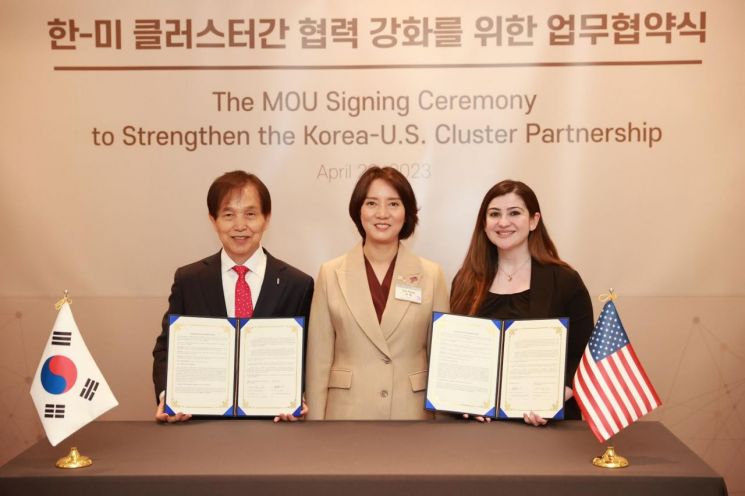 At the signing ceremony last month for a memorandum of understanding to explore cooperation plans for professional talent development between Korea Advanced Institute of Science and Technology (KAIST) and Moderna, KAIST President Kwang Hyung Lee, Minister Young Lee of the Ministry of SMEs and Startups, and Alpha Gerei, Chief Commercial Officer of Moderna (from left), are posing for a commemorative photo.
 [Photo by Ministry of SMEs and Startups]
Moderna is also expanding its production capacity, which was criticized for delays in vaccine supply during the COVID-19 pandemic. Recently, Moderna reportedly purchased a 90,000㎡ site and a 13,000㎡ manufacturing facility near its headquarters in Cambridge, Massachusetts, USA, for $91 million (about 120 billion KRW). The company plans to complete related work and begin operations by September next year, with a total expansion investment of $322 million.
CEO Bancel emphasized that "to produce vaccines that respond to the types of viruses prevalent in each region, manufacturing plants must be distributed worldwide," indicating that this production expansion will likely extend beyond the U.S. to a global scale. In March, Moderna announced plans to build a new innovation technology center in Oxfordshire, UK, capable of producing 250 million vaccines annually by 2025.
If these plans materialize, competition to attract Asian production bases is expected to intensify. When Moderna established its domestic branch in 2021, such expectations were high, but the matter was settled with Samsung Biologics handling the production of finished COVID-19 vaccine products (DP). There have also been speculations about Moderna building a factory in Japan, but nothing concrete has emerged yet. However, during President Yoon Suk-yeol’s state visit to the U.S. last month, Moderna signed a memorandum of understanding (MOU) with the Korea Health Industry Development Institute, Yonsei University’s K-NIBRT (Bio Process Training Center) project group, and the Korea Advanced Institute of Science and Technology (KAIST) to train domestic mRNA specialists. This ongoing cooperation suggests that the possibility of establishing a domestic factory in South Korea remains alive.
© The Asia Business Daily(www.asiae.co.kr). All rights reserved.
![User Who Sold Erroneously Deposited Bitcoins to Repay Debt and Fund Entertainment... What Did the Supreme Court Decide in 2021? [Legal Issue Check]](https://cwcontent.asiae.co.kr/asiaresize/183/2026020910431234020_1770601391.png)

















