Among 10 New Ship Orders, 6 Are 'Methanol'
Ship Fuel Expected to Surpass Carbon Neutrality Regulations
Liquid at Room Temperature... Easier to Handle than LNG
The world's largest shipping company Maersk has set a goal to advance its carbon neutrality target by about 10 years, from 2050 to 2040. As a solution to achieve carbon neutrality, it chose methanol instead of LNG. Since ordering methanol ships from HD Hyundai Heavy Industries in 2021, it has ordered a total of 19 vessels to date. The reason Maersk rejected LNG, which many shipping companies chose, was the judgment that it is not an effective fuel for carbon neutrality. Maersk's choice then became the trend just two years later.
LNG, which had established itself as the carbon-neutral ship fuel, is fading, and the era of methanol has arrived. As environmental regulations on ships are strengthened, orders for methanol ships are continuing.
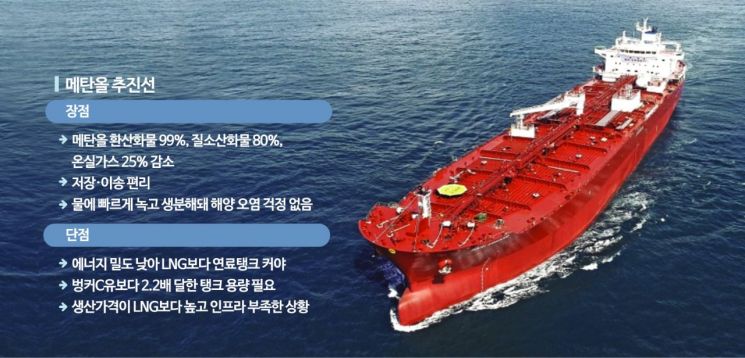
The shipbuilding industry estimates that 6 out of 10 new ship orders in the first half of this year will be methanol ships. Until last year, LNG ship orders were overwhelming, but this year a reversal in the trend is being sensed. According to a report by the British shipping research firm Clarkson Research, 93% of container ships ordered in January and February were methanol ships.
Methanol's biggest advantage is that it is liquid at room temperature, making it easier to handle than LNG, which requires liquefaction at cryogenic temperatures. It does not require cryogenic storage tanks or processing facilities needed for LNG ships. Also, even if spilled into the sea, it biodegrades, making it relatively free from marine pollution issues. It contains no nitrogen oxides or sulfur, so it is also free from environmental regulations. Methanol-dedicated engines have already been commercialized.
However, methanol ships also have limitations. Methanol has a lower energy density than bunker C oil or LNG, so more quantity is needed to produce the same output. Installing large fuel tanks reduces space inside the ship, leading to criticism that it is unsuitable except for container ships.
So far, methanol ships have had an advantage mainly in container ships that operate on regular routes. This is because carbon-neutral fuel is important for regularly operated routes. However, it is expected that larger ships such as bulk carriers will respond quickly to this trend in the future.
Larger ships emit relatively more carbon dioxide, so they face the challenge of proactively responding to international carbon neutrality regulations.
The International Maritime Organization (IMO) plans to hold the 80th meeting of the Marine Environment Protection Committee (MEPC) this July to discuss amendments to raise the international shipping greenhouse gas reduction targets. IMO established greenhouse gas reduction targets in 2018, planning to reduce total emissions by 50% by 2050 compared to 2008 levels. The amendment is expected to increase the 2050 reduction target from 50% to 100%.
Kim Chang-wook, a specialist at the Korean Register, said at the regular forum of the Marine Journalists Association held on the 30th, "Until hydrogen or ammonia is used as ship fuel, LNG or methanol is attracting attention as an intermediate step," adding, "After 2025, when the supply of bio-methanol increases, the use of methanol fuel is likely to expand significantly."
© The Asia Business Daily(www.asiae.co.kr). All rights reserved.
![User Who Sold Erroneously Deposited Bitcoins to Repay Debt and Fund Entertainment... What Did the Supreme Court Decide in 2021? [Legal Issue Check]](https://cwcontent.asiae.co.kr/asiaresize/183/2026020910431234020_1770601391.png)
















