Government Refusal to Explain Draws Recent Court Frustration
Case Lost by Inmate in April Last Year Proceeded Without Lawyer
Claims Contradict Former Minister Choo Mi-ae's Parliamentary Remarks... "Considering Criminal Charges for Litigation Fraud"
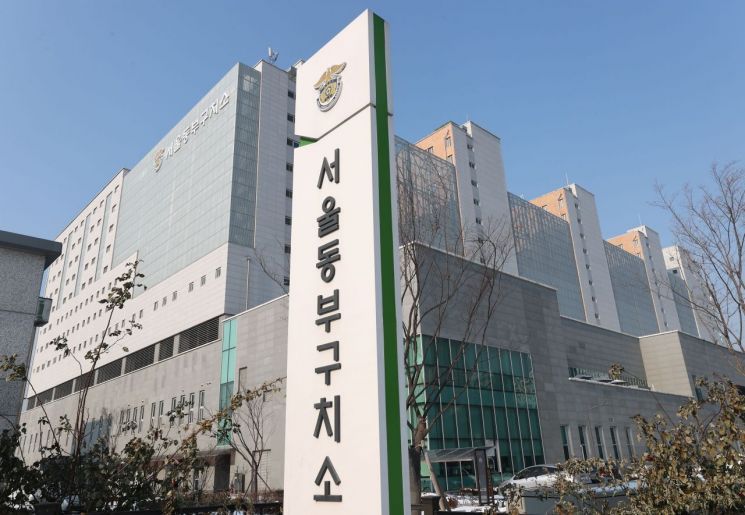
As the trial over the class-action lawsuit filed by inmates and their families affected by the COVID-19 outbreak at Seoul Eastern Detention Center in early 2021 has yet to produce a first-instance verdict after more than two years, it has recently been confirmed that the court expressed strong dissatisfaction with the government's refusal to comply with the order to disclose information about the correctional officers the affected inmates had contact with and the infection routes.
Presiding Judge Expresses Dissatisfaction with Government’s Uncooperative Clarifications… “Isn’t There Some Responsibility?”
According to the legal community on the 31st, during the hearing held on the 23rd at the Seoul Central District Court Civil Division 18 (Presiding Judge Park Jun-min), Judge Park said to the government’s representative, “We previously issued an order to prepare clarifications, but shouldn’t you at least clarify where the inmates were transferred to and with whom they were when they tested positive?” The order to prepare clarifications is a directive from the court requiring parties such as plaintiffs or defendants to explain, prove, or state opinions on certain matters before the trial date to clarify the litigation relationship.
Judge Park also said, “Isn’t this the state? If there is responsibility, you must take responsibility. I don’t think this should be treated as a burden of proof issue,” adding, “If the facts are not clarified, the trial cannot proceed.”
In lawsuits claiming damages for illegal acts, it is generally the plaintiff?in this case, the inmates or their families?who bears the burden of proof regarding the defendant’s negligence and the causal relationship to the damages. However, considering the special nature of the incident occurring within the closed environment of a detention center, which is not open to the public, the government must provide at least minimal information to allow the trial to proceed.
Judge Park stated, “The defendant claims no responsibility for the outbreak that occurred while inmates were confined in the detention center, but isn’t there some responsibility at least in principle?” He also said, “Even if there was a group infection, the focus should be on whether there is liability for compensation, not on telling the plaintiff to ‘figure it out yourself.’”
Currently, Civil Division 18 is hearing three consolidated cases: one filed in January 2021 by two inmates and seven family members who were infected with COVID-19 at Seoul Eastern Detention Center and are claiming damages against the Republic of Korea and then-Minister of Justice Choo Mi-ae; another filed in March 2021 by eight inmates and 32 family members; and a third filed in July 2021 by eight inmates and 24 family members. The total number of plaintiffs is 81.
The case initially filed in January 2021 was referred to mediation in March of the same year but failed to reach an agreement and was transferred to a collegiate panel in June. After several hearings, on January 12 of this year, the court issued an order to the defendant Republic of Korea to clarify the correctional officers the inmates had contact with and the infection routes within the detention center. This order was issued just before the hearing scheduled for January 17.
However, the government did not comply with the court’s clarification request, citing insufficient time. Ahead of the hearing scheduled for March 28, the government submitted a written statement on March 17 expressing difficulty in providing clarifications. The government argued that “it is currently difficult to identify which correctional officers had contact, and information about the structure and scale of the detention facility could lead to risks of undermining supervision” as reasons.
The defendant Republic of Korea (under the Ministry of Justice) is represented by the Korea Legal Aid Corporation. Former Minister Choo Mi-ae has personally retained a lawyer and is proceeding with the lawsuit.
As the defendant refused to comply with the court’s clarification request, the court asked the plaintiff’s representatives in March to identify, within the possible scope, the correctional officers the infected inmates had contact with and the inmates’ movement routes at the time.
In response, Park Jin-sik, a lawyer from the law firm Between representing the plaintiffs, reviewed emails received from inmates’ families when first taking the case, contacted inmates who had since been released one by one to collect relevant information, and submitted it to the court.
In June 2021, the National Human Rights Commission of Korea investigated complaints related to the COVID-19 outbreak at Seoul Eastern Detention Center and other correctional facilities and confirmed “inadequate responses by correctional facilities,” requesting the Ministry of Justice to issue an institutional warning to Seoul Eastern Detention Center. The commission found that the detention center ▲ did not notify inmates of their COVID-19 test results and refused to confirm results, ▲ after receiving the first mass testing results, held 185 close-contact inmates in one space for four hours without social distancing or other quarantine measures, and ▲ after the second mass testing notification, housed close-contact inmates with different infection routes together in the same room without separating symptomatic individuals. It was also found that many plaintiffs in this lawsuit were infected while being housed together with close-contact inmates from different groups.
Inmate Lost Lawsuit in April Last Year Without Stated Reasons… This Trial Expected to Set Standards for Government’s Management and Supervision Responsibilities
Previously, in April last year, an inmate infected with COVID-19 while detained at Seoul Eastern Detention Center lost a damages claim lawsuit against the state. At that time, Judge Woo Kwang-taek of the Seoul Central District Court Civil Division 7 concluded that “the evidence submitted by the plaintiff alone cannot establish the Ministry of Justice’s illegal act,” but since the claim amount was only 30 million KRW, the detailed reasons for the judgment were not disclosed.
The Small Claims Procedure Act allows that for cases with claims not exceeding 30 million KRW, the court may orally explain the judgment’s reasons without including them in the written judgment. However, it appears that the inmate conducted the lawsuit without legal assistance and failed to properly assert and prove the claims.
In contrast, in the current case, multiple inmates are asserting facts they personally experienced through lawyers, and since it is a collegiate panel case requiring written reasons for judgment, it is expected that regardless of whether the plaintiffs’ claims are accepted, specific standards regarding the government’s management and supervision responsibilities over inmates in detention facilities will be presented.
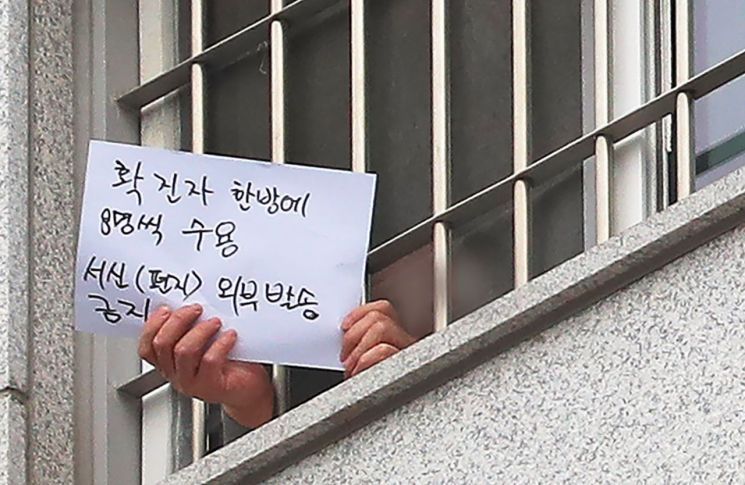 On December 29, 2020, at Seoul Eastern Detention Center in Songpa-gu, Seoul, an inmate is seen holding up a note addressed to the press, in which he wrote complaints about overcrowding of confirmed cases and the ban on sending letters.
 [Image source=Yonhap News]
Government Claims “No Epidemiological Contact Between Staff and Inmates”… Contradicting Former Minister Choo Mi-ae’s Statements
Meanwhile, during the trial, it was revealed that the government made claims completely contradicting statements made by former Minister Choo Mi-ae when she appeared before the National Assembly. In its response dated May 20, 2021, the government argued, “The first wave centered on staff starting in late November 2020 and the second wave centered on inmates starting in early December are not only different in viral characteristics but also show no epidemiological contact between the waves; therefore, each infection route is different and they are distinct types.”
However, on January 8, 2021, when former Minister Choo appeared before the National Assembly’s Judiciary Committee, Kim Do-eup, a member of the People Power Party, questioned her, saying, “Minister, you said that an asymptomatic inmate entered during the social transmission phase and caused a large-scale spread, but the first inmate tested positive on December 14, right? Do you know the cause of this infection? Do you know the infection route? Yes? Do you know? You don’t, do you?”
When Kim said, “The first inmate who tested positive was infected by one of the 12 staff members who had previously tested positive,” former Minister Choo replied, “I am aware.” She also said at the time, “We identified everyone who had contact with those (infected) staff and completed a full investigation immediately.”
In other words, former Minister Choo acknowledged that she was informed by Seoul Eastern Detention Center that the first inmate infected was infected by a correctional officer. Now, the government claims there was no contact between infected correctional officers and inmates and that the viruses were different.
Regarding this, lawyer Park stated, “The government’s false claims to mislead the court to avoid liability for damages may constitute litigation fraud.”
He added, “The initial response dated May 20, 2021, was from the Ministry of Justice under Minister Park Beom-gye. Minister Han Dong-hoon should identify who made these false claims within the Ministry of Justice or Seoul Eastern Detention Center and take action. If the person responsible for the false claims is identified, we are considering criminal charges for litigation fraud.”
At Seoul Eastern Detention Center, more than 1,000 COVID-19 cases occurred from late 2020 to early 2021, sparking controversy over the Ministry of Justice’s poor management.
© The Asia Business Daily(www.asiae.co.kr). All rights reserved.


















