Jaeseok 289, Chan 178, Ban 107, Invalid 4, etc.
Opposition: "Yoon, clear violation of legislative authority"
Ruling party: "The National Assembly is fostering social conflict"
President Yoon Suk-yeol's request for reconsideration of the Nursing Act bill was rejected at the National Assembly plenary session on the 30th.
On the afternoon of the same day, the National Assembly held a plenary session and conducted a secret handwritten vote on the reconsideration of the Nursing Act. Out of 289 members present, 178 voted in favor, 107 against, and 4 votes were invalid, resulting in the bill's rejection.
The Nursing Act aims to clarify the scope of nurses' duties and strengthen the treatment of nursing personnel. It was passed at the plenary session on the 27th of last month with 179 votes in favor and 2 abstentions out of 181 members present, but returned to the National Assembly after President Yoon exercised his right to request reconsideration at the Cabinet meeting on the 16th.
According to Article 53 of the Constitution, a bill on which the president exercises the right to request reconsideration must be approved by a majority of the total members and by two-thirds or more of the members present. Currently, with 299 total seats in the National Assembly, if the People Power Party (114 seats) collectively rejects it, approval is impossible.
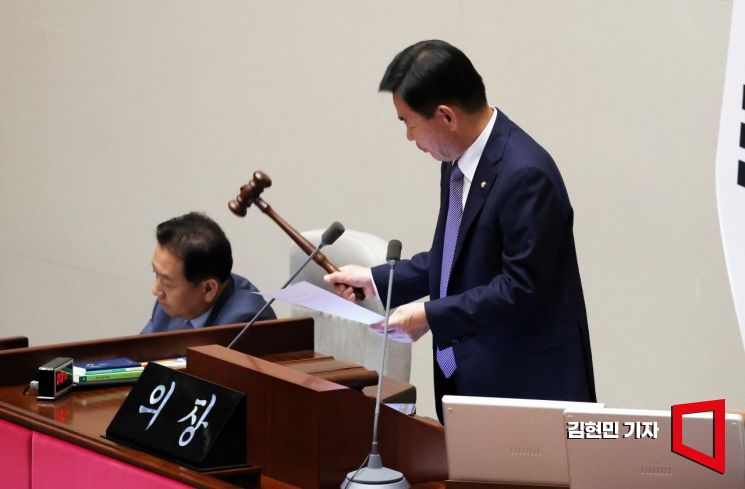 President Yoon Suk-yeol exercised his veto power on the Nursing Act bill, which was finally rejected in the National Assembly plenary session on the 30th. In the plenary session, out of 289 members present, 178 voted in favor, 107 against, and 4 invalid votes, resulting in the final rejection of the Nursing Act bill. Photo by Kim Hyun-min kimhyun81@
The People Power Party attempted to create a mediation proposal and negotiate with the Democratic Party and the Korean Nurses Association before the Nursing Act passed the plenary session, but since no bipartisan agreement was reached, the original bill was put to a revote as is. The mediation proposal prepared by the People Power Party included changing the bill's name from Nursing Act to Nurse Act, abolishing the high school graduation requirement for nursing assistants, and maintaining the Medical Service Act provisions on integrated nursing and caregiving services.
Earlier, the ruling party decided on a party line of 'rejection' after negotiations on a bipartisan mediation proposal failed. Yoon Jae-ok, the floor leader, said at the members' meeting held before the plenary session in the afternoon, "It is expected that the Nursing Act will be brought up as an agenda item (in the plenary session). I understand that conflicts between professional groups continue," adding, "It is regrettable that we have to reject it as a party line in reality."
The Democratic Party insisted on passing the original bill that day. Park Kwang-on, the floor leader, said at the morning strategy meeting, "We had several discussions on preparing a revised Nursing Act between the ruling and opposition parties, but we could not find common ground," adding, "More than one million people cannot go to hospitals without someone's help. Considering the protectors and families of those one million people, and the fact that the public medical system will be further strengthened through the Nursing Act, benefiting the public, it is right for the Nursing Act to be passed."
Plenary Session Debate on Pros and Cons Also Clashed Between Ruling and Opposition... Loud Voices
In the plenary session that day, the ruling and opposition parties clashed in debate over the pros and cons. Jeong Chun-sook, chairperson of the National Assembly Health and Welfare Committee and a Democratic Party member, said, "Despite the Democratic Party and the People Power Party having duly reviewed and processed the bills they each proposed in accordance with the National Assembly Act to provide broad nursing benefits to the public in response to new infectious diseases, treatment, care, and nursing, the exercise of the veto right is a clear infringement on legislative authority," and earnestly requested, "I sincerely ask members of the National Assembly to show their conscience and conviction in the secret ballot revote on the Nursing Act."
Democratic Party member Seo Young-seok fiercely criticized, saying, "Instead of joining forces to prepare for a super-aged society, the ruling party refuses to vote on the bill they proposed and reviewed, fearing they might be disliked in Yongsan and not receive nominations, thus rushing into self-denial." In response, ruling party members shouted back, "What are you talking about now?" and other loud retorts.
People Power Party member Lee Jong-sung opposed the Nursing Act, arguing it would increase confusion in the medical field. He said, "Unilaterally passing a bill that affects not only one profession but also other professional areas is an irresponsible act by the National Assembly itself, provoking severe social conflict nationwide." He added, "The top priority issue we must solve is improving nurses' treatment," and promised, "Going forward, the People Power Party will actively cooperate with the government and continue efforts to improve nurses' treatment."
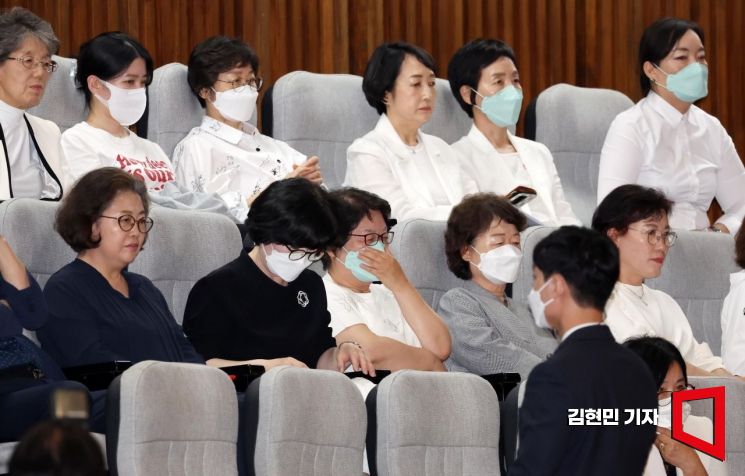 President Yoon Suk-yeol's request for reconsideration (veto) of the Nursing Act bill was finally rejected at the National Assembly plenary session on the 30th. At the plenary session, out of 289 members present, 178 voted in favor, 107 against, and 4 invalid votes, resulting in the final rejection of the Nursing Act bill. The photo shows nurses watching the plenary session that day. Photo by Kim Hyun-min kimhyun81@
Kim Jin-pyo: "Regret Over Repeated Rejection of Bills on Reconsideration"
On the day, about 50 nurses wore white clothes and sky-blue masks and watched the vote inside the plenary hall. During the members' debate on pros and cons, they nodded in agreement during the pro side and shook their heads or sighed during the opposition side, quietly remaining in their seats without making loud noises. While the secret ballot votes were being counted, they leaned their upper bodies toward the meeting hall and tightly clasped their hands, praying for the bill's passage. When the bill was finally rejected, they quietly closed their eyes or wiped their eyes as if holding back tears and left the meeting hall.
Kim Jin-pyo, Speaker of the National Assembly, said after the final rejection of the Nursing Act, "Despite repeatedly urging both ruling and opposition parties to make concessions and prepare a compromise on the Nursing Act, it is very regrettable that the political confrontation has led to repeated rejection of the bill after reconsideration." He added, "I ask the ruling and opposition parties and the government to sit down together and prepare policy alternatives, including improving nurses' treatment, resolving shortages of essential medical personnel, expanding medical school quotas, realizing medical fees, and addressing medical deserts, so that the bills prepared through bipartisan consultation can practically help improve the quality of medical services for the people."
© The Asia Business Daily(www.asiae.co.kr). All rights reserved.


















