Unsold Units Continue to Rise After Completion
Housing Transactions Decline for the First Time in 3 Months
While the number of unsold houses nationwide has decreased for two consecutive months, the so-called "malignant unsold houses"?those remaining unsold after completion?continued to increase. Additionally, housing permits, construction starts, and sales performance have been sluggish, raising concerns about future supply shortages.
According to the "April Housing Statistics" released by the Ministry of Land, Infrastructure and Transport on the 30th, the number of unsold houses nationwide last month was 71,365 units, down 1.0% (739 units) from the previous month. After turning to a decline in March for the first time in 11 months, this trend continued for two consecutive months.
However, the decrease is small to consider the unsold housing issue resolved, and the figure still far exceeds the Ministry's risk threshold of 62,000 units.
Last month, unsold houses in the metropolitan area increased by 5.2% to 11,609 units from 11,034 units the previous month. Seoul (1,058 units) and Incheon (3,071 units) decreased by 2.4% and 13.9%, respectively, while Gyeonggi (7,480 units) increased by 17.1%. In the provinces, the number decreased by 2.2% to 59,756 units.
The number of unsold houses after completion, which remain unsold even after construction is finished, was recorded at 8,716 units, up 0.8% (66 units) from the previous month. This is the highest figure in 1 year and 10 months since June 2021 (9,008 units). By city and province, Gwangju saw the largest increase nationwide, rising by 25.9% (49 units).
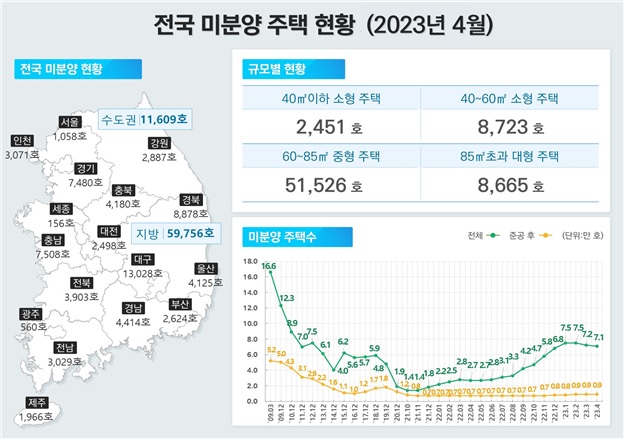 April Nationwide Unsold Housing Statistics / Image provided by the Ministry of Land, Infrastructure and Transport
The decrease in unsold houses is analyzed to be influenced by a reduction in the volume of housing sales itself.
From January to April this year, nationwide housing permits totaled 123,371 units, down 23.3% compared to the same period last year. Apartments accounted for 106,087 units, down 17.5%, while non-apartment housing dropped 46.3% to 17,284 units.
During the same period, construction starts were 67,305 units and sales were 39,231 units, plunging 43.2% and 50.3%, respectively. In Seoul, apartment construction starts from January to April this year were 6,239 units, down 59.3% (9,081 units) compared to the same period last year. However, sales of multi-family housing increased by 15.2% to 3,795 units.
Amid this trend, concerns are emerging that housing supply shortages could worsen in the next 2 to 3 years. Typically, housing is supplied 2 to 3 years after construction starts and 3 to 5 years after permits are issued.
Housing transaction volume (sales) also slowed. In April, nationwide housing transactions (based on reporting date) totaled 47,555 cases, down 9.1% from the previous month. Compared to the same month last year, it decreased by 18.6%. Nationwide, after declining for eight consecutive months from May last year to January this year, transactions increased again from February but fell off after three months.
In Seoul, transactions were 5,122 cases, down 11.9% from April last year. However, housing transactions in the Gangnam 4 districts (Gangnam, Seocho, Songpa, and Gangdong districts) increased by 14.1% to 1,125 cases.
Due to rental fraud and other issues, the jeonse and wolse (long-term lease and monthly rent) market remains subdued. The combined number of jeonse and wolse transactions in April (based on reporting date), including lease and fixed-date registration data, was 219,317 cases, down 17.0% from the previous month. By lease type, jeonse transactions were 102,642 cases, and wolse transactions were 116,675 cases. The proportion of wolse in jeonse and wolse transactions from January to April this year was 54.5%.
© The Asia Business Daily(www.asiae.co.kr). All rights reserved.


















