May 1-20 Semiconductor -35%·China -29%
Intermediate goods exports to China and Vietnam down 28% through April
"Solve wage and labor issues and increase productivity"
"Reducing working hours and increasing wages are good things. However, to sustain this, labor productivity must be improved. To increase productivity, labor flexibility must be guaranteed. The problem in Korea is that neither of these two conditions is adequately met."
Jung Manki, Vice Chairman of the Korea International Trade Association (KITA), said this on the 30th at the '4th Press Briefing on Trade Issues' held at the Trade Center in Gangnam-gu, Seoul. While tax credits and cash support are beneficial, he argued that improving corporate productivity is crucial to overcoming export weaknesses. He pointed out that slowing down the pace of relaxing actual working hours and expanding flexible working systems to boost productivity is an urgent task. Regarding responses to the US-China conflict, he advised that companies cannot ignore China and must approach the situation pragmatically.
Korea's exports from January to April amounted to $200.9 billion, a 13.1% decrease compared to the same period last year. Imports were $226.2 billion, down 5% over the same period, resulting in a trade deficit of $25.3 billion. Exports from May 1 to 20 were $32.4 billion, down 16.1% year-on-year. The export growth rates were -16.4% in January, -7.6% in February, -13.6% in March, and -14.3% in April. The trade deficit amounts were $12.5 billion in January, $5.2 billion in February, $4.6 billion in March, and $2.6 billion in April. The export growth rates by country from January to April were China -29%, Vietnam -26.3%, Japan -13.1%, the United States 1.3%, and the European Union (EU) 5.2%. By product category, semiconductors declined by 40.3%, steel products by 14.6%, petroleum products by 7.9%, auto parts by 3.1%, while passenger cars increased by 43%.
KITA stated that the reason for the sluggish exports was the reduction in exports of intermediate goods to China, Vietnam, Hong Kong, and Taiwan. Exports of intermediate goods from January to April decreased by 20.5% compared to the same period last year. By country, exports declined to China (-28.5%), Vietnam (-28.2%), Hong Kong (-43.8%), Taiwan (-38.5%), the United States (-13.7%), Japan (-15.5%), and India (-1.1%). Intermediate goods refer to raw materials or parts used by producers to make finished products. Semiconductors and steel are representative examples.
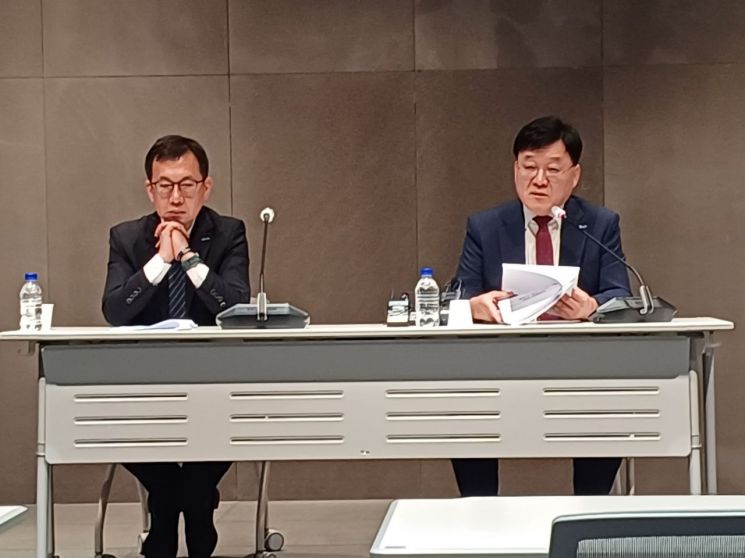 Jung Manki, Vice Chairman of the Korea International Trade Association (right), speaking at the '4th Press Briefing on Trade Issues' held on the 30th at the Trade Center in Samseong-dong, Gangnam-gu, Seoul.
 [Photo by Moon Chaeseok]
The problem is not that exports to specific countries or products are temporarily sluggish due to an economic downturn. The real issue is that the domestic industrial fundamentals have weakened because investment, labor, and research and development (R&D) productivity have declined, worsening business conditions. Korea's global export market share was 2.74% last year, the lowest level since the financial crisis.
Domestic manufacturing facility investment excluding semiconductors decreased from 68.3 trillion won in 2017 to 46.3 trillion won in 2020, then recovered to 60.5 trillion won in 2021. Over 17 years since 2004, overseas investment by the manufacturing sector was about twice the amount of foreign investment in Korea, but this ratio increased significantly to 2.3 times in 2018 and 6.2 times in 2021. Vice Chairman Jung Manki said, "When foreign companies enter Korea, they consider exports as well, but because the Korean business environment is poor, it is difficult to attract investment."
Labor productivity has also declined due to systems like the 52-hour workweek. In 2021, Korea's labor productivity was $42.9, ranking 29th among 37 OECD member countries. This was $10.7 lower than the average of $53.6. Labor productivity is calculated by dividing the gross domestic product (GDP) per capita by total labor hours. It is also pointed out that the actual working hours, not the statutory '40 hours + 12 hours' workweek, have sharply decreased. According to the International Labour Organization (ILO), Korea's actual weekly working hours decreased from 42.5 hours in 2017 to 37.9 hours in 2022, a reduction of 4.6 hours (10.8%) over five years. The rate of decrease during the same period was higher than Germany (-3.7%) and the United States (-0.5%).
On the other hand, wages have increased. Considering exchange rates, Korea's real minimum wage rose from $6.82 in 2017 to $8.76 in 2021, an increase of 28.4%. This growth rate was higher than that of the UK (10.7%), the US (-9.5%), and France (-0.2%) during the same period. Vice Chairman Jung said, "The wage increase is happening too quickly relative to Korea's capabilities, and the reduction in actual working hours is proceeding too rapidly. If corporate competitiveness weakens, it could lead to a reduction in jobs."
KITA proposed both short-term and mid-to-long-term measures. In the short term, they suggested enhancing labor flexibility, stabilizing wages, resolving financial difficulties caused by high interest rates, easing tax burdens, and expanding the supply of foreign labor (E-9 visa). In the long term, they emphasized establishing a business environment at least equal to foreign countries, improving R&D productivity, and increasing the birth rate.
Regarding measures for the US-China conflict, they stated that China should not be ignored or provoked. At least at the corporate level, companies should make 'pragmatic' choices according to their business circumstances. Vice Chairman Jung said, "When I met with senior economic officials from Taiwan, they said that TSMC decides on investment in the US not out of patriotism but purely based on business judgment." He added, "In the long run, semiconductor issues will also be driven by cost, economic, and commercial considerations rather than political decisions." He continued, "Even companies, not just the government or politicians, should strive to engage with China to secure practical benefits."
© The Asia Business Daily(www.asiae.co.kr). All rights reserved.
![Clutching a Stolen Dior Bag, Saying "I Hate Being Poor but Real"... The Grotesque Con of a "Human Knockoff" [Slate]](https://cwcontent.asiae.co.kr/asiaresize/183/2026021902243444107_1771435474.jpg)
















