Korea Federation of SMEs Surveys 618 Companies
"Minimizing Price Increases Necessary" Response Rate 62.1%
Requests for Government Support on Price Hikes Also Made
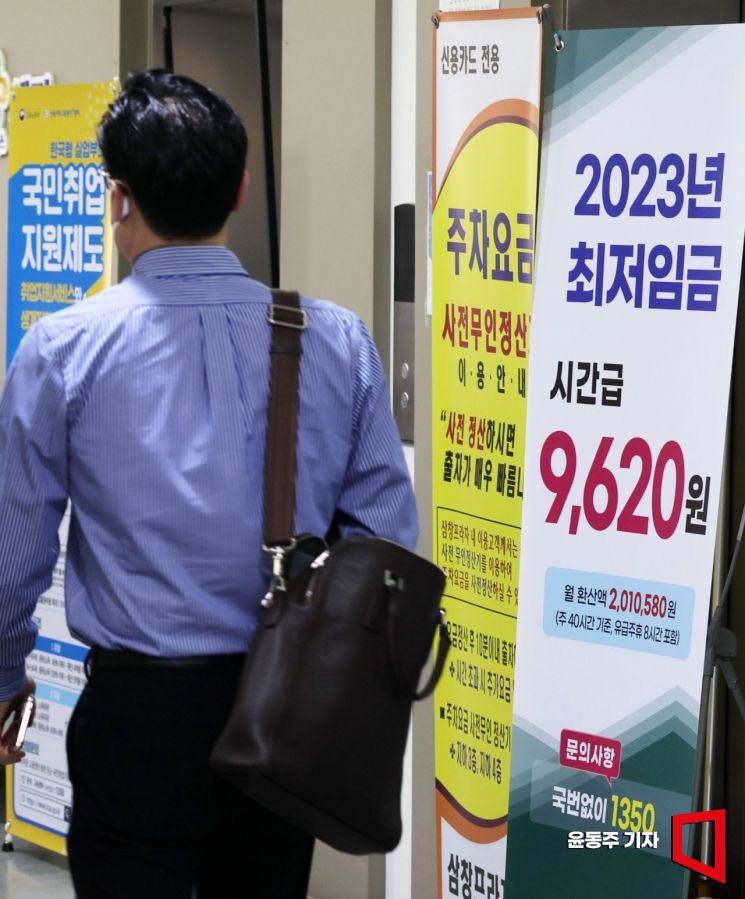 A banner displaying this year's minimum wage information is hung at the Western Employment Welfare Plus Center in Mapo-gu, Seoul, where the first meeting of the Minimum Wage Commission to decide next year's minimum wage level is scheduled for the 2nd. Earlier, the first plenary meeting, which was supposed to be held on the 18th of last month, was canceled without even starting as labor representatives staged an indoor protest demanding the resignation of Kwon Soon-won, a public interest committee secretary and professor at Sookmyung Women's University. Photo by Yoon Dong-ju doso7@
Seven out of ten small and medium-sized enterprises (SMEs) stated that they would reduce employment if the minimum wage is raised to a high level next year.
On the 30th, the Korea Federation of SMEs held a special committee meeting on the minimum wage for SMEs and announced the results of the "Survey on Difficulties and Opinions Related to the Minimum Wage." This survey was conducted from the 27th of last month to the 16th of this month, targeting 618 SMEs employing workers at the minimum wage level.
68.6% of SMEs responded that if the minimum wage is significantly increased next year, their countermeasures would be "reducing new hires (60.8%)" or "laying off existing employees (7.8%)." This suggests that the increase in the minimum wage will have a significant impact on employment.
Regarding the appropriate minimum wage level for next year, 62.1% of SMEs expressed the opinion that the increase should be minimized. Specifically, 38.3% said it should be frozen, 2.6% said it should be lowered, and 21.2% said it should be increased by around 1%.
The main factor worsening management and employment conditions was also most frequently cited as "minimum wage increase (55.2%)." This shows the need for a reasonable decision on the minimum wage level to ensure smooth management of SMEs.
As for improvements to the minimum wage system, the most common opinion was the need to "establish government support for the increase in the minimum wage to mitigate the impact (67.8%)." This was followed by "extending the decision cycle to 2-3 years (16.3%)" and "reflecting companies' payment capacity in the decision criteria (10.2%)."
Kim Moon-sik, chairman of the special committee, said, "The number of workers not receiving the minimum wage reached 2.76 million last year, indicating very low acceptance in the field," and added, "The minimum wage decision should not impose the burden of living expenses for low-wage workers on micro SMEs and small business owners."
© The Asia Business Daily(www.asiae.co.kr). All rights reserved.
![Clutching a Stolen Dior Bag, Saying "I Hate Being Poor but Real"... The Grotesque Con of a "Human Knockoff" [Slate]](https://cwcontent.asiae.co.kr/asiaresize/183/2026021902243444107_1771435474.jpg)











