Long-term stay is easier and language barriers are lower, leading to high employment demand
System reform needed considering the increase in foreign workers
Last year, Korean-Chinese (Joseonjok) workers accounted for the largest proportion of foreign unemployment benefit recipients residing in South Korea.
According to data received on the 29th from the Ministry of Employment and Labor by the office of Kim Young-jin, a member of the Democratic Party of Korea, a total of 12,107 foreigners received unemployment benefits last year. Among them, Joseonjok accounted for more than half, totaling 6,938 people, or 57.3%.
The proportion of Joseonjok among all foreign workers who paid employment insurance premiums last year was 33.5%. However, among all foreign recipients, it reached 57.3%, revealing that the proportion of recipients is much higher compared to the proportion of payers.
In the case of Joseonjok, if they receive a compatriot visa (F4), they can stay long-term regardless of their unemployment status. Additionally, due to lower language barriers, demand for Joseonjok workers is increasing, and as the phenomenon of avoiding so-called ‘3D jobs’ intensifies, the number of unemployment benefit recipients has also increased.
By nationality, Chinese nationals were the most numerous with 1,506 people, followed by Vietnamese with 623 people. Combining Joseonjok and Chinese nationals, the total was 8,444 people, accounting for 70% of all foreign recipients.
Unemployment benefits paid to foreigners increased from 28.9 billion KRW in 2018 to 76.2 billion KRW last year. This represents nearly a threefold increase over the past five years. In 2020, when COVID-19 occurred, the amount reached 100.9 billion KRW, surpassing 100 billion KRW for the first time.
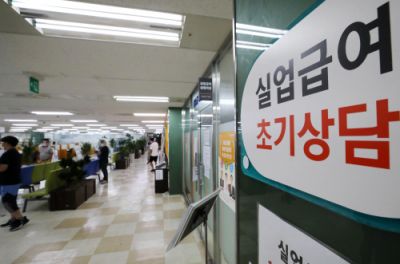
The number of recipients also showed an increasing trend, rising from 6,624 in 2018 to 7,967 in 2019, 15,371 in 2020, and 15,436 in 2021.
The average benefit per person is also high, not significantly different from that of Koreans. Last year, the average unemployment benefit received by Koreans was 6,691,000 KRW per person, which is 394,000 KRW higher than the 6,297,000 KRW received by foreigners.
The obligation for foreign workers to enroll in employment insurance was applied to workplaces with 30 or more regular employees in 2021, and this year it has been expanded to workplaces with fewer than 10 employees.
In particular, 89.8% of foreign workers under the Employment Permit System are concentrated in manufacturing. As of April, among the increase of 104,000 manufacturing enrollees, 99,000 were foreign workers. Domestic enrollees numbered only 5,000, and this number continues to decline.
The Employment Permit System was introduced in 2004 to allow small and medium-sized enterprises that could not find domestic workers to hire foreign workers with government approval. Earlier, the Ministry of Labor increased the employment permit quota this year to a record high of 110,000 people.
Meanwhile, there is growing support for urgent reform of the foreign unemployment benefit system considering the increasing number of foreign workers. The unemployment benefit recipient rates for national workers with a high proportion of E9 (non-professional worker visa), such as Vietnamese and Filipinos, were 2.2% and 1.5%, respectively, compared to 7.2% for Joseonjok.
Those who enter with an E9 visa are deported immediately if they cannot work for more than three months. This is believed to be the reason why their proportion of unemployment benefit recipients is significantly lower.
© The Asia Business Daily(www.asiae.co.kr). All rights reserved.
![Clutching a Stolen Dior Bag, Saying "I Hate Being Poor but Real"... The Grotesque Con of a "Human Knockoff" [Slate]](https://cwcontent.asiae.co.kr/asiaresize/183/2026021902243444107_1771435474.jpg)
















