With the final agreement on the U.S. debt ceiling increase reached, only congressional approval remains. Even if the bill passes Congress by the default deadline set by the U.S. Treasury Department on the 5th of next month, there are forecasts that the fiscal tightening under this agreement will further stimulate concerns about a slowdown in the U.S. economy.
On the 29th (local time), Bloomberg News reported, "The provisional agreement prepared over the weekend by U.S. President Joe Biden and House Speaker Kevin McCarthy is expected to undergo ratification procedures in Congress within a few days," adding, "While this agreement avoids the worst-case scenario of a financial collapse due to default, it will be a cause that increases the risk of recession in the world's largest economy, the United States."
The agreement includes raising the federal government debt ceiling for two years in exchange for freezing the 2024 government budget at this year's level and increasing it by only 1% in 2025. The work requirements for federal welfare recipients, such as food assistance programs and food stamps, which were a last-minute point of contention, will also be strengthened according to Republican demands.
Although the debt ceiling negotiations, which had been at a stalemate, have been resolved, fiscal spending cuts resulting from this are inevitable. Reducing government spending to support the already exhausted U.S. economy is expected to negatively affect the sluggish economic recovery and put pressure on inflation, potentially becoming a variable in the Federal Reserve's interest rate hike trajectory.
Bloomberg analyzed, "Federal government spending has supported U.S. economic growth over the past few quarters, but this debt ceiling agreement greatly increases the likelihood that this momentum will weaken." According to a Bloomberg survey conducted two weeks ago, economists estimated a 65% chance that the U.S. will enter a recession next year.
Jack Albin, Chief Investment Officer (CIO) of investment advisory firm Cresset Capital Management, forecasted, "The fiscal tightening decision under this agreement will be another factor pressuring inflation."
The U.S. debt ceiling issue is already impacting the real economy. Joel Prakken, Chief U.S. Economist at S&P Global Market Intelligence, said, "Uncertainty over the debt ceiling has already simultaneously contracted consumption, investment, and corporate activities," adding, "Even with a dramatic agreement, the economic growth rate for the quarter (Q2) will slow, leaving irreversible side effects."
Warning signs have also appeared regarding a shift to interest rate cuts. For the Federal Reserve (Fed) to halt further interest rate hikes, more evidence of slowing inflation is needed, but this fiscal tightening decision could produce the opposite result by accelerating inflation deceleration.
Bloomberg reported that when the Fed updates its own outlook on interest rates on the 14th of next month, this debt ceiling agreement will be a new consideration. Experts had previously expected that the Federal Open Market Committee (FOMC) meeting next month would hold rates steady, and that the rate hike cycle would conclude with a 0.25 percentage point increase at the July meeting.
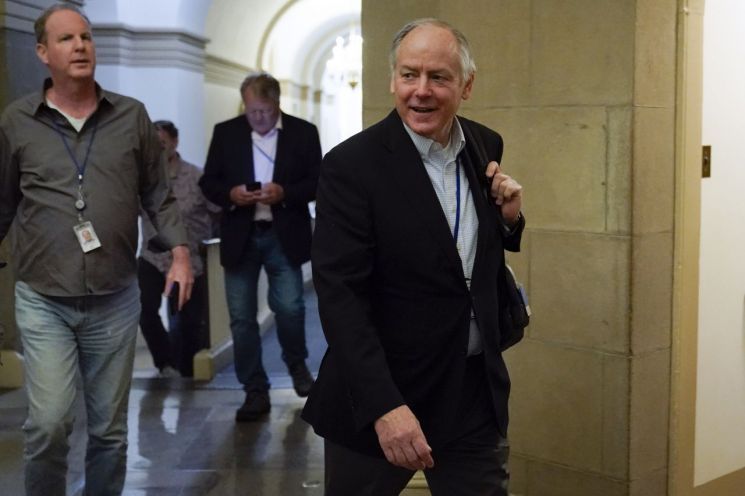 Senior Advisor Steve Ricchetti leading the White House negotiation team. [Image source=AP Yonhap News]
Meanwhile, President Biden and Speaker McCarthy reached a principle agreement on raising the limit after a marathon 1 hour and 30-minute phone call the previous day, and finalized the agreement after coordinating the bill draft and further calls with their working negotiation teams that evening.
Both sides agreed to raise the debt ceiling for two years until 2024, freeze spending for the 2024 fiscal year, and increase the budget by no more than 1% in 2025. The agreement also includes reclaiming unused COVID-19 funds, expediting approval procedures for certain energy projects, and adding work requirements for recipients of food assistance programs for low-income households.
© The Asia Business Daily(www.asiae.co.kr). All rights reserved.
![Clutching a Stolen Dior Bag, Saying "I Hate Being Poor but Real"... The Grotesque Con of a "Human Knockoff" [Slate]](https://cwcontent.asiae.co.kr/asiaresize/183/2026021902243444107_1771435474.jpg)

















